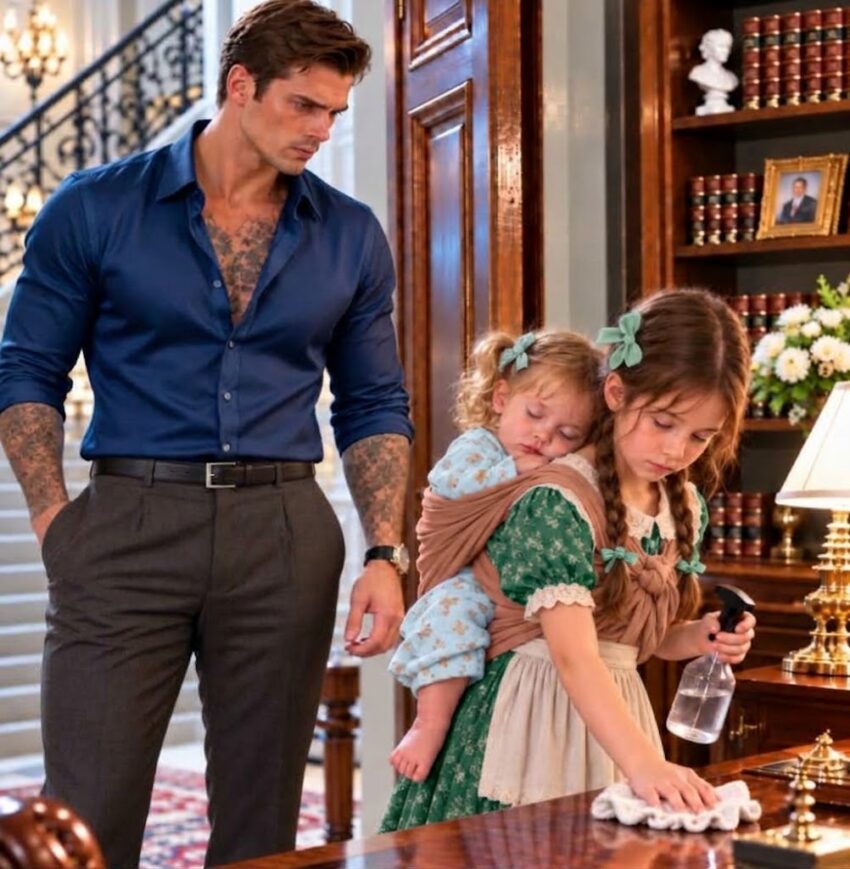
She was six years old, wearing her mother’s work uniform with the sleeves rolled four times, and her baby sister was knotted to her back with a bedsheet. She begged me not to fire her mother.
I promised I wouldn’t, and I was about to take them both back downstairs to bed.
Then she lifted one small, red hand toward the bookcase behind my desk.
Three knocks came from inside the wall.
By sunrise, I had learned that my father had built my entire life around one secret, and that secret was standing in front of me in a uniform that didn’t fit.
Part One: The Light Under the Study Door
My flight from London landed late, and by the time my driver turned onto our street in Beacon Hill, it was almost two in the morning.
The house should have been dark. It always was at that hour. I’d paid a lot of money and spent a lot of years making sure my home was the one place in the world where nothing surprised me.
But a thin line of light showed under my study door. And behind the door, something was humming.
I opened it slowly.
The vacuum was taller than the child pushing it. She was leaning her whole weight into the handle, dragging it across my rug in short, stubborn strokes, and she was wearing a gray service uniform so big it fell past her knees like a dress. The cuffs had been rolled up again and again. The fabric was damp. Later I found out she had washed it in the sink so it would look clean for me.
Tied to her back with a knotted bedsheet was a baby, fast asleep, one tiny fist pressed against her sister’s shoulder.
I said the first thing that came out of me.
“What are you doing?”
The girl jumped so hard the vacuum fell over. She spun around, and the baby stirred and settled again. She couldn’t have been older than six. Her hands were raw and red, and I could smell lemon. On my antique leather desk, a bottle of furniture polish stood beside a cloth, and a pale, cloudy streak ran across the leather where she’d scrubbed it.
“I’m sorry,” she said in a rush. “I’m sorry, I’m almost done. Please don’t fire Mama.”
“Your mother?”
“Hannah. She cleans your study on Thursdays. She’s sick. She’s really hot and she can’t get up.” Her chin trembled, but she held it steady. “If the study isn’t clean, you’ll fire her, and then we can’t live downstairs anymore. So I’m doing it.”
I didn’t know what to say. I’d spent my whole adult life in rooms full of powerful people, and nothing had prepared me for a six-year-old in a borrowed uniform bargaining for her family’s home.
“What’s your name?”
“Ellie.”
“And her?”
“Rosie. She’s eleven months.”
I crouched down so I wasn’t towering over her.
“Ellie, listen to me. Nobody is firing your mother. Not tonight and not because of this. You and Rosie are going back downstairs to bed, and I’m going to get a doctor for your mom. Okay?”
She studied me the way children study adults they’ve been told to be careful around. Then her eyes slid past me, to the tall walnut bookcase behind my desk.
She lifted one red hand and pointed.
“Okay,” she whispered. “But you have to be quiet near the wall. Sometimes it knocks.”
I almost smiled. Old houses make noises, and this one was nearly two hundred years old.
Then it happened.
Knock.
Knock.
Knock.
It came from inside the bookcase. Slow and deliberate, like someone tapping a door with one knuckle.
Ellie grabbed my sleeve.
What followed is still a blur when I look back on it. I called my head of security, Silas Grant, who has worked for me for eleven years and has a gift for showing up without making a sound. His team found the release behind the third shelf in under twenty minutes. The whole bookcase swung outward on hinges I never knew existed.
Behind it, a narrow staircase led down beneath the library into a room I had never seen.
There were monitors and old recording equipment, some of it decades old and some of it new. There were shelves of canned food and bottled water. There was a tunnel that ran under the garden wall toward the house next door.
And there were photographs pinned across one wall. Hundreds of them.
Most of them were of me.
Me leaving the office. Me getting into cars. Me at restaurants, at airports, at my front door. Mixed in were pictures of Hannah, my quiet housekeeper of eight years, and a few of Gordon Pierce, my late father’s attorney.
Gordon had been dead for three years. I had been at his funeral.
By the time I made it down to the basement apartment, the doctor was already with Hannah. She was burning with fever and only half awake. I was standing at the foot of her bed trying to understand how any of this was possible when Ellie appeared in the doorway with Rosie in her arms and an old photograph in her hand.
“I found this,” she said. “Is it important?”
Part Two: Six Words on the Back
For a long moment, nobody in that cramped basement apartment moved.
The photograph shook a little between my fingers.
My father, Salvatore Ferrante, stood on the left. He looked younger than I remembered him near the end. Next to him stood Hannah, pale and worn out but smiling faintly. In her arms was a newborn baby, wrapped in a white hospital blanket.
I turned the photograph over.
Six words looked back at me in my father’s sharp, slanted handwriting.
NICHOLAS MUST NEVER KNOW ABOUT ELLIE.
My own name had never looked so strange to me.
I raised my eyes to Hannah. Every bit of color had drained from her face.
“Ellie,” she whispered. “Where did you find that?”
Ellie stayed in the doorway, holding Rosie close. Someone upstairs had found her a clean sweater, and the sleeves hung so far past her hands that only her fingertips showed.
“In your sewing box.”
Hannah closed her eyes.
“You told me never to open it,” Ellie went on. “But tonight I thought maybe there was money in it.” Her voice dropped. “For medicine.”
Hannah pressed a hand over her mouth, and I had to look away.
The secret room, the photographs, a dead attorney on my wall, my father’s handwriting. Suddenly none of it seemed as important as the fact that a six-year-old had gone through her mother’s things hoping to find enough money to buy medicine.
“Ellie,” I said. “Come here.”
She didn’t move. She looked at her mother first.
That small pause told me more about myself than I wanted to know. In my own house, a little girl needed permission to walk over to me.
Hannah nodded, and Ellie crossed the room. I crouched down until we were eye to eye.
“Your mother is not losing her job.”
She searched my face. “Even though she couldn’t clean?”
“Even though she couldn’t clean.”
“And even though I used the wrong stuff on your desk?”
“What wrong stuff?”
“The bottle with the lemon on it.”
Hannah made a choked little sound that was almost a laugh. I glanced up at the ceiling, toward the study and the antique leather desk that was almost certainly ruined. Strangely, I couldn’t make myself care.
“We’ll survive the lemon,” I said.
Ellie thought about that. Then, very quietly: “Are we going to lose our apartment?”
“No.”
It came out before I’d thought it through. But once I’d said it, it felt like the first simple, true thing anyone had said all night.
“Nobody is putting you or your mom or Rosie out on the street.”
Her shoulders loosened, just a little. It was amazing how much fear one breath could carry out of such a small body.
Then she looked at the photograph in my hand.
“Why weren’t you supposed to know about me?”
Hannah pushed herself up on her pillows. “Ellie—”
“No.” I stood. “She deserves an answer.”
Hannah held my gaze. “So do I, apparently.”
The doctor had warned us not to wear her out, but in that moment Hannah looked less sick than scared. She held out her hand for the photograph, and I gave it to her. Her thumb moved slowly across my father’s face.
“Your father made me promise something,” she said.
“What?”
“That if he died, I’d stay in this house.”
“As a housekeeper.”
“As whatever kept me close enough to watch that library.”
I looked at Ellie, then back at Hannah. “And her? Why wasn’t I supposed to know about her?”
Hannah’s eyes filled.
“Because he was afraid of what you’d do if you knew.”
That hit harder than I expected. “What I’d do?”
“You weren’t the man you are now,” she said gently. “Not back then. I’ve spent eight years in this house watching what your father made of you.”
I’d spent years teaching rooms full of powerful people that silence could be a weapon. Hannah Brooks used it better than any of them.
“He loved you,” she said.
“That’s a generous way to put it.”
“He did. He was just afraid.”
“My father wasn’t afraid of anything.”
Her expression changed. She lifted her eyes toward the ceiling, toward the library above us.
“Yes, he was,” she said. “He was terrified of that wall.”
Part Three: Pancakes at Three-Thirty
By three-thirty in the morning, my house no longer felt entirely like mine.
Security staff moved through the halls. The doctor stayed with Hannah. Two technicians were cataloguing the equipment in the hidden room under the library.
And Ellie was sitting at my kitchen island, eating pancakes.
Rosie slept beside her in a laundry basket lined with blankets. At the stove stood my house manager, Mrs. Delgado, in her bathrobe, flipping pancakes like it was any other Sunday.
“You’re up,” she said without turning around.
“So are you.”
“I heard there was a six-year-old working in this house at two in the morning.” She glanced at me over her shoulder, and her eyes narrowed. Apparently this was my fault.
Maybe it was.
“Hannah never said a word to me,” I said.
“Hannah doesn’t say a word to anyone when she’s scared.”
“You knew she was sick?”
“I knew she’d been coughing.”
“And you didn’t tell me?”
Mrs. Delgado set the spatula down and looked at me.
“Would you have noticed?”
I had no answer for that.
Ellie was pouring syrup over her pancake with great care. Far too much syrup. I sat down across from her, and she peeked up at me.
“Are you mad?”
“About the syrup?”
She nodded.
“No.”
She poured a little more. I almost smiled.
Then she glanced toward the hall. “Is Mama going to the hospital?”
“The doctor wants her there until her fever comes down.”
Her fork stopped. “Can Rosie and me go?”
“Rosie and I.”
“What?”
“You said ‘Rosie and me.’”
“You’re correcting her grammar right now?” Mrs. Delgado asked.
I ignored her. “You’ll go with your mother,” I told Ellie. “But first I need to ask you something. The knocking. How long have you been hearing it?”
“A long time.”
“How long?”
She thought hard. “Since before Rosie.”
Rosie was eleven months old.
“Every night?”
“No. Mostly when Mama isn’t home. When she goes to the store, or takes Rosie to the doctor.”
“Did anyone ever come out of the wall?”
She shook her head. Then she hesitated.
“Once.”
Every part of me went still. “Who?”
“I don’t know. A man.”
“What did he look like?”
She frowned, digging through the memory. “Old.”
“How old?”
“Like you.”
Mrs. Delgado suddenly turned back to the stove with great interest. I was forty.
“Thank you,” I said.
“He had gray here.” Ellie touched both sides of her head. “No glasses. No beard. Tall.”
“Did he talk to you?”
Her fork went still again.
“Yes.”
“What did he say?”
She glanced at the dark kitchen windows. “He asked if Mama still had the key.”
The brass key. I’d seen it on Hannah’s nightstand.
“Did you tell him?”
“No. Mama says never tell strangers where things are.”
Smart child.
“Then what happened?”
“He gave me a candy.”
“And?”
“I threw it away.”
Mrs. Delgado turned around. “Why, sweetheart?”
Ellie looked puzzled that anyone would need to ask. “Because Mama says don’t take food from strangers.” Then she added, “And it was licorice.”
For the first time that whole night, I laughed. It surprised me so much I stopped right away.
Ellie stared at me. “You can laugh?”
Mrs. Delgado burst out laughing. I gave her a look, and she turned back to the stove, shoulders still shaking.
But Ellie smiled, and something in the kitchen shifted.
For years, I had run my home like a fortress. Quiet. Controlled. Predictable. Now there was syrup on the marble, a baby asleep in a laundry basket, security officers in my library, and a six-year-old openly wondering whether I had normal human feelings.
The house had never felt more alive.
Then Ellie’s smile faded.
“The man said something else.”
“What?”
“He said Mama was supposed to remember her promise.”
“What promise?”
“I don’t know.” She squeezed her eyes shut, trying to get the words exactly right. Then she opened them.
“He said, ‘Tell Hannah the second wall doesn’t belong to Nicholas.’”
I stopped breathing.
Part Four: The Promise She Kept
At ten past four, Hannah was well enough to talk again.
I went into her room alone and shut the door behind me. Ellie and Rosie were asleep in the guest room next to mine. The brass key lay on Hannah’s nightstand, and she caught me looking at it.
“He found Ellie, didn’t he?”
“Someone did,” I said. “She told me a man came out of the wall months ago and spoke to her.”
“I know.”
“And you never told me.”
“I was trying to keep her safe.”
“From who? Gordon Pierce?”
Her eyes flickered. That was answer enough.
“You told everyone Gordon was dead,” I said.
“I believed Gordon was dead. You were at his funeral too.”
“There was a body.”
“There was a sealed casket.”
I stared at her. “When did you find out?”
“Two years ago. He came to the service door one night, alive, and told me someone had found the passage.” She looked down at her hands. “He wouldn’t tell me who.”
“Hannah, you’ve worked in this house for eight years. Are you telling me it was all because of a room you don’t understand?”
“No.” Her gaze moved to the brass key. “I’ve worked here because of Ellie.”
There it was again. Every thread in this night led back to that little girl.
I pulled the chair closer to the bed. “Start at the beginning.”
Hannah was quiet for a moment, gathering it.
“I was twenty-three when I met your father,” she said. “At Massachusetts General. My mother was dying of cancer, we barely had insurance, and I was standing at the billing desk crying because I didn’t know how we’d pay for any of it. Your father was there visiting someone. He bought me a coffee.”
“My father?”
She smiled faintly. “Hard to believe?”
“Very.”
“He could be kind, Nicholas. He just didn’t like anyone to see it.”
I said nothing. That side of Salvatore Ferrante wasn’t completely unknown to me. Just rare.
“Two weeks later, he offered me a job,” she went on. “Gordon handled the paperwork. On paper, I was a housekeeper. In reality, I was supposed to watch the library. If I ever saw the bookcase move, or heard sounds behind it, or saw the dust disturbed near the shelves, I was to call a number.”
“Why didn’t he just seal the passage?”
“I asked him that. He said closing a door doesn’t stop someone who already knows where it is.”
That sounded exactly like my father.
“That’s how I met Owen,” she said, and her voice softened on the name. “Owen Brooks. He was a restoration carpenter. Your father hired him to work on this house and a few of his other properties. Hidden staircases, sealed rooms, old foundations. Owen understood houses like this one the way some people understand music.”
“The passage,” I said.
“He found something more than the passage. He found the second wall.”
“What’s behind it?”
“I never saw it. He wouldn’t tell me. He said the less I knew, the safer we’d be.” She gave a tired little laugh. “We got married a year later, in a courthouse, on a Tuesday.”
I hated that sentence, the less you know, the safer you’ll be. I’d heard versions of it my whole life. Secrets were always supposedly being kept to protect someone. Usually, they protected the people keeping them.
“And Ellie?”
Hannah’s breathing went shallow.
“Six years ago, your father called us after midnight. You were in Singapore that month. He told us to come up to the library right away.” She looked at the wall that separated us from the study above. “It was the strangest night of my life. He was standing by the bookcase, holding a newborn baby girl. And Nicholas, he was terrified.”
“My father didn’t get terrified.”
“He did that night.”
I believed her, because she wasn’t trying to convince me.
“He put her in my arms and asked us to raise her as our own,” Hannah said. “He said she had no one else who could keep her safe. He said no child should pay for what the adults around her had done.”
“Whose child was she?”
“I don’t know. I asked. He wouldn’t tell me.” She swallowed. “Ellie isn’t mine by blood, Nicholas. But she has been mine every single day since that night.”
The room was very quiet.
“Owen held her for the first time right there by the bookcase,” she said, and a smile broke through the tears. “He cried. Then he told me she had my nose.” She laughed softly. “He was wrong twice over. She wasn’t mine, and she didn’t even have a nose yet. She was a newborn.”
Despite everything, I smiled too.
“The photograph,” I said. “Who took it?”
“Your father had Gordon take it that night. I asked him why.” She looked straight at me. “He said someday Ellie might need proof that someone besides me was there when she came into the world.”
That didn’t sound like the father I knew either. Or maybe I had only ever known one side of him.
“He died the next year,” Hannah said. “Before he did, he made me promise to stay in this house and keep watching the library. And he made me promise you’d never know about her.”
“And Owen?”
Her face crumpled, then steadied.
“Owen gave me that key the week before he disappeared. He said if anything ever happened to him, I should keep it close and stay right here. That this house would be the first place he’d come back to.”
“When did he disappear?”
“Twenty months ago. I was pregnant with Rosie.” Her voice dropped to almost nothing. “They found his truck near the harbor. They never found him.”
I let that sit between us for a long moment.
“So for twenty months,” I said finally, “you’ve been raising two children alone in my basement, keeping my father’s promise, and watching a wall.”
Hannah lifted her chin.
“Somebody had to.”
Part Five: The Second Wall
At sunrise, we opened the second wall.
It took us nearly an hour to find it. Silas’s team had searched the hidden room under the library twice and found nothing but the equipment, the supplies, the photographs, and the tunnel toward the house next door.
Ellie found it in thirty seconds.
Of course she did. The doctor had cleared Hannah to be moved to the hospital, and Ellie had insisted on coming down first.
“You said I could help,” she reminded me.
“I said you could watch.”
“Watching is helping.”
I looked at Silas for support. He looked at the ceiling. Coward.
Ellie walked slowly along the brick wall, running her fingertips over the mortar. Then she stopped and knocked. Solid. She moved six inches to the right and knocked again.
Hollow.
Every adult in the room froze.
Ellie looked very pleased with herself. “Told you.”
Silas crouched beside her. “How did you know to do that?”
She shrugged. “I knock on walls.”
“Why?”
“Because sometimes they knock back.”
Silas turned his head slowly toward me. I pretended not to notice.
Behind a loose brick at that exact spot, we found a small keyhole. Hannah’s brass key slid in perfectly. When I turned it, something heavy shifted inside the wall, and a narrow section of brick swung inward.
Behind it was another chamber. Smaller than the first, and much older. No monitors. No food. Only dust, a wooden chair, a metal cabinet, and a small black safe.
Ellie tried to follow me in. I turned around.
“Stay there.”
“But I’m the one who found it.”
“Yes.”
“So I should come.”
“No.”
“Why?”
“Because I’m responsible for you.”
She considered that very seriously.
“Since when?”
The question stopped me cold. Silas suddenly found the ceiling fascinating again.
I looked at her. “Since tonight.”
Something in her face changed. Not dramatically. Just enough. She stepped back beside Silas.
“Okay.”
The safe looked like it had been installed in the 1940s. The brass key didn’t fit it. But taped underneath was an envelope with my name across the front in my father’s hand.
NICHOLAS FERRANTE.
My fingers went cold as I opened it.
Nicholas,
If you are reading this, then Hannah has failed to keep you out of this room. Do not blame her.
There are things I should have told you while I was alive. I chose not to. I believed secrecy would keep you safe. Perhaps I was wrong.
This safe holds the beginning of the truth, but not all of it. Before you open it, understand this: Owen Brooks never betrayed this family. Whatever you are told about him, do not believe it.
And if anyone ever comes to you wearing my face, do not let him learn what Ellie can unlock.
I read the last line twice.
Wearing my face. It made no sense.
And Ellie. Again.
“What does it say?” she called from the doorway.
I folded the letter. “Nothing you need to worry about.”
She crossed her arms. “That means it’s something bad.”
Silas coughed to hide a laugh. I looked at him, and he became extremely serious.
I turned back to the safe. What Ellie can unlock. I looked down at the key in my hand, but it didn’t fit.
“Maybe it’s not a key,” Ellie said.
“What?”
She pointed. “It has letters.”
She was right. The dial didn’t show numbers. It showed letters. It was a word lock with six positions.
“Six letters,” Silas said.
I’d already tried the obvious answer in my head. E-L-L-I-E. Only five.
Ellie edged closer, ignoring my instructions, and this time I let her. She studied the dial. Then she whispered:
“Brooks.”
Six letters.
Silas and I looked at each other. I turned the dial. B. R. O. O. K. S.
Click.
The safe door swung open.
Inside were four things: a thick bundle of documents, an old cassette recorder, a silver pocket watch, and a sealed envelope addressed in my father’s handwriting.
FOR ELLIE BROOKS, WHEN SHE IS OLD ENOUGH TO ASK WHY.
Ellie stared at it. “That’s me.”
“Yes.”
“Can I open it?”
I looked at the envelope, then at her. “No.”
Her face fell.
“When you’re older,” I said.
“How much older?”
“I don’t know.”
“Seven?”
“No.”
“Eight?”
“No.”
“Nine?”
“Ellie.”
“Ten?”
Silas turned his back to hide his face.
I put the envelope back in the safe. “When your mother decides you’re ready.”
She thought about it, then nodded. That mattered to me. She trusted Hannah’s judgment completely. I found myself hoping that someday she might trust mine.
I took out the documents. Property records. Architectural drawings of my house that showed rooms I had never been told about. A birth certificate for Ellie Brooks: Mother, Hannah Brooks. Father, Owen Brooks. Perfectly ordinary, and, as I now knew, a careful lie that my father had paid someone to make official.
Under it was a trust document.
I read the first page, then the second, then went back to the first, sure I’d misread something.
“What is it?” Silas asked.
I handed it to him. His eyebrows rose.
Ellie looked from one of us to the other. “What?”
Silas chose his words carefully. “Someone set up a trust for you.”
“What’s a trust?”
“Money,” I said.
“How much?”
I looked at the figure again. “Enough.”
“How much is enough?”
“More pancakes than you could eat in your whole life.”
She looked deeply impressed.
But I wasn’t smiling anymore. The trust had been created three weeks after Ellie was carried into my library. It had been funded by my father.
Twenty million dollars, for a baby he had made sure I would never know existed.
Part Six: What Trying Looks Like
Hannah woke up in a hospital room at nine that morning. I was sitting beside her bed.
“You found it,” she said.
“Yes.”
“What was inside?”
“A trust. For Ellie.”
Her eyes opened all the way. “What?”
“You didn’t know?”
“No.”
“My father funded it three weeks after he gave her to you.” I leaned in. “Twenty million dollars.”
For a moment, the hospital monitors seemed very loud.
“No,” Hannah said.
“Yes.”
“No. I don’t want it.”
“It isn’t yours to refuse. It belongs to Ellie.”
“I don’t want anything from your family.” Her eyes flashed. “I’ve protected my girls without your money.”
“By letting a six-year-old clean my study at two in the morning?”
The words were out before I could stop them.
Hannah flinched as if I’d struck her, and I regretted it instantly.
The silence stretched. I got up and went to the window. Boston lay under a flat gray sky.
When I spoke again, my voice was quieter. “That was unfair.”
She didn’t answer.
I turned around. “You were sick. You were scared. And you’ve spent years carrying secrets that should never have been yours to carry alone.”
Her eyes filled. “I didn’t know she’d gone upstairs. I woke up and they were both gone.” Her voice cracked. “I thought someone had taken them.”
I sat back down. “She was trying to protect you. She thought if the study wasn’t clean, I’d fire you. And if I fired you, you’d lose your home.”
“I know,” Hannah whispered. She covered her face and cried, very quietly, which was somehow worse than if she’d sobbed.
I waited.
“I’ve been trying,” she said at last.
“I can see that.”
“No.” She lowered her hands and looked at me with a kind of worn-out dignity. “You can’t. People like you don’t know what trying looks like when there’s nothing underneath you.”
I didn’t argue, because she was right.
I understood pressure. I understood responsibility. I knew what it felt like to have a room full of people waiting for me to fail. But I had never once in my life wondered whether getting sick for a few days might cost me the roof over my head.
Hannah wiped her cheeks. “I don’t want your pity.”
“You don’t have it.”
That surprised her.
“You have my respect,” I said. “And my apology.”
“For what?”
“For living twenty feet above you for eight years and knowing nothing about your life.”
Her face softened a little. “I wasn’t exactly trying to be noticed.”
“I know. But things are going to change.”
She tensed at once. “You said you weren’t firing me.”
“I’m not. But you’re not living in that basement anymore.”
“Nicholas—”
“There are twelve bedrooms in that house.”
“We are not moving upstairs.”
“Why not?”
“Because I work for you.”
“You’re currently in a hospital bed.”
“I’ll recover.”
“Good. Then you can argue with me at full strength.”
Despite herself, she smiled. A small smile, but a real one. Then she grew serious.
“What happens when you find out why your father was hiding her?”
Through the narrow window in the door, I could see Ellie in the hallway, sitting next to Mrs. Delgado with Rosie asleep in her lap. Ellie was holding a picture book upside down, pretending to read it, waiting for her mother.
“I don’t know,” I said.
Hannah studied my face. “You’re not like him, you know.”
“I’m not sure that’s a compliment.”
“It is.”
“Hannah.” I looked back at her. “Whatever this turns out to be, Ellie won’t face it alone.”
Her eyes filled again, but this time she didn’t look away.
“Neither will you.”
Those three words reached a place in me that had been locked far longer than the chamber under my library. I nodded once.
Then the door opened and Silas came in. One look at his face told me the morning had just gotten more complicated.
Part Seven: A Dead Man in the Photograph
“We went through the photographs from the hidden room,” Silas said, and shut the door behind him. “They weren’t all taken recently.”
“I know. Some of them go back years.”
“No. You don’t understand.” He laid several prints across the hospital tray table. “Decades.”
The first one showed me walking out of Harvard at twenty-two. The second showed me standing at my father’s graveside. The third showed me standing outside my first office.
Someone had been watching me for most of my life.
Then Silas set down another photograph, and Hannah gasped.
It was Owen. Alive. Thinner, grayer, wearing a dark coat on a city street. The date stamped in the corner was four months after his truck was found at the harbor.
Hannah snatched it up. “Where was this taken?”
“We don’t know yet.”
She stared at her husband’s face. Her hands were shaking so badly the picture rattled.
“He was alive,” she whispered. “He was alive.” She looked up at me. “Then why didn’t he come home?”
I had no answer.
“There’s one more,” Silas said quietly. “This one is worse.”
The last photograph had been taken six months ago, right outside my front door.
Owen stood on the left. Gordon Pierce, the attorney I’d watched them bury, stood on the right.
And between them stood an old man with silver hair, leaning on a cane.
For a moment, my mind simply refused to make sense of what I was seeing. Then my whole body went cold, because I knew that face. I’d looked up at it every day of my childhood.
“Nicholas?” Hannah whispered.
I couldn’t answer.
“Who is he?” Silas asked.
I picked up the photograph.
My father stared back at me. A man I had buried five years ago.
Part Eight: The Tapes
We were back in Beacon Hill a little before noon.
Hannah had to stay at the hospital, but she’d insisted the girls come home with me. “I want them somewhere safe,” she’d said.
For the first time in my life, someone thought of my house as the safe place. I wasn’t at all sure she was right.
Ellie fell asleep in the car with Rosie beside her. When we got home, I carried Rosie inside, and Mrs. Delgado carried Ellie up to bed. The house was silent again. But it wasn’t the silence I’d come home wanting the night before. This one felt like waiting.
I went down into the passage alone with Silas. In daylight, it looked less mysterious and more deliberate. Someone had built this. Someone had maintained it. Someone had used it for years.
The second chamber stood open. The old cassette recorder sat on the table where we’d left it. We hadn’t listened to it yet. Too much had been happening.
There was already a tape inside. Its handwritten label read:
NICHOLAS — IF YOU FOUND ELLIE
“Ready?” Silas asked.
“No.”
I pressed play anyway.
Static filled the room. Then a voice.
My father’s voice. Older and slower than I remembered, but unmistakable.
“Nicholas. If you’re hearing this, you found the room. And you found Hannah.” A pause. “But if you found Ellie… then I failed.”
I gripped the edge of the table.
“There’s something you need to understand about that child. She is not your enemy. She is not a threat to your inheritance. And she is not Owen Brooks’s daughter.”
Behind us, a small voice said, “What?”
I spun around.
Ellie stood at the bottom of the stairs, barefoot, clutching the brass key she must have taken from my desk. Her eyes were fixed on me.
The tape kept playing.
“Owen and Hannah agreed to raise her because I asked them to.”
Her face went white. I crossed the room fast and knelt in front of her.
“Ellie—”
She stepped backward. “Who’s my dad?”
I couldn’t answer. Not because I didn’t want to, but because the tape hadn’t told us yet.
Silas reached for the recorder just as it gave a sharp click. The tape had run out.
Ellie’s lip trembled. “Who’s my dad?”
I reached for her again, and this time she let me. I pulled her gently against my chest. For a few seconds, she stayed stiff as a board. Then her arms went around my neck, and I felt her shaking.
“I don’t know,” I whispered. “But I promise you, your mom is your mom. Nothing on any tape changes that.”
“You promise?”
“I promise.”
“Are you going to find out?”
“Yes.”
“Are you going to tell Mama?”
“Yes.”
She leaned back and looked at me. “And you’re not going to make us leave?”
There it was. The question that really mattered to her. Not who her father was. Not what was hidden in the walls. Not why dead men kept turning up in photographs.
Home.
I looked her straight in the eye. “No.”
“Even if there’s something bad on the next tape?”
“Even then.”
She studied my face. Children have a remarkable gift for spotting promises adults don’t mean. Finally, she nodded.
“Okay.”
“Nicholas.” Silas was staring into the cassette compartment. “There are two tapes.”
The first cassette had been resting on top of a second one, hiding it. Silas lifted it out. No date. No explanation. Just two words in my father’s handwriting.
FOR ELLIE.
She squeezed my hand. “That’s mine.”
“Yes.”
“Am I old enough?”
I thought about the envelope in the safe. When she is old enough to ask why.
Ellie had already asked. Maybe she’d been asking her whole life without knowing it.
I put the second tape in and pressed play.
Static. Then my father’s voice again, gentler this time.
“Ellie.”
The little girl beside me went completely still.
“If you’re hearing this, then Nicholas kept his promise. I hope he became the man I always believed he could be.”
I hadn’t made my father any promise about Ellie. I couldn’t move.
“There’s something both of you deserve to know. Nicholas, the night you were born, your mother gave birth to two sons.”
My knees nearly gave out.
“What?” Silas breathed.
“You had a brother. A twin. I let the whole world believe I had only one son. I had my reasons, and if he is alive, he will tell you them himself.”
My entire childhood rearranged itself in a single sentence. Every locked door. Every argument I’d overheard through a wall. Every photograph my father refused to explain. Every year of silence.
“What was his name?” I whispered, as if a dead man could hear me.
My father answered anyway.
“His name is Luca. And Nicholas…”
The static crackled.
“…Luca is Ellie’s father.”
Ellie looked up at me. I looked down at her. Neither of us said anything. We didn’t need to.
We weren’t strangers. We weren’t an employer and his housekeeper’s daughter.
We were family. She was my brother’s child.
My niece.
Ellie’s eyes filled with tears. “Does that mean…” Her voice wobbled. “You’re my uncle?”
I knelt down in front of her. For once in my life, the answer was simple.
“Yes.”
She threw her arms around me, and I caught her. And somewhere inside the walls of the house my father had filled with secrets, something in me finally came unlocked.
Part Nine: The Man in the Tunnel
Silas’s phone buzzed. He answered, listened, and his expression changed.
“Where?” A pause. He looked at me. “When?”
He lowered the phone.
“What?” I asked.
“We traced the house next door. It’s not owned by a company anymore.” He swallowed. “The deed was transferred yesterday. To Luca Ferrante.”
I stood up slowly. “That’s not possible.”
According to the tape, Luca was my twin. According to every record I’d ever seen, I was an only child. And until ten minutes ago, Owen Brooks had been Ellie’s father.
Before anyone could say another word, it came.
Knock.
Knock.
Knock.
Ellie whipped around toward the bricks. But the sound wasn’t coming from the wall. It was coming from the far end of the tunnel, the one that ran toward the house next door.
Someone wasn’t knocking on a wall. Someone was knocking on a door.
Silas reached for his radio. I pulled Ellie behind me.
Footsteps came down the tunnel. Slow. Steady. Unhurried. Whoever it was already knew we were there.
A shadow stretched across the stones. Then a man stepped into the light.
Tall. Gray at the temples. No glasses. No beard. Exactly the way Ellie had described him.
Her fingers dug into my hand. “That’s him,” she whispered. “The licorice man.”
The stranger stopped and simply looked at me. There was something painfully familiar about him. He had my eyes. My mother’s chin. My father’s way of standing, with his weight a little back on his heels.
It was like looking into a mirror that had lived a different life.
Then his gaze dropped to Ellie, and everything in his face softened.
“Ellie.”
She ducked behind my legs.
I stepped forward. “Who are you?”
His eyes were wet. And then he smiled, not like a stranger, but like a man who had been waiting his whole life for this exact moment.
“My name is Luca.”
My brother. Ellie’s father. Alive, and standing in my basement.
But what he said next made even that seem small.
“Nicholas, listen to me carefully.” The smile vanished. “The man in those photographs is not our father.”
I stared at him.
“Our father really did die five years ago,” Luca said. “You buried the right man.”
“Then who is the man with his face?”
Luca went pale. “The reason I’ve been hiding my whole life.”
He reached into his coat.
“Hands where I can see them,” Silas snapped.
Luca froze, then moved slowly and carefully, and drew out a small, creased photograph. He laid it on the table.
It showed my father in his fifties, with Gordon Pierce at his side. And a third man, standing shoulder to shoulder with my father.
A man with exactly the same face.
“Our father had a twin,” Luca whispered. “His name is Aurelio. And he’s been using the house next door for years.”
Then the lights went out.
In the pitch dark above us came three slow knocks. And a man’s voice drifted down through the hidden passage.
“Nicholas.”
I knew that voice. I’d heard it on the cassette ten minutes earlier. I’d heard it my entire childhood.
It was my father’s voice. Except now I knew it belonged to someone else.
Ellie pressed hard against my side. Luca leaned close to my ear.
“Whatever he tells you,” he breathed, “don’t let him find out we know about the third room.”
“The what?”
A floorboard creaked directly over our heads. Somewhere behind the bricks, a heavy lock clicked.
And for the first time that night, the knocking came from beneath our feet.
Part Ten: The Third Room
Knock. Knock. Knock.
Nobody moved.
Ellie’s grip tightened on my fingers. “What’s under us?”
Silas clicked on his flashlight. In its beam, Luca’s face looked exhausted.
“The reason our father built all of this,” he said, and nodded at the old wooden chair. “Move it.”
Silas dragged it aside. Set into the stone floor beneath it was an iron ring. A trapdoor.
“The third room?” I asked.
Luca nodded. “Dad found it thirty years ago. Aurelio has wanted what’s down there ever since.”
Overhead, the footsteps moved again. Closer now. Silas spoke low into his radio, then looked at me. “Security’s sealing the house.”
“No one gets near Ellie.”
“Already handled.”
I looked down at her. “Ellie, go upstairs with Silas.”
“No.”
“Ellie.”
“You promised you wouldn’t send me away.”
“I’m not sending you away. I’m keeping you safe.”
She searched my face, unconvinced. Then Luca crouched in front of her. He looked every bit as scared as she did.
“Ellie,” he said softly. “I know I haven’t earned the right to ask you for anything. But please go with Silas.”
Her voice was tiny. “Are you really my dad?”
Luca closed his eyes for a second. “Yes.”
“Then why did you leave?”
The question almost broke him.
“I thought staying away would keep you safe.”
Ellie frowned. “That didn’t work.”
Despite everything, I nearly laughed. So did Luca, through the tears.
“No,” he whispered. “It didn’t.”
She finally let go of my hand and went to Silas. At the foot of the stairs, she turned around.
“Uncle Nico?”
The words hit me harder than anything else that night.
“Yes?”
“Come back.”
“I will.”
When she was gone, Luca and I hauled the trapdoor open together. A narrow staircase led down beneath the foundations of the house.
At the bottom there was no treasure. No money. No weapons.
There were records. Thousands of them. Shelves of property deeds, bank ledgers, letters, photographs, and names. Decades of secrets.
And in the middle of the room, in a leather chair, sat an old man with silver hair and a cane across his knees. Behind him, a second tunnel opened into the dark, toward the house next door.
My father’s face. But not my father.
He smiled. “Nicholas.”
I stopped at the bottom step. “What’s your name?”
The smile thinned. “Aurelio.”
His gaze moved to Luca. “So you finally came home.”
“This was never my home,” Luca said.
Aurelio sighed. “You sound exactly like your father.”
“Good.”
For the first time, real anger flashed in the old man’s eyes. He turned back to me.
“Your father stole everything from me. The company. The properties. The family name.”
“That’s the story you’ve told yourself for forty years,” Luca said. He looked at me. “Our grandfather left the company to Dad. Aurelio swore he’d take whatever Dad loved most. So the night we were born, Dad made sure he’d only ever find one of us. He sent me to be raised by friends in Vermont under another name. And when I had a daughter, and her mother died bringing her into the world, Dad did the same thing again. He hid her with Owen and Hannah.”
Aurelio ignored him. “All I ever wanted was what belonged to me.”
I looked around at the shelves. “And all this?”
“Proof,” he said. “That your father was no saint.”
“I never thought he was.”
That seemed to catch him off guard.
I stepped closer. “My father lied to me. He hid my brother. He hid my niece. He filled this house with walls and secrets and called it protection.”
A faint smile returned to Aurelio’s face. “Then perhaps you understand me.”
“No,” I said. “I understand why secrets nearly destroyed this family. And I’m finished protecting them.”
For the first time, he looked uncertain.
Footsteps sounded on the stairs behind us. Silas came down with two of his officers.
Aurelio rose slowly, leaning on his cane. “You have no idea what those records contain.”
“Then we’ll find out.”
“You’ll destroy your father’s legacy.”
I looked at the shelves around us. For most of my life, I’d believed a legacy was something you protected. A name. A company. A house. A reputation.
Then I thought about a six-year-old scrubbing my desk at two in the morning because she was afraid her mother would lose everything.
And finally, I understood.
“Maybe some legacies deserve to end,” I said.
Epilogue: Open Windows
Three months later, the basement apartment was empty.
Hannah hated that. She argued with me for eleven straight days. I won on the twelfth.
She and Rosie moved into two rooms on the second floor. Ellie picked the bedroom across the hall from mine. Not because it was the biggest, but because its window looked out over the garden.
Luca didn’t move in. Some things need time.
Owen came home in the spring. We learned that when Aurelio discovered Ellie existed, Owen had vanished on purpose, to draw the danger away from his family and help Luca stay hidden. He and Gordon Pierce had spent those twenty months pretending to cooperate with Aurelio, keeping him close and keeping him watched. That was the photograph outside my front door.
When Hannah finally saw her husband again, I quietly left the room. Some reunions belong only to the people who survived the separation.
Gordon, it turned out, had faked his death to slip out from under Aurelio’s control. He had helped my father build the maze of passages and false ownership records that kept Aurelio away from the third room for decades, and in the end he agreed to tell investigators everything. The records beneath my house uncovered forty years of hidden deals, disputed property transfers, and family agreements. Lawyers spent months untangling them, and Aurelio spent those months answering their questions.
I stopped caring about most of it.
Ellie’s trust was entirely legitimate. My father had set it up properly, and it would pass to her when she turned twenty-one. Hannah still hated the idea. Ellie only wanted to know whether twenty million dollars could buy twenty million pancakes.
I told her no. She said that was very disappointing.
One evening, about six months after the night everything changed, I came home early.
The house was noisy. Rosie was shrieking with laughter somewhere upstairs. Mrs. Delgado was arguing with someone in the kitchen. Hannah had music playing.
And Ellie was sitting at my antique leather desk, the same one she’d nearly ruined with lemon polish, drawing.
She looked up. “You’re home.”
“So it seems.”
She went back to her drawing. I came closer.
There were seven people in the picture: Hannah, Rosie, Luca, Owen, Mrs. Delgado, Ellie, and me.
I pointed at myself. “Why am I so tall?”
“Because you’re bossy.”
“That doesn’t explain the height.”
“It does to me.”
Then I noticed something else. We were all standing in front of the house. But she hadn’t drawn any walls around it. No hidden rooms. No secret passages.
Just windows. Open windows.
She slid the paper toward me. “You can have it.”
“For my study?”
She nodded.
I glanced at the pale, cloudy mark the lemon polish had left on the leather. I had refused to let anyone replace the desk. Some marks deserve to stay. They remind you where your life changed.
Ellie hopped down from the chair and stopped at the door.
“Uncle Nico?”
“Yes?”
“Are you happy now?”
I almost gave her the kind of answer I’d given people my whole life. Controlled. Careful. Empty.
Instead, I looked around. At the toys under the chair. At the fingerprints on the glass. At the sound of a baby laughing upstairs. At a family I hadn’t known existed a year ago. And at the little girl who had walked into my study in the middle of the night believing she had to clean it to keep a roof over her head.
“Yes,” I said.
Ellie smiled and ran upstairs.
For a moment, the study was perfectly quiet.
Then:
Knock.
Knock.
Knock.
I froze. It was coming from behind the bookcase.
I walked over slowly and swung the hidden door open.
Mrs. Delgado stood on the other side, holding a broom.
“If this passage is staying open,” she said, “then someone has to clean it.”
I looked at the broom. Then at her.
“No six-year-olds.”
She smiled. “Now you’re learning.”
She walked off, and I laughed. This time, I didn’t stop myself.
For decades, the walls of that house had existed to hide the truth. Now its doors stayed open. Hannah had a real home. Luca had a second chance. Ellie had her answers. And I had something my father, for all his careful planning, never managed to leave me.
A family without secrets.
That night, on my way upstairs, I passed Ellie’s drawing, framed now and hanging beside the library door. At the bottom, in crooked blue crayon, she’d added one sentence:
HOME IS WHERE NOBODY HAS TO BE AFRAID OF KNOCKING.
I stood there for a long time. Then I turned off the lights.
And for the first time in my life, I left every hidden door unlocked.