Belonging.
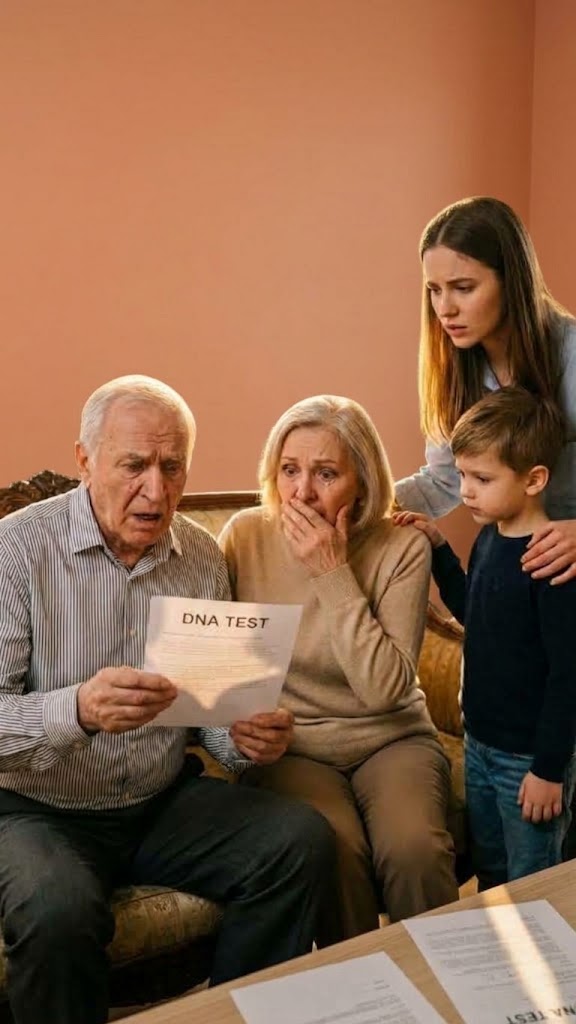
The word caught in her throat as her mother’s eyes shifted from Eli’s face to the portraits on the wall, silently counting years, bloodlines, and the places where the official story no longer fit.
Eli stood quietly beside her, sensing the tension without fully understanding it. He had imagined this moment so many times, but nothing had prepared him for the way everyone seemed to be looking at him as though his existence had suddenly changed the meaning of the room.
When she introduced him—Eli—her father’s jaw tightened, but she did not stop there. Before they could reshape the narrative again, she spoke the other name that shattered the careful distance they had kept from the truth: Robert Keller.
Eli watched his grandmother’s hand tremble around the crystal glass. He felt his stomach tighten as the room seemed to lose its warmth. He knew Keller was his father, but he had never understood why that name carried so much silence.
The reaction was immediate. Crystal trembled in his grandmother’s hand as the man they had toasted at Christmas and trusted in business was dragged from rumor into undeniable reality.
This was the same man whose signature sat beside her father’s on contracts that built the house, and the same hands that had pinned her in a darkened library while celebration echoed just beyond the door.
Eli looked at his mother and saw something he had never fully seen before—not weakness, but the exhaustion of someone who had carried the truth alone for years. His instinct was to reach for her, but he hesitated, afraid that even one movement might break the fragile silence.
His existence forced them to confront the crime they had once hosted, defended, and then quietly tried to erase.
His grandfather’s composure cracked first, not with visible grief, but with a loaded question: why had she never told them it was Keller?
Eli lowered his eyes. Part of him wanted to disappear from the room. Another part wanted to hear every word, because for the first time, the silence surrounding his family was finally being broken.
She refused to recite the old answer—that they would not have believed her—and instead laid the truth out in sequence: the party, the library door that never fully closed, the dress she never wore again.
Her mother flinched at details she had previously dismissed as misunderstandings, her hands worrying the edge of a dish towel until the seams strained.
Eli felt anger rise inside him, followed quickly by confusion. He had spent years wondering where he belonged, never realizing that the answer had been buried beneath a story his family was too afraid to tell.
When she finally named what had happened in plain language, the room fell so still that Eli’s breathing sounded impossibly loud.
For a moment, he felt exposed, as though the truth about his mother had somehow become his burden too. Then he looked at her and understood that she was not asking him to carry it. She was finally putting it down.
What followed was not a neat resolution but a gradual, fractured healing.
His grandfather made a halting admission that he should have listened differently. His grandmother quietly removed Keller’s awards and carried them to the trash.
Eli watched her return to the room with empty hands. Something inside him shifted. It was not forgiveness—not yet—but it was the first sign that the adults who had failed his mother were finally willing to face what they had done.
He allowed them to earn back trust one small moment at a time.
There were still questions he could not answer and feelings he could not name. But for the first time, he did not feel like an unwanted piece of someone else’s history. He was Eli. He was her son. His existence was not something that needed to be hidden or explained away.
She did not regain the stolen years or the version of herself that might have existed in a home that chose her over its reputation, but she claimed something more enduring—the power to name the past, to love her child without apology, and to occupy those rooms without shrinking.
Eli watched her stand there, no longer trying to make herself smaller for anyone.
He understood then that her courage was also part of his inheritance.
That truth became the only legacy she allowed to stand, and the only inheritance she intended for her son.