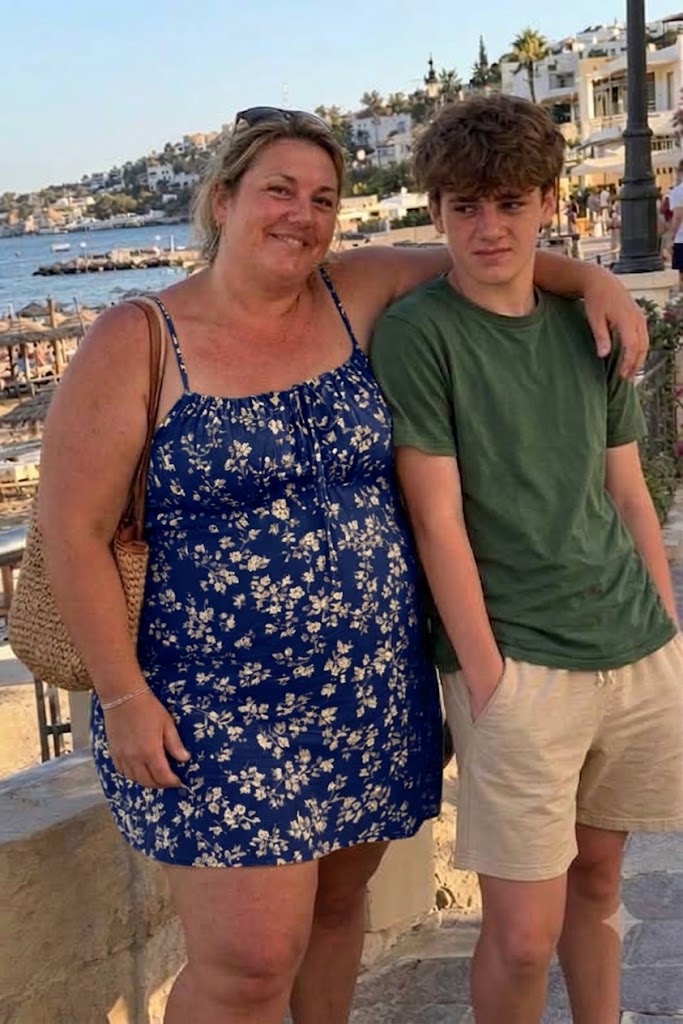
“I don’t want a picture with Mom when she looks like that.”
That’s what my fifteen-year-old son said out loud, in front of the entire pool deck, with water still dripping off my arm.
I had just gotten out of the pool on the fourth day of our family vacation, and for the first time in fifteen years, I hadn’t grabbed a towel first. I felt good. Not thin, not transformed, just good — good enough to call my son over and ask for one picture together. One.
He looked at me, looked away, and started scanning the deck like he suddenly had somewhere else to be. When I pushed, that’s when it came out — loud enough for my sister-in-law, my husband, and half the resort to hear, his eyes dragging down my body as he said it.
I stood there. Arm out. Saying nothing.
And so did my husband.
That’s the part I couldn’t wrap my head around. Twenty-one years married to David, and I have never once seen that man let something go — not a rude waiter, not a stolen parking spot, nothing. But he didn’t stand up. He didn’t raise his voice. He just looked at our son for a few long seconds, then dropped his eyes to his phone and started typing.
I assumed he was checking work email. I actually believed that.
Then my son’s phone buzzed in his hand.
He read it, and something in his face came apart. A second message landed. Then a third. He stopped scrolling, gripped the phone with both hands, and wouldn’t look up at me.
“What are you saying to him?” I whispered.
“Something he should’ve been told years ago,” David said, without looking up.
He wouldn’t tell me what was in those messages. Not that night, not when I pushed, not when I got angry that our son had walked off the pool deck without a word of apology.
“You’ll know when he tells you,” was all David would give me. He wrapped a towel around me himself instead, and told me quietly: not everything needs an audience.
Part of me hated him for that in the moment. Because part of me wanted an audience — I wanted him to defend me loudly, to embarrass Ethan the way Ethan had embarrassed me. Instead my husband chose silence, at least the kind everyone could see.
What I Didn’t Know My Husband Was Telling Our Son
Here’s what nobody at that pool knew, including our own son: this body wasn’t always this size. When David met me, I was twenty-four and thin enough to wear his shirts as dresses.
Then came seven years of trying for a baby — tests, procedures, hormones, pregnancies that lasted just long enough to make us believe, and then didn’t. Nobody outside our marriage knew how bad those years really were. Not even Ethan. Especially not Ethan.
By the time Ethan finally happened — and yes, people throw the word miracle around too easily, but for us it was never figurative — my body had already changed for good.
I was terrified through the whole pregnancy, and near the end, everything went wrong at once. Ethan was delivered by emergency surgery. I lost a dangerous amount of blood. The scar never faded properly — it runs from below my navel down and across, thick and raised, and I had spent fifteen years covering it. Not from shame. Just so strangers wouldn’t stare.
That afternoon, for reasons I still can’t fully explain — maybe turning forty-nine, maybe watching other women my age stop apologizing for their bodies — something in me had shifted enough to walk out of that pool uncovered for the first time in fifteen years.
And the first thing that greeted me was my son’s disgust.
At dinner, Ethan didn’t come down. I let him stay upstairs. Around 10:30 that night, there was a knock on our door. He stood there looking wrecked — not dramatic-teenager wrecked, actually shaken.
“Can I talk to Mom?”
David left the room without being asked.
The Text Messages That Broke Him
Ethan apologized — for what he said, and harder to get out, for the way he’d looked at me. I told him an apology doesn’t erase something the second it’s spoken. He nodded, then held out his phone.
“Dad said you should know.”
I opened the thread and started reading what David had sent our son while I stood dripping on that pool deck.
“Look at your mother’s stomach. Not her weight. The scar. Look at it.”
“That’s where you came out. You almost didn’t. She was on that table for four hours, and at one point a nurse pulled me into the hallway and asked if there was anyone I wanted to call.”
“You know we tried for a long time before you. You don’t know it was seven years. You don’t know how many times it didn’t work — because she made sure you never saw any of it.”
My hands started shaking as I kept scrolling.
“She ate for two because she was terrified of losing you. She gained a lot of weight, and she never lost it — not because her body failed her, but because it was busy keeping you alive.”
“She calls you her miracle. She’s called you that since the day you were born, and I don’t think you’ve ever wondered why.”
Then came the message Ethan later told me he read four times before he could stand to bring me the phone.
“Your mother has never once been ashamed of that scar. She told me years ago it’s the only part of her body she’d never change, because it’s proof you’re here. She stood in front of everyone today and let it show for the first time in fifteen years. And the first thing she heard was you.”
The last one was short.
“I didn’t marry your mother for the way she looked. She’s the same person she was at twenty-four — she’s just carrying the evidence of what she did for you. Go stand next to your mother.”
“Can I See It?”
I lowered the phone. For a long moment, neither of us said anything.
“I didn’t know,” Ethan finally said. “Dad never told me.”
“Neither did I.”
He came closer and asked to see the scar. I lifted my shirt just enough. He’d seen it a hundred times as a toddler, back when a mother’s body is simply where a mother’s body is, before teenagers learn to catalog everything. This time he actually looked at it.
“That happened because of me?”
“No. Because something went wrong when you were born. That’s different.”
“Did you almost die?”
“Yes.”
His face crumpled, and for the first time in years, my teenage son let me hold him without pulling away.
Between sobs, he admitted the real reason he’d panicked at the pool — some boys at school talk about each other’s moms, rank them, mock them, and if you don’t join in, they turn it on you instead. He hadn’t wanted Rachel’s photo posted anywhere it could be seen. Not an excuse. Just the truth.
“I forgive you,” I told him. “But don’t ask me to pretend it didn’t hurt. And don’t apologize just because your father scared you into it.”
“He didn’t scare me,” Ethan said. “He just made me feel like an idiot.”
I almost smiled. “He’s talented that way.”
The Second Photo
The next morning we had a family picture scheduled by the pool. I stood in front of the mirror holding my cover-up, fifteen years of habit telling my hands what to do, when Ethan knocked.
He looked at the cover-up, then at me.
“Don’t,” he said. “Don’t hide because of what I said.”
I put it down and walked downstairs without it.
Rachel lined everyone up under the palm trees for the family shot. Ethan wandered to the edge of the group — and for one second, the old hurt rose again.
Then he walked back.
Not to David’s side.
Mine.
He put his arm around my shoulders and asked if we could take one more, just the two of us, “because I want one with my mom.”
I didn’t suck in my stomach. I didn’t angle away from the camera or press a hand over the scar. I just stood there, my son beside me, and smiled.
Click.
By lunch he was complaining about the slow Wi-Fi again, because growth is rarely as cinematic as we want it to be. But something had shifted — not in my body, but in the way my son saw it. And maybe, finally, in the way I saw it too.
For fifteen years I believed that scar was only proof of what my body survived to bring him into the world.
That morning, it became proof of something else entirely: that people can hurt us without meaning to, understand exactly why, and still choose to become better.