Part – 1
The Boy Who Never Asked
My son Caleb had wanted the same bicycle for almost a year. Every time we drove past the sporting goods store on Route 9, his head would turn toward the window like it was pulled by a string. He knew everything about that bike — the matte black frame, the orange lettering, the exact gear ratio, the price down to the last cent.
But he never once asked me to buy it for him.
That was Caleb. He’d learned, somewhere along the way, not to ask for things.
So when he walked into the kitchen one evening standing a little too straight, like he’d rehearsed his opening line in the mirror, I already knew something was coming.
“I got a job,” he said.
I set down the dish towel. “A job? At fourteen?”
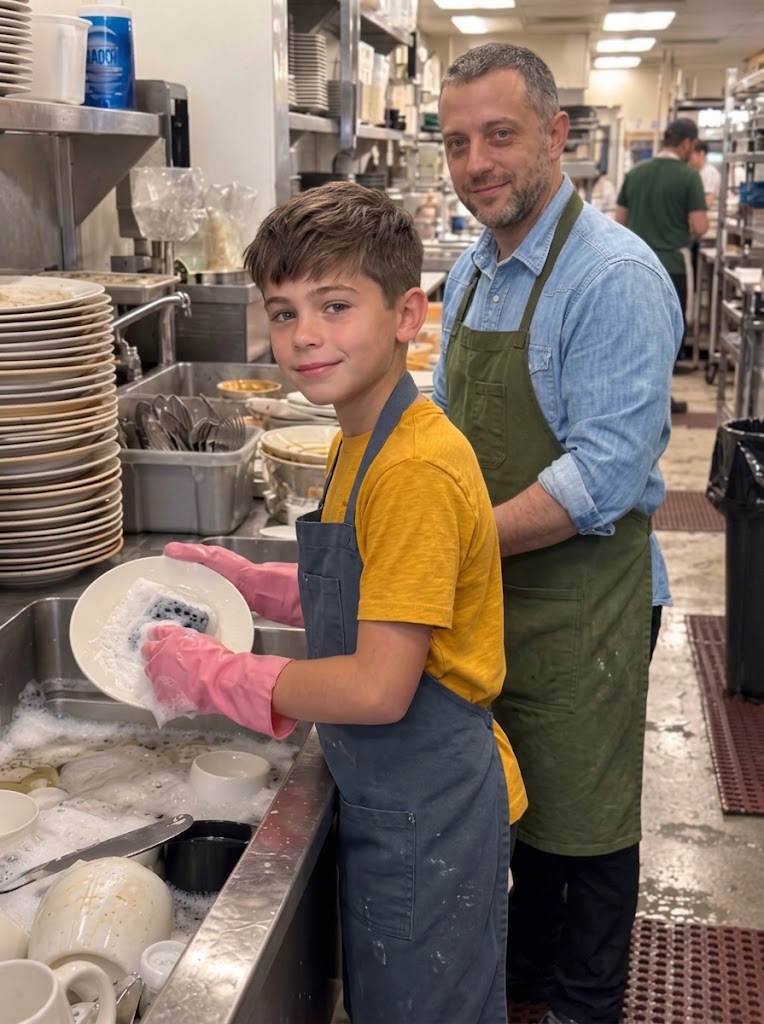
“At Tony’s Diner on Cherry Street. Saturdays. Washing dishes.”
He hesitated for half a second before adding, “I want to buy the bike myself.”
I smiled — the kind of smile mothers give when their heart swells and aches at the same time. “You don’t have to do that, honey. We could save for it together.”
He shook his head, firm. “No. I want to earn it.”
Tony, he explained, paid cash every Saturday. He’d already said yes.
On the surface, it sounded like any fourteen-year-old boy wanting a taste of independence. But to understand why this mattered so much, you have to understand what Caleb had already survived.
Three years earlier, his father — my husband, Daniel — had died suddenly. No warning, no chance to prepare, just a medical emergency that took him from us in less than two weeks. One day Daniel was in our driveway teaching Caleb how to change a tire. Two weeks later, I was standing in black, accepting casseroles from neighbors, while my eleven-year-old son gripped my hand so tightly it left marks.
Caleb changed after that. Not the way people expect grief to change a child — he didn’t act out, didn’t grow angry or withdrawn. He grew responsible. Almost unnervingly so.
He started taking out the trash before I asked. If he noticed I looked tired, he’d quietly make himself a sandwich instead of asking what was for dinner. At birthdays and Christmas, he stopped asking for gifts entirely.
“I’m good, Mom. I don’t need anything.”
At first I told myself he was simply maturing. It took me longer than it should have to understand the truth: at eleven years old, my son had quietly decided he was now the man of the house. He’d seen me cry in the kitchen when I thought he was asleep. He’d watched me move bills around the table, trying to make numbers stretch further than they could. And somewhere in that grief, he’d made himself a promise.
I will not become one more thing my mother has to worry about.
So when he told me he wanted to earn his own bicycle, it fit him perfectly.
“All right,” I said. “But school comes first. If it ever gets to be too much, you tell me.”
“Deal.” He grinned and hugged me, and for one brief second, all I could think was: Daniel, you should see him now.
The Money That Didn’t Add Up
Every Saturday after that, Caleb left the house in his oldest jeans and came home hours later smelling like dish soap, fryer oil, and syrup. His hands turned red and cracked from the hot water. Some nights at dinner, I’d watch him flex his fingers and wince without saying a word.
“How’s the bike fund coming?” I’d ask.
“Almost there,” he’d say, and go back to his food.
One month passed. Then two. Then five.
Still no bike.
That was when I quietly started doing the math. Caleb had told me Tony paid around sixty dollars a Saturday. Even allowing for a missed shift here and there, he should have had well over a thousand dollars by now. The bike cost six hundred. He should have been riding it since spring.
So where was the money going?
I told myself harmless stories to fill the silence. Maybe he wanted something more expensive now. Maybe there was a girl he was saving for. Maybe he was secretly planning to surprise me with something and didn’t want to spoil it. Fourteen-year-olds were allowed to have secrets — I kept repeating that to myself, like a rule I needed to believe.
Then, one night, I got up for a glass of water and passed his bedroom. The door was cracked, the light still on. I looked inside without meaning to.
Caleb was sitting on the floor by his bed, counting money. A lot of money. Bills fanned across the carpet, and he was murmuring numbers under his breath, completely absorbed.
Something about the scene made the hair rise on my arms.
Then he looked up and saw me, and his face changed instantly. Real fear — the kind I hadn’t seen on him since his father’s funeral. He swept the bills together, shoved them into his backpack, and hugged it against his chest like I might try to take it from him.
“Mom. Hey.” His voice cracked slightly.
“What is all that money, Caleb?”
“My bike money.”
“That’s a lot of bike money for a boy without a bike.”
He laughed, too quickly. “Tony pays me in small bills. It just looks like more than it is.”
Then, again: “Almost there.”
I knew, standing in that doorway, that something was wrong. I just didn’t know what. And I wasn’t ready to accuse my grieving fourteen-year-old of something I couldn’t even name.
“Okay,” I said instead, and stepped back. “Don’t stay up too late.”
I barely slept that night.
Torn Jacket, Muddy Shoes
A few weeks later, things got worse.
Caleb was always home from the diner by six-thirty. That Saturday, seven o’clock came and went. Then seven-thirty. His phone rang straight to voicemail. By eight, I was pacing the kitchen, imagining every terrible thing that could happen to a fourteen-year-old boy walking home after dark.
Then the back door opened, and I froze.
His sneakers were caked in mud. His jeans were filthy. The shoulder of his jacket was torn, and there was a raw scrape along his cheekbone.
“Caleb!”
He wouldn’t meet my eyes. “It’s nothing. I fell.”
“You fell?”
“Near the creek. Slipped on the bank.” He tried to move past me toward the stairs. “It’s not a big deal.”
“Come here. Let me look at your face.”
“I’m fine, Mom.” He pulled away, and something about the whole scene refused to sit right with me. That wasn’t a fall. That looked like a struggle.
So I asked the question that would keep me awake for days.
“Where’s your paycheck?”
He went still.
“I put it somewhere safe.”
My stomach dropped. “Where?”
“It’s safe. That’s all you need to know.”
“What does that mean?”
He looked, suddenly, unbearably tired. “Can I please just take a shower?”
He went upstairs before I could answer. A minute later I heard the water running, and I stood alone in the kitchen with my hand pressed over my mouth.
By then, every gentle explanation I’d invented had collapsed under its own weight. A secret gift didn’t explain torn clothing. A crush didn’t explain hidden cash and real fear. Something was happening to my son, or because of my son, and I no longer knew which.
And then the thought arrived — the one I hated myself for even thinking.
What if he’d gotten mixed up in something dangerous? What if the diner job was only half the story — what if some older kid, or worse, some adult, had pulled him into something he couldn’t get out of? Drugs. Theft. Anything.
He was fourteen. Fatherless. Trying so hard to be strong for me that I wondered if I’d left an opening for someone to take advantage of that. Wasn’t that exactly the kind of boy people targeted?
I hated the thought. But fear writes the darkest story it can when the truth stays hidden, and mine had a lot of material to work with.
That night I decided: no more “almost there.” No more vague answers. I was going to sit him down and make him tell me everything.
I never got the chance.
The Call That Stopped My Heart
Two days later, Tony called.
I was at my desk when my phone lit up with a number I didn’t recognize.
“Hello?”
“Is this Caleb’s mother?” The voice was older, rough around the edges, but not unkind.
“Yes. Who’s this?”
“This is Tony. I own the diner where your son works.” A pause. “I need to talk to you about him.”
My stomach clenched. “Did he do something wrong?”
The silence on the line stretched too long.
“Honestly,” Tony finally said, “I don’t know how to answer that.”
“What does that mean?”
Another pause. Then: “Do you know what Caleb does with every paycheck I hand him?”
My mouth went dry. “He’s saving for a bicycle.”
“That’s what he told you?”
“Yes.”
Tony exhaled slowly. “Ma’am, you might want to sit down.”
I gripped the edge of my desk instead. “Why?”
“Because everything that boy has told you about that money is a lie.”
The room seemed to tilt. The bike. The savings. Almost there. Months of it, all of it, apparently untrue.
“What is he doing?” My voice came out as barely a whisper. “Tony, please. What is my son doing with the money?”
That was when I heard it — shouting in the background. A voice I would know anywhere.
Caleb.
Not his calm, careful voice. A voice full of panic.
“Please, Tony! Don’t tell my mom!”
Then another voice — a man, angry. Something crashed. Glass, or dishes, hitting the floor.
“Caleb?!” I was on my feet before I realized I’d stood, my chair rolling back behind me. “What’s happening? Tony!”
He came back on the line breathing hard. “Ma’am, you need to get down here.”
“What happened?”
“Your son tried to do it again, and this time—” He cut himself off. “Just get here. Now.”
The line went dead.
I don’t remember most of the drive. I left without my coat. I ran a light I shouldn’t have. I prayed out loud, the words tumbling out before I could stop them. Please, God. Not him. You already took Daniel. Please don’t take my son too.
Tony’s words looped on repeat in my head. He tried to do it again. Do what? Steal from the register? Was that where the cash had come from all along? Had someone caught him? Was he hurt? Had that crash been him hitting the floor?
By the time I reached the diner, I’d already lived through every nightmare version of this moment.
The Truth in the Diner
I ran inside, and my knees nearly buckled.
Because everything I had imagined was wrong. Completely, entirely wrong.
Caleb was standing in the middle of the diner. He wasn’t hurt — not badly. But he was crying, and Caleb never cried. Not since his father’s funeral. Yet there he was, tears streaming down his face, a fistful of cash held out toward a woman sitting in a booth.
She was crying too. On the table in front of her sat a stack of papers, a couple of prescription bottles, and a child’s crayon drawing.
Tony stood between them. A tray of broken dishes lay scattered across the floor — the crash I’d heard on the phone. Just dishes. Nothing worse.
“Caleb?” My voice came out strangled.
He turned, and the moment he saw me, his face crumpled completely. “Mom.” He broke into sobs. “I’m so sorry.”
I crossed the room to him. “Sorry for what? What happened?”
“I didn’t want you to know.”
“Know what?”
Tony stepped forward then, looking as worn out as I felt, his own eyes shining. “I think my phone call gave you the wrong idea.” He set a hand gently on Caleb’s shoulder. “Your son hasn’t done anything wrong. He’s been doing something I’ve never seen most grown adults do.”
I looked between him and Caleb, not understanding.
Tony took a breath. “Every Saturday, Caleb works my kitchen. I pay him sixty dollars.” He nodded toward the woman in the booth. “And every single Saturday, the second I hand it to him, he walks it straight over to her.”
For a moment I couldn’t speak.
Her name was Renee. She had two young children — a boy around six, a girl around four. Her husband had left. She’d lost her job. She was behind on rent, and her son’s asthma inhaler had become a luxury she sometimes couldn’t afford alongside groceries. She brought her kids to the diner because it was warm, and Tony quietly fed them without charging when he could.
Caleb had noticed. Of course he had — he noticed everything now. He’d watched Renee count coins before ordering. Watched her split one plate between two kids. Heard her son cough in a way that worried him. And he recognized, instantly, the look on her face.
He’d seen it before. On me. After his father died.
Caleb knew exactly what it looked like when a parent was drowning and trying desperately not to let their child see it.
So one Saturday, months earlier, when Tony handed him his pay, Caleb hadn’t put it in his pocket. He’d walked straight to Renee’s table and set all sixty dollars down in front of her.
“This is for your kids.”
She tried to refuse. He walked away before she could argue.
The next Saturday, he did it again. And the one after that. Every week, for six months straight.
My fourteen-year-old son had been standing at a sink, scrubbing greasy plates until his hands cracked, so he could hand every dollar he earned to a struggling mother and her children.
There had never been a bicycle fund. The bike had only ever been his cover story. The cash I’d caught him counting that night in his room wasn’t savings — he’d been making sure Renee had enough before he handed it over. Sometimes, Tony added quietly, Caleb even threw in money from his own allowance, especially on weeks the inhaler ran short.
Then another memory clicked into place.
“The torn jacket,” I said. “The mud. What actually happened?”
Caleb wiped his face. “Some older boys hang around near the creek. They saw me giving Renee money through the diner window one time. They figured I carried cash every Saturday.” His voice dropped. “They were waiting for me that night. I ran. I fell climbing the bank — that’s how the jacket tore. And my face.”
“But you told me your paycheck was somewhere safe.”
“It was.” His voice went even quieter. “I still had it on me. I just — I gave it to her the next week instead.”
I pressed my hand over my mouth. My son had been chased through the dark, had fallen, had come home covered in mud and said nothing — because he was afraid that if I found out, I’d make him stop.
“Why didn’t you tell me?” My voice broke completely.
“Because you would have stopped me,” he said, and he wasn’t wrong. I opened my mouth to argue and found I had nothing to say.
What Grief Taught Him
“We don’t have a lot either,” Caleb went on, tears still falling. “I knew you’d say we couldn’t afford to give it away. But they had less than we do.”
Then he looked at me, and his voice cracked open completely.
“I remember, Mom. After Dad died — I remember you crying when you thought I was asleep. I remember when the power almost got shut off. I remember Mrs. Delgado bringing us groceries, and that woman from church paying our heating bill.” He wiped his eyes with the back of his hand. “When I saw Renee and her kids, they looked like we did. And I had money. So I thought — maybe I could be the one who helped, this time.”
I was crying too now, openly, in the middle of that diner.
“I did want the bike,” he admitted, looking down at his raw, cracked hands. “But this mattered more.”
And then he said the words that undid me completely.
“Dad would have done it. You always told me he’d give someone the coat off his back if they needed it. So I thought — if I can’t have him anymore, maybe I could at least try to be like him.”
I sank into the nearest chair and pulled him against me, holding him tighter than I had in years.
“I’m not angry,” I whispered into his hair. “Do you hear me? I have never in my life been prouder of anyone.”
Renee came over once we’d both stopped shaking. She told me she’d tried, every single week, to refuse Caleb’s money — told him to save it, buy his bike, keep it for himself. But he’d simply leave the cash on her table and disappear back into the kitchen before she could hand it back. That money had kept her lights on. Bought groceries. Filled her son’s inhaler more times than she could count.
Tony finally explained why he’d made the call. He’d watched this happen for months and admired the boy more than he knew how to say. But once the older boys started targeting Caleb, he knew it had gone further than he could quietly allow. That afternoon, when Renee learned what had happened at the creek, she’d refused to take another dollar from him. Caleb insisted. She pushed the money back. He pushed it toward her again. The argument grew heated, someone bumped a tray, and a stack of dishes hit the floor — the crash I’d heard through the phone.
“In forty years running this place,” Tony told me, shaking his head, “I’ve never seen a kid like that.” Then he looked at me. “And I figured the woman who raised him deserved to know.”
In the weeks that followed, everything shifted. Renee and her children became part of our lives, but I knew quickly she didn’t need to keep surviving on a fourteen-year-old’s Saturday wages. She needed real stability — and by then, three years past losing Daniel, I had finally reached a place where I could offer some. I made calls. A friend helped her land a steady job. I walked her through assistance programs she qualified for but hadn’t known existed. Within two months, she was caught up on rent, and her son’s inhaler was no longer a choice she had to make against groceries.
Tony gave Caleb a raise. He also gave him a rule.
“You can help whoever you want — you earned that money fair and square,” he told him. “But next time someone comes after you, you tell somebody. You don’t have to carry it all alone. Even the biggest hearts need backup.”
Once Renee was steady on her feet, she stopped accepting Caleb’s paychecks altogether. So, naturally, he found somewhere else to give. He started volunteering at a downtown shelter on Sundays and still gives away part of what he earns most weeks. The only difference now is that he doesn’t hide it.
Sometimes I go with him.
And the bicycle — the matte black one with orange lettering that started this whole story? I bought it for his birthday a few months after that day at the diner. When he realized what it was, he started crying all over again.
“Mom, you didn’t have to.”
“I know,” I said.
“Then why?”
I smiled. “That’s the point.”
I told him something his father used to say. You don’t help someone because you have to. You help because you can.
These days, Caleb rides that bike to the shelter every Sunday.
People sometimes ask if I regret those months I spent sick with worry. I don’t know how to answer that honestly. I was terrified. I’d imagined my son stealing, getting pulled into something dangerous, turning into someone I wouldn’t recognize. I was wrong about nearly everything.
Except one thing. His father’s death had changed him. I had simply misjudged the direction.
I thought grief might be pulling my son toward darkness. Instead, it had made him fluent in other people’s pain. He knew exactly what drowning looked like, because he’d been underwater once himself — and when he saw another family struggling to keep their heads above the surface, he didn’t look away.
He reached out.
For three years, I believed my job was teaching Caleb how to survive grief — how to stay strong, how to keep moving forward. But somewhere along the way, without my ever meaning to teach it, he learned something else entirely. He took the worst thing that ever happened to him and turned it into compassion. Into the instinct to notice the person everyone else walks past.
His father was exactly the same way. And it turns out, so is his son.
Sometimes I watch Caleb pedal that black-and-orange bike down the street toward the shelter, and I think about Daniel, and I hope, somehow, he can see him too.
Fourteen years old. Hands still rough from years at a dish sink. A heart bigger than I ever knew how to measure.
Caleb once told me everything he did was because he wanted to grow up to be like his father.
Watching him now, I think the truth is simpler than that.
He already is.