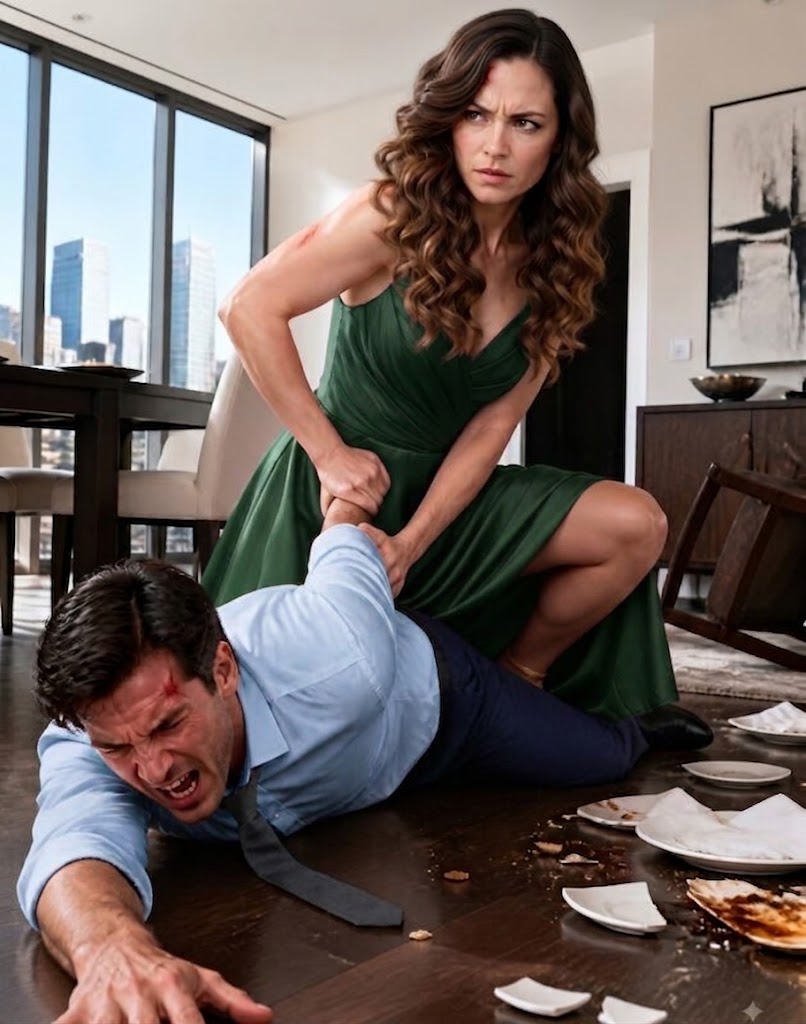
Three days after our wedding, my husband sent our dining table crashing onto its side because dinner was late.
Plates shattered across the floor. Gravy splashed onto the rug. One of the wineglasses we had received as a wedding gift rolled beneath the sofa before breaking against the wall.
And there I stood, still wearing my damp office clothes, staring at the man I had promised to spend my life with seventy-two hours earlier.
He pointed at me as though I were an employee who had failed some ridiculous test.
“Maybe now you’ll understand how things are going to work in this marriage.”
For several seconds, I couldn’t speak.
Then something inside me became strangely calm.
I looked at the broken dishes.
I looked at the overturned table.
Finally, I looked at my husband.
“Go on, Mason,” I said quietly. “Explain exactly how you think this marriage is going to work.”
He had no idea that by the end of the week, the disaster he had started would uncover a secret my family had buried for fifteen years.
And somehow, his family was buried in it too.
The Man I Married Disappeared in Three Days
My name is Claire Bennett.
I was thirty-four when I married Mason Reed.
Before him, I had built a life I was proud of.
I worked as a financial analyst, owned a comfortable two-bedroom condo, had savings, friends, a career, and—something I didn’t fully appreciate until later—peace.
Then Mason came along.
We met at a bookstore café on a rainy Saturday afternoon.
He was funny without trying too hard, confident without seeming arrogant, and unusually interested in what I had to say. He remembered small things. He brought me coffee before big meetings. He listened when I talked about work.
At least, I thought he listened.
Looking back, there were signs.
Whenever someone praised me, Mason would make a joke.
If I mentioned getting a bonus, he would say something like, “Don’t get too important for the rest of us.”
If I stayed late at the office, he would complain that my priorities were “out of balance.”
If I disagreed with him in front of friends, his smile would tighten.
But nothing had ever seemed serious enough to frighten me.
Not until that Tuesday.
Heavy rain had turned my usual thirty-minute commute into nearly two hours. By the time I reached home, I was exhausted.
Mason was already there.
He was sitting on the sofa, scrolling through his phone.
No greeting.
No “Are you okay?”
Not even a glance at my soaked coat.
“Traffic was terrible,” I said. “Give me twenty minutes. Dinner’s almost ready.”
Silence.
Mason had always been particular about dinner times.
Before the wedding, I thought it was one of those harmless habits couples adjusted around.
That evening, I discovered it was something else entirely.
I reheated the roast I had prepared that morning, added vegetables, and carried everything toward the dining room.
“Dinner,” I called.
Mason stood.
The look on his face made me stop.
He walked past me without a word, planted his foot against the heavy wooden table, and kicked.
Hard.
The entire thing tipped sideways.
Dinner hit the floor.
For a moment, neither of us moved.
Then Mason turned toward me.
“I’ve been sitting here waiting for almost an hour.”
I stared at him.
“You knew there was a storm.”
“That isn’t the point.”
“What exactly is the point?”
His voice rose.
“The point is that we’re married now. Things are different.”
I almost laughed because the sentence sounded so absurd.
“Different how?”
He stepped closer.
“Starting tomorrow, you’re going to stop behaving like you’re still single.”
My stomach tightened.
“What does that mean?”
“It means I’m done with this independent-woman routine.”
I couldn’t believe what I was hearing.
Mason continued as if he had rehearsed the speech.
He wanted access to my bank accounts.
My passwords.
My cards.
He wanted me getting up earlier to make breakfast.
He wanted dinner ready when he came home.
And according to him, my career had somehow become my “little office job” three days after our wedding.
Then he said something I still remember word for word.
“A wife who keeps challenging her husband eventually has to learn where the line is.”
I stared at him.
“What line?”
“The one you keep crossing.”
He expected me to shrink.
Instead, I felt years of buried instinct rise inside me.
There was something terrifyingly familiar about his tone.
Not the words.
The certainty behind them.
I had heard that certainty before.
When I was a child.
From my father.
I bent down, picked up a broken piece of porcelain, and placed it carefully on the overturned table.
Then I straightened.
“Mason, tell me something.”
“What?”
“If I refuse to give you my passwords, refuse to quit my job, and refuse to wake up at five in the morning to prove I’m a good wife… what happens?”
His jaw tightened.
“Don’t test me.”
“What happens?”
He raised his hand.
That was the moment everything changed.
I didn’t scream.
I didn’t move backward.
I simply looked at his raised hand and said:
“Put it down.”
Something in my voice stopped him.
“What did you just say?”
“You heard me.”
His hand slowly lowered.
He looked genuinely shocked.
As though marriage had given him some authority I had unexpectedly refused to recognize.
“You don’t speak to me like that.”
“I’ll speak however I need to when someone stands in my home threatening me.”
His expression changed.
“Your home?”
“Yes.”
I pointed around the room.
“I bought this condo six years before I met you.”
“We’re married.”
“And?”
His mouth opened, but nothing came out.
That was when I finally understood something I should have seen much earlier.
Mason had never wanted a strong wife.
He wanted the appearance of one.
He liked telling people I worked in finance.
He liked introducing me as accomplished.
He liked my condo.
My stability.
My confidence.
But only as long as none of those things gave me power he couldn’t control.
“You’re overreacting,” he muttered.
I looked down at the shattered plates.
“You kicked over a dining table because traffic made me late.”
“You pushed me.”
There it was.
Not regret.
Not embarrassment.
Blame.
I suddenly felt exhausted.
Not frightened.
Finished.
“I spent most of my adult life believing the difficult part was building a good life,” I said. “Turns out the difficult part is deciding who deserves to share it.”
Mason grabbed his jacket.
“Maybe tomorrow you’ll stop being dramatic.”
“No.”
He looked at me.
“You need to leave.”
He laughed once.
I didn’t.
His smile disappeared.
“You’re serious?”
“Completely.”
“Claire, I live here.”
“Then tonight you can live somewhere else.”
For perhaps the first time since I had met him, Mason had nothing clever to say.
He stared at me as if he were seeing a stranger.
Maybe he was.
Because the woman standing in front of him wasn’t the one who had spent two years overlooking small warning signs to keep the peace.
He walked out twenty minutes later.
I locked the door behind him.
And then I stood in the wreckage of my dining room and wondered how I had managed to marry someone I apparently hadn’t known at all.
My Sister Asked One Question
The next morning, sunlight poured through the windows as if nothing had happened.
I swept glass from beneath the cabinets.
Scrubbed sauce from the floor.
Lifted the broken dishes into a trash bag.
The overturned table remained where it was.
I couldn’t bring myself to touch it.
At 8:17 a.m., my older sister, Rachel, called.
“Why do you sound strange?”
“I’m tired.”
“Claire.”
Rachel had known me too long to accept that answer.
I sat on the kitchen floor and told her what had happened.
She listened without interrupting.
Then she asked:
“Are you safe?”
“Yes.”
“Is he there?”
“No.”
“Good.”
A pause followed.
Then she said something I wasn’t expecting.
“I never trusted him.”
I closed my eyes.
“Why didn’t you tell me?”
“I tried.”
“No, you didn’t.”
“Not directly.”
That irritated me.
“Then what do you mean?”
Rachel sighed.
“Every time you accomplished something, he found a way to make it smaller.”
I didn’t answer.
“At Mom’s birthday dinner last year,” she continued, “you told us you’d been chosen to lead that new project. Everyone congratulated you. Mason immediately started telling the story about how you once burned pasta.”
“That was a joke.”
“Was it?”
I stared at the floor.
Rachel’s voice softened.
“He seemed happiest when you were impressive to strangers and unsure of yourself at home.”
That sentence hurt because part of me recognized it.
“I kept trying so hard to be easy to love,” I whispered, “that I never stopped to ask whether the person beside me actually loved me well.”
Rachel was quiet.
Then she said:
“That’s what you need to ask now.”
For three days, Mason sent messages.
None contained the words I needed.
You embarrassed me.
You’re blowing this out of proportion.
Married couples fight.
You know I’d never actually hurt you.
Call me when you’re ready to act like an adult.
By Friday, I had stopped responding.
Then at six in the evening, someone knocked.
Mason.
He looked tired.
“I came to apologize.”
I stayed in the doorway.
He wasn’t entering unless I wanted him to.
“All right,” I said. “Apologize.”
He swallowed.
“I shouldn’t have kicked the table.”
I waited.
“That’s it?”
“What else do you want?”
And there it was.
Even his apology was about furniture.
Not the threat.
Not the raised hand.
Not the demand for my money.
Not the belief that marriage entitled him to control me.
He rubbed his forehead.
“My dad was strict when I was growing up. He believed a man had to keep order in his home.”
“Then your father taught you badly.”
Mason frowned.
“I lost my temper.”
“That may explain your behavior. It doesn’t erase it.”
For once, he didn’t argue.
Instead, he reached into his jacket.
“There’s something else.”
He pulled out a faded cream-colored envelope.
Every thought disappeared from my mind.
I recognized it immediately.
“Where did you get that?”
“It fell out when I moved one of the boxes in the bedroom.”
I snatched it from his hand.
The envelope belonged to a collection of old documents I rarely touched.
Inside was a photograph.
My hands began trembling.
I was sixteen in the picture.
Beside me stood a woman with dark hair, a wide smile, and one arm wrapped around my shoulders.
My mother.
The woman I had been told abandoned us fifteen years ago.
But it wasn’t the photograph that terrified me.
It was the folded note behind it.
The paper looked new.
At the bottom was a date.
Six months earlier.
And the handwriting belonged to my mother.
I would have recognized it anywhere.
There was only one sentence.
Claire, I finally know what your father did.
The Woman I Thought Had Abandoned Me
My mother disappeared when I was sixteen.
My father told Rachel and me she had chosen another life.
He said she was unhappy.
Restless.
Selfish.
He told us not to chase someone who didn’t want to be found.
At sixteen, I believed him.
What else was I supposed to do?
My father, Richard Bennett, was admired by nearly everyone who knew him.
He volunteered.
Donated to charities.
Remembered birthdays.
Spoke softly.
People described him as dependable.
But the man inside our house was different.
He never shouted much.
He didn’t have to.
He had rules.
He believed disagreements were disrespect.
Questions were challenges.
Privacy was secrecy.
And obedience was love.
My mother had been the only person who consistently stood up to him.
She laughed loudly.
She changed her mind.
She argued without apologizing for having an opinion.
And then one morning she was gone.
No goodbye.
No phone call.
No birthday card.
Nothing.
For years, I believed some part of her simply hadn’t loved us enough to stay.
Now I was holding proof that she had been alive six months earlier.
And somehow, she knew something about my father.
After Mason left, I tore through the cabinet where the envelope had been stored.
Nothing.
Then I remembered something odd.
My father had built the cabinet himself when Rachel and I were children.
He had always been obsessive about hidden hinges and fitted woodwork.
I removed the bottom drawer.
Behind it was a thin wooden panel.
My heart started pounding.
I pressed one corner.
Click.
The panel shifted.
Behind it was a shallow compartment I had never known existed.
Inside sat a dusty metal box.
I carried it to the floor.
There were letters inside.
A small brass key.
Two photographs.
And an old digital voice recorder.
A strip of yellowing tape had been stuck across its back.
One word was written on it.
Claire.
My fingers shook as I pressed play.
Static filled the room.
Then a woman inhaled.
And after fifteen years, I heard my mother’s voice.
“If you found this, then something happened that made you start looking.”
I covered my mouth.
The recording crackled.
“I need you to understand one thing before anything else. I did not leave because I stopped loving you or Rachel.”
Tears filled my eyes instantly.
“I left because I discovered something about your father. And once I understood what was happening, I was afraid staying would put both of you deeper inside a life I was desperately trying to escape.”
I pressed my fist against my lips.
For fifteen years, I had carried the same question.
Why weren’t we enough?
Her voice answered it from the past.
“You were the reason I wanted to stay. You were also the reason I knew I had to survive.”
Then came a burst of static.
Her voice returned faintly.
“Your father wasn’t working alone. The truth is that Richard—”
The audio distorted.
“No.”
I grabbed the recorder.
“Come on.”
Her voice flickered again.
“—and if anything happens, find—”
Static.
Then silence.
The recording ended.
I sat on the floor until nearly midnight.
My husband had destroyed my dining room.
But somehow, that single act had pushed open a door to something much older.
Something my family had spent fifteen years hiding.
The Name Mason Recognized
Rachel arrived the next morning twenty-two minutes after I called.
She listened to the recording twice.
The second time, she went pale.
“I remember something.”
“What?”
“The night before Mom disappeared.”
Rachel had been twelve then.
She remembered waking after midnight and hearing our parents arguing downstairs.
Mom had been crying.
Our father had kept repeating:
“You don’t understand what you’re interfering with.”
Rachel had convinced herself it was a dream.
Now neither of us believed that.
We spent the day going through the box.
Most of the letters were incomplete.
Some contained addresses.
Others had initials.
A few pages appeared to have been torn from larger documents.
But one name kept surfacing.
Margaret Vale.
The name appeared on an old mailing label.
Then on the back of a photograph.
Then again in one of my mother’s handwritten notes.
Margaret Vale.
I knew I had heard it somewhere.
I simply couldn’t remember where.
That afternoon, Mason returned for the rest of his clothes.
Our marriage was effectively over, even though neither of us had used the word divorce yet.
He packed silently.
Before he left, I made a decision I still can’t fully explain.
I showed him the name.
“Does Margaret Vale mean anything to you?”
The shirt in Mason’s hands slipped halfway into his suitcase.
His entire face changed.
“Where did you see that?”
My pulse quickened.
“You know her?”
“No.”
“That wasn’t what I asked.”
He sat slowly on the edge of the bed.
“My father used to mention that name.”
I stared at him.
“What did he say?”
“Not much.”
“Mason.”
He rubbed his hands together.
“When I was a kid, I heard him arguing with someone on the phone. Later I asked who Margaret was.”
“And?”
“He told me some people spend their whole lives trying to dig up things that should stay buried.”
My skin went cold.
“What else?”
Mason hesitated.
“He said if anyone ever contacted our family asking about Margaret Vale—or about anything connected to those years—we were supposed to say nothing.”
The room seemed to tilt.
“What years?”
“I don’t know.”
“You expect me to believe that?”
“Yes, because I was twelve.”
I studied his face.
For the first time since this nightmare started, Mason wasn’t angry.
He was frightened.
And that scared me more.
“My father knew yours,” he added.
“What?”
“Not well. At least, that’s what he always claimed.”
I felt suddenly sick.
This was no longer just about my missing mother.
Somehow, the family of the man I had married was connected to the secret my father had spent fifteen years protecting.
Before I could ask another question, someone knocked on the front door.
Three slow knocks.
Rachel came out of the kitchen.
“Are you expecting someone?”
“No.”
The knocking came again.
I walked toward the door.
Mason followed several steps behind me.
“Who is it?” I called.
Silence.
Then a woman answered.
“Claire.”
My entire body went still.
The voice was older.
Softer.
But I knew it.
I had listened to it over and over the night before.
Behind me, Rachel gasped.
I placed one hand against the door.
“Who are you?”
There was a long pause.
Then the woman outside said:
“I’m the woman your father spent fifteen years teaching you to forget.”
My knees nearly gave way.
Rachel began crying before the door even opened.
But I couldn’t move.
Because my mother wasn’t alone.
Someone stood beside her.
A person I had never seen before.
They were holding an old family photograph inside a plastic sleeve.
My mother looked at me.
“I know you have questions.”
I could barely form words.
“Who is that?”
Instead of answering, she nodded toward the photograph.
I took it.
The picture had been taken about a year before she disappeared.
My father stood on one side.
My mother stood beside him.
Behind them were several people whose faces I didn’t recognize.
And near the edge of the photograph stood a young woman.
I stared at her.
Then at my mother.
Then back at the picture.
Same eyes.
Same nose.
Same shape of the mouth.
Even the slight tilt of her head looked familiar.
Because I had seen that face thousands of times.
Every morning.
In the mirror.
My hands began to shake.
“Mom…”
She reached for me.
“There’s something you were never supposed to discover.”
I looked again at the stranger in the photograph.
Someone my father had apparently erased from every album, every story, every memory of our family.
Someone I had never been told existed.
Someone who looked exactly like me.
And beside me, Mason whispered a single sentence that made my blood run cold.
“I’ve seen that woman before.”