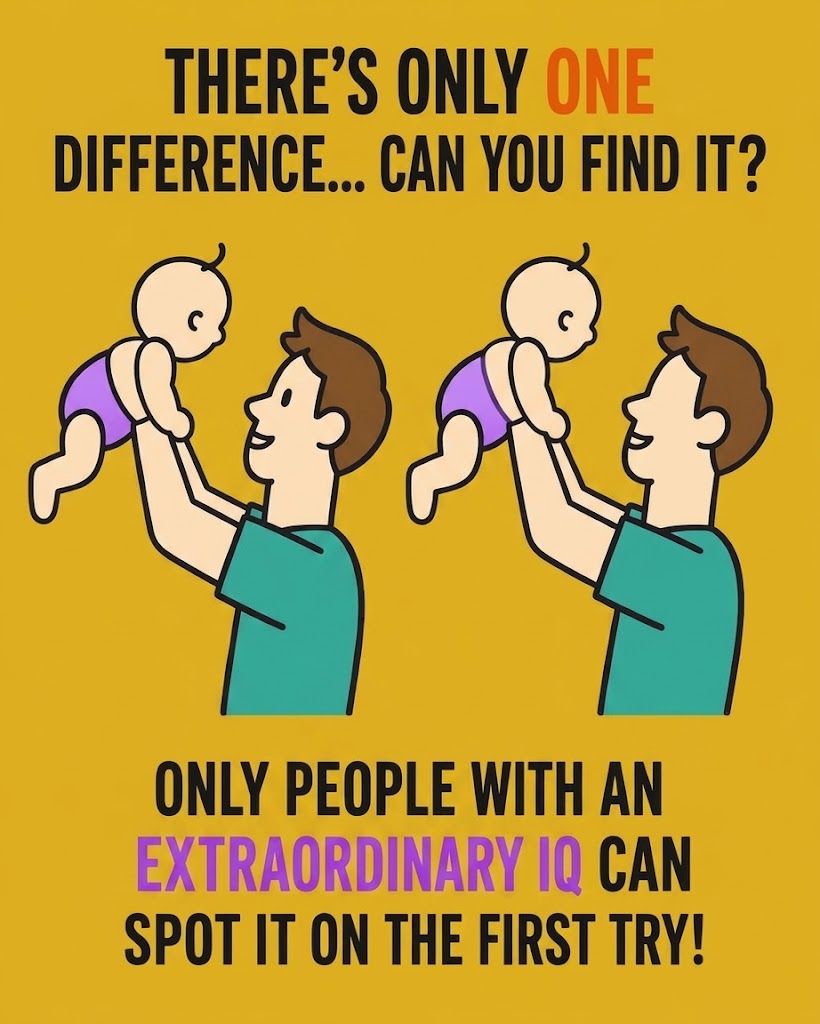
At first glance, two nearly identical pictures can seem completely the same. The colors may match, the shapes may appear to be in the same positions, and every major object may look unchanged. That first impression can be surprisingly convincing, even when one small feature has been deliberately altered.
Spot-the-difference puzzles take advantage of the fact that people usually process a visual scene as a whole before carefully checking every individual detail. The challenge is therefore less about having exceptional eyesight and more about directing attention methodically.
Visual perception is designed to work efficiently rather than to examine every part of the environment with equal attention. When people look at a familiar scene, the brain rapidly organizes colors, edges, shapes, depth, and objects into a meaningful picture. That ability is extremely useful because everyday life would become overwhelming if every line and surface had to be analyzed independently each time it appeared.
The same efficiency, however, can make tiny alterations harder to detect. When two images share the same overall structure, the brain may continue recognizing the familiar scene while overlooking a small change hidden inside it. This is one reason staring at the center of the picture is not always the best strategy.
The main subject usually attracts attention first, while smaller objects near the edges can receive less careful inspection. Puzzle creators often place differences in exactly those areas because viewers are more likely to focus on the most obvious shapes.
A missing line, reversed direction, changed color, altered number of objects, or slightly different gap can remain unnoticed even after several quick comparisons.
A more systematic search usually works better. Begin in one corner of the first picture and compare the corresponding area in the second picture. Then move slowly across the images in a predictable direction. Instead of jumping from object to object randomly, divide the scene into smaller sections and complete one section before moving to the next.
It can also help to compare one visual feature at a time. First examine outlines. Then compare colors. After that, check positions, directions, spacing, repeated objects, and small decorative elements.
Repeated objects deserve special attention. If a picture contains several flowers, windows, birds, buttons, leaves, or other similar shapes, counting them can be more reliable than relying on a quick impression. The brain is good at recognizing a group but not always at instantly identifying a change in the number of similar items.
Direction is another useful clue. Objects that point left or right, faces that look in different directions, handles that curve differently, or shadows that fall on opposite sides are common forms of subtle variation. These differences are easy to miss because the identity of the object remains unchanged.
Spacing can be equally deceptive. Two images may contain exactly the same objects but place one of them slightly closer to another. A small gap may disappear, or two shapes may overlap differently.
Color changes can also be difficult when they are subtle. A bright red object changing to blue is usually obvious, but a pale green becoming slightly darker or a small section changing shade can easily escape attention.
Image quality matters more than many viewers realize. A puzzle viewed on a large monitor may be easier than the same puzzle viewed on a small phone. Compression can blur fine lines or reduce color contrast. Screen brightness, reflections, and glare can also interfere with detecting small differences.
Fatigue can influence performance as well. When someone is tired, attention may become less consistent, and it can become harder to maintain a careful search pattern. The same person may solve a puzzle quickly at one time and struggle with it later. That does not mean their intelligence has changed. It simply reflects the fact that visual attention depends on temporary conditions as well as individual habits.
Expectations are another powerful factor. If someone believes the difference must be hidden in the largest object, they may spend too long inspecting that area. Meanwhile, the actual change may be near the edge. A useful strategy is therefore to deliberately check areas that initially seem unimportant.
This effect helps explain why a second person sometimes finds the answer immediately. They may not be more observant overall. Their attention may simply begin in a different place. One viewer notices shape first, another notices color, and another naturally counts repeated objects.
For that reason, spot-the-difference puzzles should not be treated as serious tests of intelligence. Solving one quickly can be satisfying, but performance on a single visual challenge does not measure overall reasoning ability, memory, creativity, education, or personality. These puzzles are better understood as entertainment that encourages focused observation.
Some online posts attach dramatic claims to visual puzzles, suggesting that finding a difference within a particular number of seconds proves exceptional intelligence or a rare personality type. Such claims should be treated cautiously. A single recreational image does not provide enough information to diagnose intelligence, emotional health, personality, or hidden motives.
The same caution applies to optical images that claim the first animal, face, or shape a person notices reveals a specific personality trait. These interpretations can be entertaining conversation starters, but they should not be confused with scientifically validated assessment.
A more useful way to approach these puzzles is to treat them as exercises in slowing down. The challenge asks the viewer to resist the natural urge to rely on the first impression. Instead of assuming the pictures are identical because they look similar overall, the viewer has to test that assumption carefully.
One technique is to mentally draw a grid across both pictures. Imagine dividing each image into four, six, or nine sections. Compare the same section in each image before moving to the next.
Another useful method is to alternate quickly between corresponding objects. Look at one object in the first image, then immediately at the same object in the second. The contrast can sometimes reveal small changes more easily than viewing each image separately for long periods.
If the puzzle contains complicated backgrounds, start with the boundaries. Check corners, edges, frames, rooftops, floor lines, tree branches, and other outlines. Small differences are often easier to hide in areas that viewers assume are merely decorative.
Next, inspect the main subject. Compare facial features, clothing, accessories, hands, feet, hair, buttons, pockets, patterns, and other repeated details.
After that, examine background objects. Count windows, leaves, clouds, books, lights, or any repeated element. A single missing item can remain unnoticed because the overall pattern still appears complete.
Text and numbers deserve careful inspection too. If a picture includes a clock, sign, calendar, jersey number, label, or other written element, one character may have been altered.
Reflections and shadows can be another source of variation. A shadow may point in a different direction or a reflection may omit an object. Because shadows are often treated as background information, people may not examine them carefully at first.
Perspective can also create misleading impressions. If the two pictures are not perfectly aligned or if one has been slightly cropped, viewers may mistake that shift for an intentional difference. Before deciding on an answer, make sure the difference is part of the illustration rather than simply a formatting change.
When sharing puzzle answers, it is helpful to explain exactly where the difference appears. Saying only “I found it” does not allow others to verify the result. A clear description lets everyone compare the same feature.
If several people produce different answers, they should check whether they are viewing the same version of the image. Viral puzzles are often reposted, resized, compressed, or edited. A version circulating on one page may not be identical to another version elsewhere.
This is especially important when counting puzzles are involved. Small shapes can disappear during compression, and overlapping objects may look different depending on resolution. A disagreement may therefore come from the image rather than from the viewers.
Visual puzzles can be useful as casual attention exercises. They encourage people to check assumptions, organize information, and explain how they reached an answer. These are practical habits even though the puzzle itself remains recreational.
The entertainment value comes partly from the tension between confidence and uncertainty. A viewer may initially feel completely sure that two pictures are identical. After the difference appears, that confidence disappears immediately.
That moment can serve as a simple reminder that first impressions are not always complete. Additional attention can reveal information that an initial glance missed.
Visual puzzles also work well socially because different people naturally use different strategies. One person scans systematically. Another notices color changes quickly. Someone else counts objects. Comparing methods can be more interesting than simply comparing how many seconds each person needed.
Speed should therefore not become the only goal. A slower viewer who finds and explains the correct difference has completed the puzzle just as successfully as someone who noticed it immediately.
For children, such puzzles can provide a playful opportunity to practice visual comparison. Adults can encourage them to describe what they notice rather than simply guessing. Asking questions such as “What is different about the shapes?” or “Can you count the objects?” can help turn the activity into a structured observation exercise.
For adults, the same basic strategy remains effective. Start broad, then become specific. First understand the overall scene, then deliberately inspect the parts that the first impression ignored.
There is no need to turn the result into a judgment about ability. People differ in eyesight, display conditions, experience with puzzles, and natural attention patterns. A person wearing glasses may perceive fine details differently from someone viewing the image under ideal conditions. A tired viewer may miss what they would normally notice. Someone using a small screen may face a much harder version of the same challenge.
These practical differences should be considered before making claims about what a person’s answer “means.”
Optical and visual puzzles are most useful when they remain what they are: structured games that encourage observation. They become less reliable when entertainment claims are presented as medical or psychological facts.
A recreational image cannot determine whether someone has superior intelligence. A quick answer may simply reflect familiarity with that type of puzzle. Someone who regularly solves spot-the-difference challenges may learn where designers often hide changes.
After solving several puzzles, viewers often stop staring only at the central subject. They begin checking corners automatically. They count repeated objects. They compare symmetry. They look for reversed shapes. Their attention becomes more strategic.
That improvement shows how much problem-solving depends on method. A person may struggle with the first puzzle and become much faster after understanding how the challenge is constructed. The improvement comes from changing the search process rather than from suddenly gaining better eyesight.
The same idea explains why hints can be so effective. A hint such as “look near the bottom left” dramatically narrows the search area. Another hint such as “check the direction of the objects” changes the feature being examined. Once attention is guided correctly, the difference may become obvious.
This demonstrates how important selective attention is in visual tasks. The information may be present the entire time, but the viewer has to direct attention toward the relevant feature.
For anyone struggling with the puzzle, the best advice is straightforward: slow down, divide the images into sections, compare corresponding areas, check outlines and colors, count repeated objects, look at direction, inspect spacing, and examine corners and background details.
Avoid repeatedly staring at the same central object. And remember that taking longer does not mean failure.
The satisfaction comes from eventually seeing the detail. Once it appears, the brain usually updates the scene immediately. The changed feature becomes part of the new interpretation. From that point onward, it may seem impossible not to see it.
That transformation is one reason spot-the-difference puzzles remain popular. They create a small but satisfying moment in which uncertainty turns into recognition.
The pictures do not change. The viewer’s attention does.
And that is what makes the challenge work.
Rather than proving who is smarter, the puzzle offers something simpler and more useful: a chance to practice looking beyond the first impression.
The best outcome is not finding the answer faster than everyone else. It is being able to explain what changed and show another person where to verify it.
That turns a quick visual puzzle into a small exercise in careful observation.
In the end, the hidden difference is only one tiny part of the picture. Finding it requires patience because everything surrounding it encourages the brain to accept the two images as the same.
Once the viewer stops relying only on overall similarity and begins comparing details deliberately, the change becomes much easier to detect.
That is the real appeal of the puzzle. It reminds people that attention can be trained, assumptions can be tested, and even an image that looks completely familiar may contain one small detail waiting to be noticed.