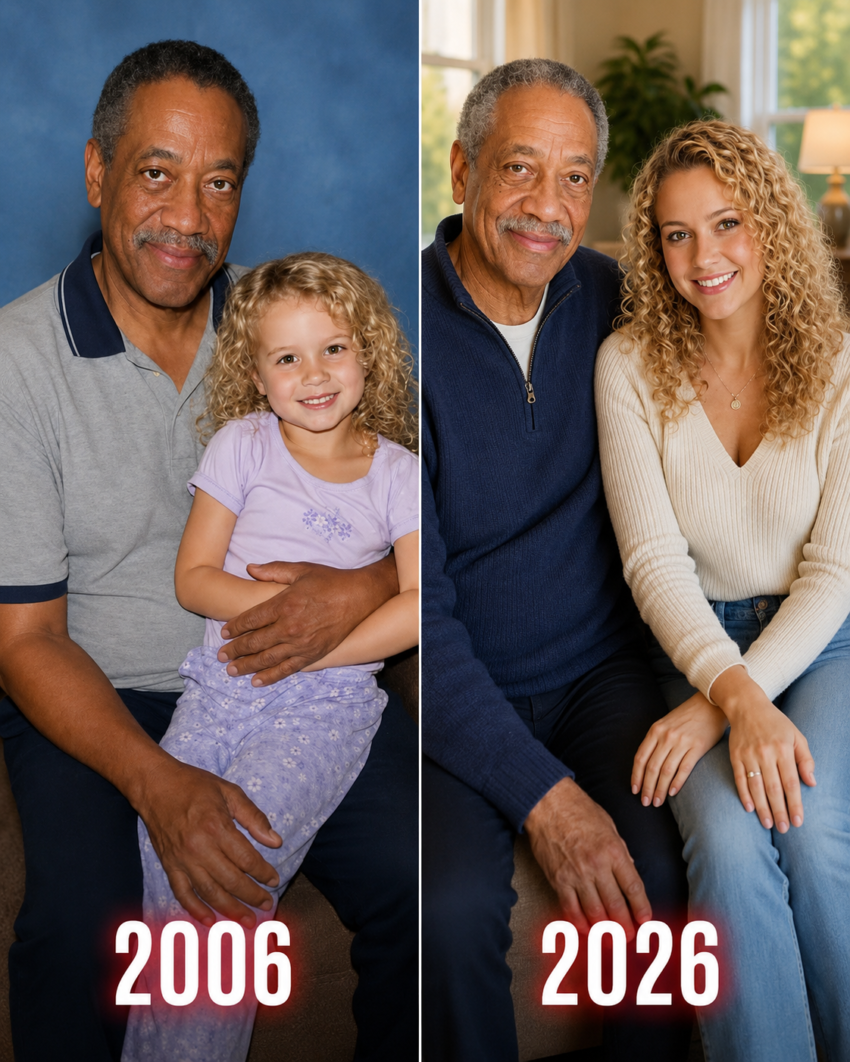
Part 1 — The Night the Snow Took Everything
People like to say that time heals every wound.
At seventy years old, I’ve learned that isn’t entirely true.
Time teaches you how to carry certain wounds. It dulls the sharpest edges. It helps you wake up, make coffee, pay bills, laugh at a joke, and keep moving even when part of you remains trapped in a moment from decades ago.
But some grief never disappears.
And sometimes, the truth behind that grief waits years before finding its way back to you.
I had already buried two wives and watched more friends leave this world than I cared to count. I thought life had exhausted its ability to surprise me.
Then my granddaughter Emily placed a folded note on our kitchen table.
Six words were written across it.
IT WASN’T AN ACCIDENT.
Those words dragged me straight back twenty years.
Back to the night I lost almost my entire family.
It happened just before Christmas.
My son Michael, his wife Rachel, and their children, eight-year-old Sam and five-year-old Emily, had come to my house for an early holiday dinner.
We lived in the sort of small town where neighbors waved from their porches and everyone knew which family had lived in which house for three generations. Winter storms were nothing unusual.
That evening, the forecast called for a few harmless flurries.
Maybe an inch or two.
Instead, the sky seemed to split open.
By early evening, thick snow was blowing sideways against my windows.
Michael decided they should leave before the roads became worse.
I stood at the front door while he held sleepy little Emily against his chest. She was bundled inside a puffy winter coat, her cheek resting on his shoulder.
“Don’t worry, Dad,” Michael told me. “We’ll be okay. I just want to get the kids home before it gets too late.”
I remember looking past him at the snow.
Something inside me tightened.
I almost asked them to stay.
To this day, I wish I had.
But I simply hugged them goodbye and watched their taillights disappear through the storm.
It was around seven in the evening.
Three hours later, someone knocked on my door.
Not a friendly knock.
Not the casual tap of a neighbor.
It was hard. Urgent.
The kind of knock that somehow tells you your life is about to change before you even turn the handle.
Officer Reynolds stood outside.
Snow was melting from his uniform, but what I noticed most was his face.
I knew immediately.
There had been a crash.
Michael’s car had lost control on an icy rural road and gone into the trees.
My son was dead.
Rachel was dead.
Eight-year-old Sam was dead.
Only Emily had survived.
She was five.
I don’t remember much about the drive to the hospital. I remember fluorescent lights. A hard plastic chair. A doctor speaking gently while I struggled to understand words that seemed to be coming from underwater.
Emily had suffered a concussion, broken ribs, bruising, and deep marks across her body from the seatbelt.
But she was alive.
The doctors said the trauma might leave her memory of the accident fragmented.
She might remember pieces someday.
Or she might never remember it at all.
“Don’t force her,” they advised me. “Let her mind recover in its own time.”
So I didn’t ask questions.
I didn’t make her relive anything.
Overnight, I became everything she had left.
I was fifty years old, grieving my son, my daughter-in-law, and my grandson—and suddenly learning how to raise a five-year-old girl.
Everyone called Emily’s survival a miracle.
The doctors said it.
The police said it.
Even our pastor used the word while standing before three closed caskets.
At the time, I desperately needed to believe him.
Part 2 — Learning to Become Her Home
The first years after the accident were a blur of grief mixed with ordinary responsibilities.
Life didn’t stop simply because ours had been shattered.
Emily still needed breakfast.
She still needed clean clothes.
She still had school.
She still needed someone to brush her hair.
I hadn’t prepared a child’s meal in decades, but I learned.
I discovered that combing a little girl’s hair required far more patience than I expected. I sat through school performances, parent-teacher conferences, scraped knees, birthday parties, science projects, and sleepless nights.
Once, I sat in a crowded school gym with tears filling my eyes while Emily performed as “Snowflake Number 3” in a winter pageant.
No one around me understood why I was crying.
But I did.
She was alive.
Sometimes that fact alone overwhelmed me.
Emily was never a difficult child.
If anything, she was too easy.
She rarely complained. She didn’t throw tantrums. She followed rules without being asked twice.
But every now and then, she would stare toward the front door with an expression that broke my heart.
It was as though some part of her was still expecting her mother or father to walk through it.
Eventually, she asked me the question I had dreaded.
“Why aren’t Mom and Dad coming back?”
I had rehearsed my answer countless times.
“It was an accident, sweetheart. There was a terrible storm. Nobody meant for it to happen.”
She quietly accepted my words.
After that, she almost never asked about the crash again.
Years passed.
Emily grew into a thoughtful, intelligent girl. She loved mysteries and puzzles, and she seemed to notice details other people overlooked.
There was a seriousness about her, too.
Sometimes I would look at her and think she had aged too quickly.
As if losing her family had placed an invisible weight on her shoulders.
Still, we built a life.
Not the one either of us had expected.
But a good one.
When she eventually left for college, the silence in my house nearly destroyed me.
I cried after she drove away.
More than I had cried at the funeral, if I’m being truthful.
There is something strange about raising a child after enormous loss. You become so focused on keeping them safe that you don’t notice how deeply their presence is keeping you alive too.
Four years after graduating, Emily came home.
She wanted to save money before getting her own place.
By then she was twenty-five and working as a paralegal for a small legal research firm downtown. She talked about eventually clerking and possibly going further in the legal field.
She was independent, capable, and brilliant.
But to me, she was still the little girl who used to fall asleep against my shoulder whenever storms frightened her.
Having her home again felt natural.
She came back from work around six most evenings. We ate together at the kitchen table while she told me about unusual cases, obscure laws, and odd things she had discovered during research.
I loved those dinners.
Then, a few weeks before the twentieth anniversary of the crash, Emily changed.
Not dramatically.
She simply became quieter.
Focused.
Distracted.
And then she began asking questions.
“Grandpa, what time did Dad leave your house that night?”
Another evening:
“Did the police ever contact you again after the crash?”
Then:
“Do you remember whether anyone else was supposed to be using that road?”
At first, I assumed she was trying to understand her past.
Maybe the anniversary had stirred something.
But there was something unsettling about the way she listened to my answers.
She wasn’t merely curious.
She was checking them against something she already knew.
Part 3 — The Note on the Kitchen Table
One Sunday afternoon, Emily came home much earlier than usual.
She didn’t even take off her coat.
She stood near the doorway holding a folded sheet of paper.
Her face was pale.
“Grandpa,” she said. “Can we sit down?”
My stomach tightened.
We went to the kitchen table.
That old table had witnessed almost our entire life together—birthday cakes, report cards, spilled milk, Sunday pancakes, homework, arguments, apologies.
Emily sat across from me.
Her fingers were trembling.
“I need you to read something before I explain,” she said. “And I need to admit something.”
She pushed the paper toward me.
I unfolded it.
There, in Emily’s careful handwriting, were the words:
IT WASN’T AN ACCIDENT.
For several seconds, I could only stare.
My chest tightened so suddenly that I wondered if something was wrong with my heart.
I tried to laugh.
“Emmy, what is this? Some kind of legal exercise? Have you been watching too many crime documentaries?”
She didn’t smile.
Instead, she looked directly into my eyes.
“I remember things, Grandpa.”
My attempt at humor vanished.