The Moment Her Smile Disappeared
My neighbor was still laughing when my eight-year-old daughter stepped onto our porch.
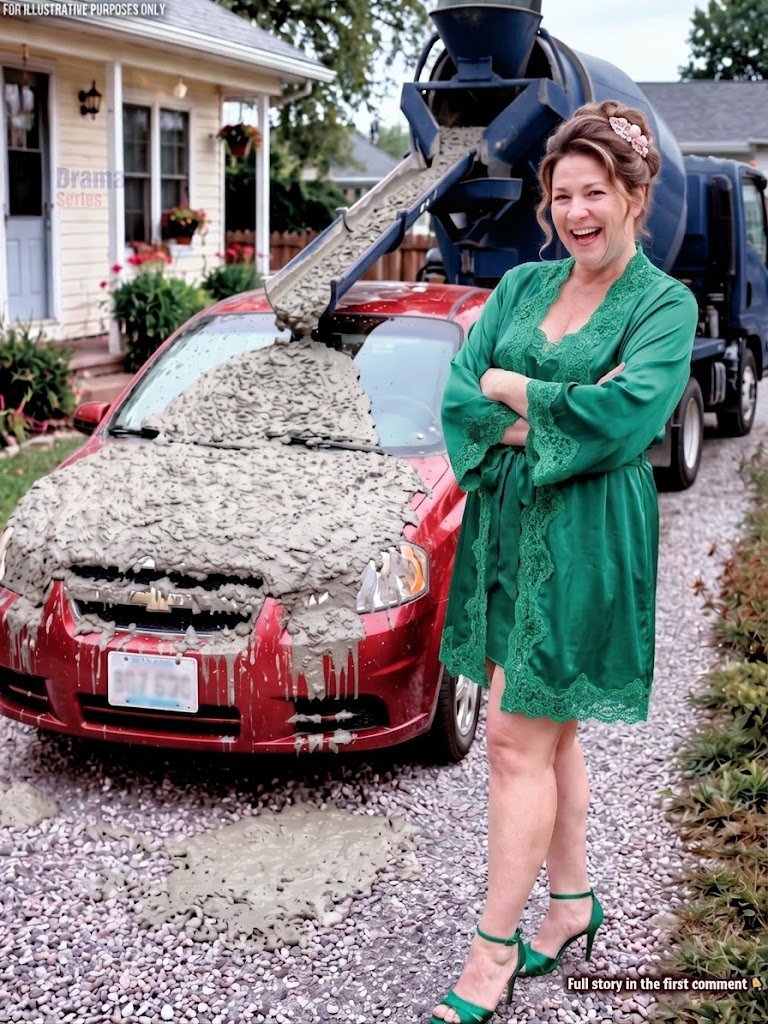
Behind us, thick gray concrete continued spilling from the chute of a construction truck. It landed across the roof, windshield, and hood of my old blue Chevrolet, slowly swallowing the car I depended on to get to work.
Valerie stood beside the truck in a silk robe and designer slippers, holding a coffee cup as though she were watching workers improve her garden.
“I guess you’ve finally learned your lesson,” she said. “Now you’ll park that junk somewhere else.”
My hands were shaking so badly that I nearly dropped my phone while trying to call 911.
Then Olivia appeared.
She didn’t cry. She didn’t scream.
She looked at the ruined car, glanced toward Valerie’s house, and gave me the smallest wink.
“Ma’am,” my daughter said politely, “I’m sorry, but you should look at your porch. Something happened.”
Valerie turned around.
The smug smile vanished from her face.
A bright red notice had been fastened to the front pillar of her enormous lake-view porch. Two county officials and a sheriff’s deputy were standing beside it.
Across the top of the notice were the words:
UNSAFE STRUCTURE — UNPERMITTED CONSTRUCTION — IMMEDIATE STOP-WORK ORDER
Valerie dropped her coffee.
“Oh God, no,” she whispered. “Please… not this.”
She had spent months trying to drive us away because my car supposedly blocked her view.
But she was about to learn that the porch she loved so much—the porch from which she had judged us—didn’t legally belong where she had built it.
And my eight-year-old daughter had the evidence that would expose everything else.
The Lake House My Father Left Behind
Three months earlier, Olivia and I had been living in a tiny rented apartment above a laundromat.
The building was old, the walls were thin, and the pipes rattled every time someone upstairs took a shower. My bedroom was barely large enough for a bed, so I gave it to Olivia and slept on a pullout couch in the living room.
I worked as an office assistant for a small medical supply company. The job paid the bills, but there was never much left after rent, groceries, utilities, and school expenses.
Still, Olivia rarely complained.
She was a thoughtful child with a wild imagination and a habit of noticing things most adults overlooked. She loved drawing maps, collecting unusual stones, and asking questions that sometimes left me searching for answers.
Then my father passed away.
Dad had raised me alone after my mother died when I was young. He was a quiet man who fixed almost anything with his hands and believed that kindness was a form of strength.
The most valuable thing he owned was a small lake house near Cedar Hollow, a peaceful community about forty minutes outside the city.
When his attorney told me Dad had left the house to Olivia and me, I cried in the parking lot for nearly twenty minutes.
The house wasn’t luxurious. The pale yellow paint was peeling. One side of the porch sagged, several windows needed replacing, and the kitchen cabinets had probably been installed before I was born.
There was no garage.
A narrow gravel driveway ran alongside the house, ending beside the back porch. That strip of gravel was the only safe place to park.
But the house was ours.
It had two bedrooms, a fireplace made of river stones, and a small backyard that sloped gently toward the lake. Dad had taught me to fish from the old wooden dock. He had pushed me on the tire swing until my feet seemed to touch the sky.
The first evening after we moved in, Olivia and I sat on the dock with our shoes off.
“Grandpa gave us a home,” she said.
“Yes, he did.”
She leaned against my shoulder.
“Then we should take care of it.”
I promised her we would.
I had no idea that our first challenge would come from the woman next door.
“People Like You Don’t Belong Here”
Valerie’s house stood on a slightly higher piece of land.
It was nearly three times the size of ours, with stone walls, tall windows, landscaped gardens, and an enormous porch overlooking the lake. The porch wrapped around the back of the house and ended in a viewing platform with glass railings.
On our third morning, I was carrying a box of dishes from my car when Valerie approached.
She wore white pants, oversized sunglasses, and a pale sweater draped across her shoulders. She held a porcelain coffee mug in one hand.
“Excuse me,” she said. “Is that your vehicle?”
I looked at my Chevrolet.
“Yes.”
“Could you park it somewhere else?”
I assumed she needed room for a delivery.
“Is it blocking something?”
“My view.”
I waited for her to laugh, but she didn’t.
“From my balcony,” she continued, “I can see the lake, your roof, and that car. It ruins the entire picture.”
“I’m sorry, but this is my driveway. There’s nowhere else for me to park.”
She removed her sunglasses and looked at the Chevrolet as though it were a pile of garbage.
“I don’t care. Park that piece of junk somewhere else. I don’t want to see that eyesore from my balcony.”
My face grew hot.
The car was old, but it was clean and dependable. Dad had helped me buy it shortly after Olivia was born. He had spent weekends teaching me how to change the oil, replace a battery, and recognize strange engine sounds.
“Does my car really bother you that much?” I asked.
Valerie looked me up and down.
“Maybe people like you don’t belong here,” she said. “Normal, wealthy people live around this lake. People who understand how appearances affect property values.”
I stared at her.
She had known me for less than three minutes.
“You’re standing on my property,” I said quietly. “Please leave.”
Valerie smiled without warmth.
“You’ll understand eventually.”
She walked back toward her house.
I wanted to believe it had been an isolated encounter.
It wasn’t.
Valerie’s Campaign to Drive Us Away
Over the next several weeks, Valerie found something new to complain about almost every day.
She complained when Olivia left her bicycle beside our porch.
She complained when I hung towels on the clothesline.
She complained that the sound of my lawn mower disturbed her Saturday mornings, even though her landscaping crew used leaf blowers for hours every Thursday.
Once, she placed a typed letter beneath my windshield wiper.
It said my vehicle was “visually incompatible with the community.”
There was no homeowners association and no neighborhood rule supporting her claim. I checked.
Another morning, I found a note taped to my front door:
MOVE THE CAR OR THERE WILL BE CONSEQUENCES.
I photographed it and placed it in a folder.
I also installed a security camera above our front porch. It covered the driveway and automatically saved footage online.
Valerie noticed it immediately.
“Are you spying on me?” she demanded.
“The camera points at my property.”
“Take it down.”
“No.”
Her expression hardened.
“You’re making a serious mistake.”
For the first time, I believed her threats might become more than words.
I filed a report with the county sheriff’s office. Since no property had been damaged yet, the deputy could only document the harassment and advise Valerie to stay off my land.
That made her even angrier.
But it also made me more careful.
And it made Olivia curious.
The Red Survey Tube
One rainy afternoon, Olivia was exploring the small attic above her bedroom when she found a long red plastic tube beneath a stack of old blankets.
“Mom, is this a treasure map?” she asked.
Inside was a rolled property survey, several photographs, and copies of letters my father had exchanged with Valerie’s husband, Grant.
Grant owned a construction company. Two years earlier, while Dad was ill, Grant had begun expanding the back of his house.
According to the letters, Dad had warned him that the planned viewing platform crossed the property line.
One of Dad’s letters read:
Grant, I am not giving permission for any part of your porch, deck, retaining wall, or foundation to enter my property. The survey stakes must remain in place.
Grant’s response was brief:
Your survey is outdated. We will proceed according to our plans.
My stomach tightened.
I spread the newer survey across the dining table and compared it with the old county map.
The line separating the two properties ran several feet beneath the corner of Valerie’s viewing platform.
Part of her porch had been built on land that now belonged to me.
That wasn’t all.
The photographs showed orange survey stakes along the boundary. In one picture, Grant’s workers had removed them.
“Grandpa knew,” Olivia said.
“He did.”
“Did they know too?”
I looked at Grant’s letter.
“Yes.”
The next morning, I contacted the county building department. I sent copies of the survey, photographs, and correspondence.
The clerk searched their records.
There was no permit for the porch expansion.
There was no approved plan for the retaining wall supporting it.
And the lower foundation appeared to have been constructed dangerously close to a drainage easement.
The county scheduled an inspection.
I didn’t tell Valerie. The inspector specifically advised me not to confront her because of the previous threats.
The inspection was set for Friday afternoon.
The same Friday Valerie decided to pour concrete on my car.
The Truck in My Driveway
That morning, Olivia had a mild fever, so she stayed home from school. My friend Rachel agreed to sit with her until I returned from work.
Around noon, Rachel called to say Olivia’s fever was gone and she was resting.
At three thirty, Rachel left for an appointment. I was already driving home and expected to arrive within ten minutes.
When I turned onto our road, I saw a large construction truck ahead of me.
Grant’s company logo was painted across the side.
At first, I assumed he was working on his own property.
Then I saw where the truck was positioned.
Its rear wheels were partly on my driveway.
The long metal chute extended over my Chevrolet.
Wet concrete was pouring directly onto the roof.
For several seconds, my mind refused to understand what my eyes were seeing.
I slammed on the brakes, jumped out, and ran toward them.
“What are you doing?” I shouted.
Grant sat behind the truck’s controls. Valerie stood a few feet away in her robe, smiling.
Concrete spread across the roof of my car and slid heavily down the windshield. It covered the hood, filled the space around the wipers, and poured over the doors.
“Stop it!” I screamed. “That’s my car!”
Grant glanced at Valerie.
She raised her coffee cup toward me in a mock toast.
“I warned you,” she said.
“You’re destroying my property!”
“I guess you’ve finally learned your lesson. Now you’ll park that junk somewhere else.”
I reached for my phone.
My fingers were shaking too much to unlock it.
Then the front door opened.
Olivia stepped outside holding Dad’s old tablet against her chest.
She looked at me, then at the truck.
And she winked.
What Was Waiting on Valerie’s Porch
“Ma’am,” Olivia said, “I’m sorry, but you should look at your porch. Something happened.”
Valerie frowned.
“What are you talking about?”
Olivia pointed toward the back of Valerie’s house.
The county inspector had arrived shortly before I did. Because the front gate was open, he and an assistant had walked around the property to examine the porch foundation.
A sheriff’s deputy had joined them after recognizing the address from my harassment report.
They had heard the truck operating and seen the concrete pouring onto my vehicle.
Now a red notice was attached to Valerie’s porch pillar:
UNSAFE STRUCTURE — UNPERMITTED CONSTRUCTION — IMMEDIATE STOP-WORK ORDER
The county inspector stood beside it with his arms crossed.
The deputy was already walking toward us.
Valerie’s coffee cup slipped from her hand and shattered on the stone path.
“Oh God, no,” she said. “Please, not this.”
Grant shut off the concrete flow.
The deputy looked at my Chevrolet, then at Grant.
“Step away from the controls, sir.”
“This is a misunderstanding,” Grant said.
“No,” I replied. “It isn’t.”
Valerie suddenly pointed at me.
“She was warned to move that car! It was interfering with our view and lowering the value of our home!”
The deputy stared at her.
“So you ordered your husband to pour concrete onto it?”
Valerie realized what she had admitted.
“I didn’t say that.”
“You just did,” Olivia said.
Valerie looked at my daughter.
Olivia raised the tablet.
“I recorded everything from the window.”
For once, Valerie had nothing to say.
The Evidence Olivia Saved
Olivia had seen the construction truck arrive while she was resting on the couch.
She recognized Grant and Valerie and remembered my warning never to confront them.
Instead, she locked the door, called 911, and opened the security camera application on Dad’s tablet.
The camera recorded Grant backing onto our driveway.
It recorded Valerie pointing toward my car.
It recorded Grant positioning the chute.
And it recorded Valerie saying, “Cover the whole thing. Maybe then she’ll understand.”
Olivia had also filmed part of the incident through the living-room window as a backup.
“You did exactly the right thing,” the deputy told her. “You stayed inside, called for help, and didn’t put yourself in danger.”
Olivia nodded solemnly.
Then she looked at me.
“I knew Grandpa’s camera would remember.”
I pulled her into my arms.
My anger gave way to relief so strong that my knees nearly buckled.
The car could be replaced.
My daughter was safe.
That was what mattered most.
Grant and Valerie were questioned separately. The concrete truck was photographed, and the recording was copied as evidence.
The deputy also documented the threatening letters I had saved.
When Valerie tried to claim the concrete had spilled accidentally, the video destroyed her story.
Grant’s own company truck had been used to intentionally damage private property. His employees later admitted he had canceled a paying job that afternoon and taken the truck himself.
This hadn’t been a careless prank.
It had been planned.
The Secret Beneath the Porch
The county’s investigation continued after the truck was removed.
A licensed surveyor confirmed that nearly six feet of Valerie’s viewing platform crossed the property line.
The retaining wall beneath it had been constructed without proper drainage. Water had been collecting behind the wall and weakening the soil.
The inspector explained that during heavy rain, part of the structure could have shifted toward our home.
Valerie’s beautiful porch wasn’t just illegal.
It was unsafe.
Grant had known the survey stakes were there. He had ordered his crew to remove them and continued building while my father was undergoing medical treatment.
Dad had tried to stop him, but he had been too sick to fight a prolonged legal battle.
He had saved every letter and photograph for me.
That red survey tube wasn’t merely a collection of old papers.
It was Dad’s final way of protecting us.
Valerie and Grant were ordered to stop using the porch immediately. They had to remove the encroaching section, rebuild the retaining wall, and restore the damaged part of my property.
Because of the intentional damage to my car, they also faced criminal charges and a civil claim.
Grant’s construction company lost several contracts after the incident became public. His insurer refused to treat the damage as an accident.
For the first time, the consequences were theirs to carry.
Our Day in Court
My Chevrolet was declared a total loss.
Even after the concrete was removed, the windshield, roof, doors, hood, and electrical components were badly damaged.
Watching the tow truck take it away hurt more than I expected.
It had been with me through nearly every difficult chapter of my adult life. Dad had sat in the passenger seat when I first drove it home. I had brought newborn Olivia home from the hospital in the back seat.
Before the car was taken, the owner of a local repair shop removed the blue Chevrolet emblem from the grille and cleaned it for me.
“Some things deserve to be kept,” he said.
Today, that emblem hangs beside a photograph of Dad in our kitchen.
Several months later, we appeared in court.
Valerie arrived in a tailored suit. She avoided looking at me.
Her attorney argued that her judgment had been affected by stress over property values and the dispute concerning the lake view.
The judge was unmoved.
“A scenic view is not a license to destroy another person’s property,” he said. “Nor does wealth create a superior right to live in a community.”
The security footage played on a large screen.
The courtroom heard Valerie call my car junk.
They heard her tell Grant to cover it.
They heard her say that people like me didn’t belong near the lake.
Then the recording showed Olivia quietly calling 911 from inside the house.
Valerie lowered her head.
Grant and Valerie were ordered to pay restitution for the car, my rental expenses, the survey, legal costs, and the damage to the driveway.
The porch had to be brought into full compliance with county rules. The section crossing my property was removed.
They were also required to stay off my land.
But the moment I remember most came after the hearing.
Valerie was leaving the courtroom when Olivia spoke.
“Mrs. Hart?”
Valerie stopped.
Olivia held my hand tightly.
“You could have just asked nicely,” she said. “My mom might have helped you plant a tree or something. You didn’t have to be mean.”
Valerie stared at her.
For the first time since we had met, she didn’t look angry or superior.
She looked ashamed.
“You’re right,” she said quietly. “I didn’t.”
Rebuilding More Than a House
The insurance settlement allowed me to buy a safe, reliable used SUV.
It wasn’t fancy, but it started every morning, had plenty of room for groceries, and included a working heater—something my Chevrolet had struggled with for years.
We also began repairing Dad’s lake house.
Neighbors I had barely known offered to help.
Mr. Lewis from across the road fixed the sagging porch steps. Rachel helped me repaint the kitchen cabinets. A retired electrician replaced several old outlets without charging me.
People brought sandwiches, tools, paintbrushes, and bags of garden soil.
The community Valerie had claimed would never accept us showed us the exact opposite.
They didn’t care that my car was old.
They didn’t care that I worked in an office instead of owning a company.
They saw a mother and daughter trying to build a home.
By the end of summer, the house had fresh white trim, a repaired porch, and flower boxes beneath the windows. Olivia painted small wooden signs for the garden.
One said:
KINDNESS GROWS HERE.
Valerie’s damaged porch took longer to rebuild.
The new version was smaller and remained entirely within her property line. The glass platform that had extended toward our driveway was gone.
For weeks, Valerie stayed inside whenever we were outdoors.
Then one Saturday morning, she walked toward our property carrying a paper bag.
She stopped at the boundary line.
“I won’t come any farther,” she said. “I know I’m not allowed.”
I put down my paintbrush.
“What do you need?”
She held out the bag. Inside was a set of watercolor pencils for Olivia and a handwritten letter.
“I owe you both an apology,” she said. “Not because the court ordered me to pay. Because what I did was cruel.”
I said nothing.
She looked toward my new SUV.
“I convinced myself that appearances mattered more than people. When you refused to obey me, I treated it as an insult. I wanted to embarrass you.”
“You tried to destroy the only transportation I had for my daughter.”
“I know.”
Her voice cracked slightly.
“I don’t expect forgiveness. I just needed to say that you didn’t deserve any of it.”
I accepted the letter but not the pencils.
“Give those to a local school,” I told her. “Olivia has what she needs.”
Valerie nodded.
“That’s fair.”
We didn’t become friends.
Some actions leave marks that an apology cannot immediately erase.
But after that day, she respected the property line. She stopped making comments, sending letters, or watching us from her balcony.
Peace, I learned, does not always mean reconciliation.
Sometimes it simply means strong boundaries, accountability, and the freedom to live without fear.
The View That Finally Changed
A year after the concrete incident, Olivia and I sat on Dad’s repaired porch eating watermelon.
The lake reflected the sunset in shades of gold and pink.
My SUV was parked in the gravel driveway.
From Valerie’s rebuilt porch, it was still visible.
But she had planted a row of flowering shrubs along her side of the property. They softened the view without blocking the lake or crossing the boundary.
As Olivia and I watched the water, Valerie stepped onto her porch.
For a moment, our eyes met.
She gave a small nod.
I returned it.
Then we both looked toward the lake.
“Do you think Grandpa would like the house now?” Olivia asked.
I glanced at the fresh paint, the flower boxes, and the little sign she had made.
“He would love it.”
“He would be proud of you too,” she said.
I smiled.
“I think he’d be proudest of you.”
Olivia leaned against my shoulder.
“I didn’t really wipe the smile off Mrs. Hart’s face,” she said. “The red paper did.”
I laughed.
“No, sweetheart. The truth did.”
Valerie had believed money gave her the right to decide who belonged beside that lake.
She had believed my old car made me less respectable, my small house made me less important, and my silence made me weak.
She was wrong about all of it.
My car had never truly blocked her view.
Her pride had.
And on the afternoon my eight-year-old daughter pointed toward that red notice, Valerie was finally forced to see what had been in front of her all along:
A person’s worth cannot be measured by the house they own, the car they drive, or the money in their bank account.
Sometimes the strongest person in the neighborhood is a single mother protecting her child.
And sometimes the bravest person is an eight-year-old girl holding an old tablet, quietly making sure the truth is never buried beneath concrete.