For two years, Mateo Álvarez had spent a fortune trying to make his sons smile again.
He hired specialists, changed schools, bought expensive toys, and filled their schedules with activities recommended by experts.
Nothing worked.
Then one Thursday afternoon, he returned home early and discovered that the quiet maid he had barely noticed had accomplished something no amount of money could buy.
His silent twins were laughing.
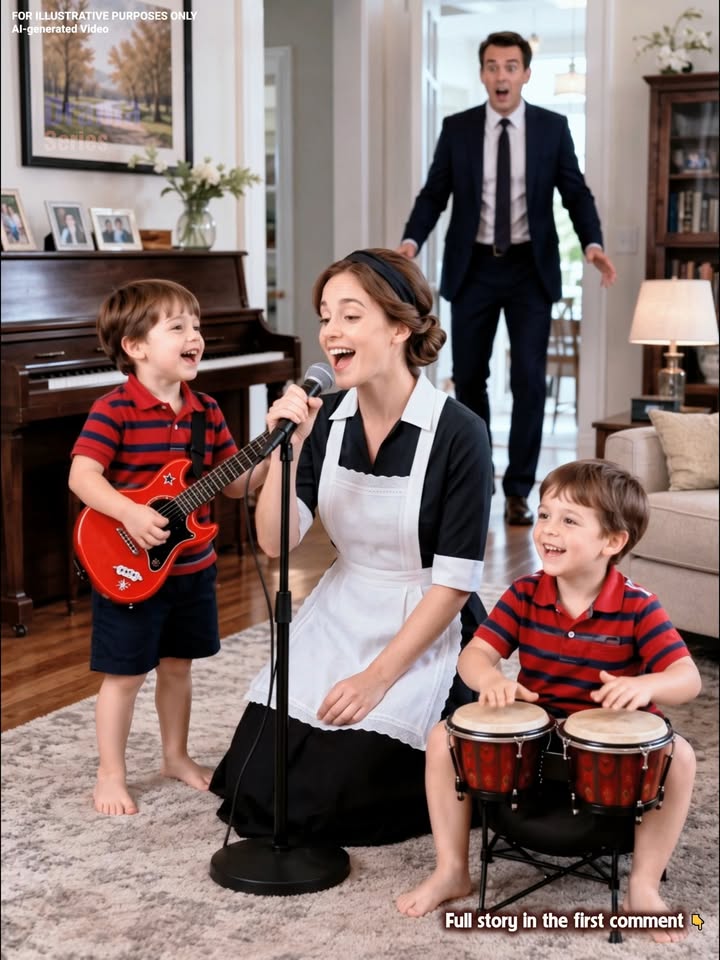
One was playing a bright red toy guitar. The other was beating a pair of small drums. And in the middle of the living room, still wearing her black uniform and white apron, Rosa was singing into a microphone as though the mansion were a concert hall.
Mateo stood frozen in the doorway.
He had hired her to keep the house quiet.
Instead, she had brought it back to life.
But the greatest shock came later, when Mateo discovered who Rosa really was—and why she had spent years searching for the woman whose photograph stood on his piano.
The House Where Laughter Disappeared
At exactly 4:47 on a Thursday afternoon, Mateo parked his dark luxury van outside his mansion in Lomas de Chapultepec.
He had arrived nearly two hours earlier than usual.
Traffic had been unbearable, his final meeting had been canceled, and all he wanted was to remove his tie, pour himself a drink, and sit in silence until the pressure in his head disappeared.
Silence had become the natural language of his house.
Two years earlier, Mateo’s wife, Clara, had died in a car accident.
Before that day, the mansion had been full of music. Clara played the piano in the mornings, sang while preparing breakfast, and danced with their twin sons in the hallways.
Leo and Santiago—whom everyone called Santi—had been four years old then.
They had been energetic little boys who built castles from sofa cushions, chased each other around the garden, and asked so many questions that Mateo sometimes joked about buying earplugs.
After Clara’s death, the questions stopped.
So did the laughter.
Leo became anxious whenever anyone mentioned his mother. Santi spoke only when absolutely necessary. They no longer played together unless an adult insisted. At dinner, they stared at their plates. At school, they sat apart from the other children.
Mateo tried everything.
He consulted respected child psychologists and enrolled the twins in a private school with small classes. He purchased art supplies, educational games, bicycles, and even a puppy-shaped robot that could respond to voice commands.
The toys remained untouched.
The therapists told him healing required patience.
But patience was difficult for a man who had built his business by solving problems quickly.
At work, Mateo could study numbers, make decisions, and control outcomes.
At home, he was helpless.
So he worked longer hours.
He told himself he was securing his sons’ future. In reality, he was avoiding a house that reminded him of everything he had lost.

The Woman Hired to Be Invisible
Three months before that Thursday afternoon, Mateo had hired Rosa Hernández through a domestic staffing agency.
She was thirty-two, originally from Oaxaca, and spoke in a gentle voice. Her references described her as responsible, hardworking, and especially patient with children.
Mateo barely looked at the final sentence.
During their interview, he gave her three simple instructions.
“Clean the house, prepare the meals, and please keep everything quiet.”
Rosa glanced toward the staircase, where Leo and Santi were watching from behind the railing.
“Of course, señor.”
“They’ve been through a difficult time,” Mateo added. “Don’t pressure them to talk. Don’t ask questions about their mother.”
“I understand.”
“And please don’t move anything in the music room.”
Rosa’s eyes briefly shifted toward the closed doors beside the piano.
“I won’t.”
Mateo hired her that afternoon.
For the first several weeks, Rosa did exactly what she had been told. She moved through the mansion silently, polished the furniture, prepared simple meals, and never disturbed the rooms that Mateo kept locked.
But she noticed things others had missed.
Leo tapped rhythms against the table whenever he felt nervous.
Santi hummed three notes under his breath before falling asleep.
Whenever Rosa cleaned the piano, both boys appeared in the doorway, watching her hands.
One morning, while preparing hot chocolate, Rosa began humming an old children’s melody.
Leo looked up immediately.
Santi dropped his spoon.
Rosa stopped.
“What song was that?” Leo whispered.
It was the longest sentence he had spoken to her.
Rosa’s heart pounded, but she kept her expression calm.
“It’s called ‘The Little Lantern,’” she answered. “Someone taught it to me a long time ago.”
“Our mother sang it,” Santi said.
Then both boys left the kitchen.
Rosa remained beside the stove, gripping the spoon in her hand.
She knew that song.
But she had never known the woman who had written it.
A Promise Made Years Ago
Long before Rosa became a maid in Mateo’s mansion, she had dreamed of becoming a music teacher.
As a child, she could not afford formal lessons, so she learned by listening. She sang at local celebrations, practiced on an old keyboard at a community center, and taught younger children to clap rhythms and harmonize.
When Rosa was nineteen, she applied to a music education program in Mexico City.
She was accepted.
But tuition, transportation, and housing were far beyond what her family could afford.
Then a letter arrived.
An anonymous sponsor had offered to pay most of her expenses.
The sponsor signed every note with only two initials:
C.M.
For three years, the mysterious woman sent encouraging letters along with tuition payments.
One letter included the melody of “The Little Lantern,” handwritten on a sheet of music.
I wrote this when I was young, the sponsor explained. Use it whenever a child feels afraid. Remind them that even a tiny light can guide someone home.
Rosa treasured those words.
Unfortunately, during her final year, Rosa’s mother became seriously ill. Rosa left the program to return home and care for her. By the time she was ready to continue her studies, the letters from C.M. had stopped.
Rosa wrote repeatedly to the foundation that had processed the scholarship, but the office had closed. Her letters were returned.
For years, she searched for the woman who had believed in her.
She wanted to explain why she had left school.
More than anything, she wanted to say thank you.
When Rosa began working at Mateo’s mansion, she knew nothing about Clara’s maiden name. The agency had told her only that the employer was Mateo Álvarez, a widower with two children.
Then, several weeks into the job, Rosa dusted a framed photograph on the piano.
The woman in the picture was young, smiling, and seated at the same instrument.
On the back of the frame, someone had written:
Clara Mendoza, age twenty-one.
Rosa nearly dropped it.
Clara Mendoza.
C.M.
It could have been a coincidence.
Yet the melody Leo and Santi remembered was the same melody contained in Rosa’s old letter.
From that day forward, Rosa carried a question she was afraid to ask.
Had Mateo’s late wife been the woman she had searched for all these years?

The Afternoon Everything Changed
On that Thursday, Rosa had no intention of breaking Mateo’s rules.
The twins returned from school shortly after three. A storm was gathering over the city, and thunder rolled in the distance.
Santi immediately covered his ears.
Leo stood motionless near the staircase.
Rosa knew storms frightened them. Clara’s accident had happened during heavy rain, and although the boys rarely discussed it, the sound of thunder often sent them into silence.
“Would you like some warm milk?” Rosa asked.
Neither child answered.
Another crack of thunder shook the windows.
Santi began breathing quickly.
Leo grabbed his brother’s hand, but he looked frightened too.
Rosa crouched several feet away, careful not to touch them without permission.
“Do you remember the lantern song?”
Leo nodded faintly.
“Your mother taught it to you, didn’t she?”
This time, Santi nodded.
“My friend taught it to me too,” Rosa said. “She wrote that a small light can help someone find the way home.”
“We don’t have a lantern,” Leo whispered.
Rosa looked around the room.
“No. But we have something better.”
She led them to a storage closet where old toys had been packed away. Inside were a small red guitar, two child-sized drums, and a microphone stand Clara had once bought for family karaoke nights.
The boys stared at the instruments.
“We’re not allowed,” Santi said.
Rosa hesitated.
Mateo’s instructions had been clear.
Keep the house quiet.
But she also remembered another sentence from one of C.M.’s letters:
Sometimes adults protect children from sadness so carefully that they also protect them from joy.
Rosa took a deep breath.
“Today, we’ll make one small exception.”
Leo picked up the guitar.
Santi sat behind the drums.
At first, they barely made a sound.
Then Rosa began singing.
Her voice was warm and clear, carrying the familiar melody through the enormous room.
Leo strummed a single string.
Santi tapped one drum.
Rosa smiled and continued.
Within minutes, the hesitant sounds became music—not perfect music, but joyful music.
Santi laughed when Leo played too loudly.
Leo laughed because Santi missed the drum and struck his own knee.
The boys began singing the words they remembered from their mother.
That was the moment Mateo opened the front door.
The Noise in the Living Room
Mateo heard the commotion before he had removed his hand from the door handle.
At first, he thought something had broken.
Then he heard singing.
He walked quickly toward the living room and stopped.
Rosa was kneeling beside the microphone.
Leo stood barefoot with the red guitar.
Santi sat behind two drums, smiling so widely that his cheeks had turned pink.
Mateo had not seen that expression on either of his sons in two years.
He should have felt relieved.
Instead, fear came first.
The scene was too similar to the life they had shared with Clara. For one painful second, Mateo imagined her sitting at the piano, turning to smile at him.
Then the memory disappeared, leaving only anger behind.
“What is going on?”
The music stopped.
Leo lowered the guitar.
Santi’s hands froze above the drums.
Rosa stood immediately.
“Señor Mateo, I can explain.”
“I told you to keep this house quiet.”
The light vanished from the boys’ faces.
Rosa looked at them, then back at Mateo.
“They were frightened by the storm.”
“So you turned my living room into a concert?”
“I was trying to help them.”
“You were hired to clean this house, not make decisions about my children.”
Rosa’s face became pale, but she did not look away.
“I know.”
“Then put those things away.”
Santi climbed down from the stool.
Leo carefully placed the guitar on the carpet.
Mateo saw their shoulders fall, but his anger would not release him.
Rosa removed her apron.
“I’m sorry I disobeyed you,” she said quietly. “I will leave.”
The boys looked up.
“No,” Leo whispered.
Mateo turned toward him.
Leo’s eyes filled with tears.
“Please don’t send Rosa away.”
Santi moved beside his brother.
“She made the thunder stop.”
Mateo stared at them.
Both boys had spoken willingly.
Not because a therapist had asked them a question. Not because they had been promised a reward.
They had spoken because they cared whether Rosa stayed.
The realization struck him harder than his anger.

The Letter Inside Her Bag
“Wait,” Mateo said.
Rosa paused near the doorway.
“I shouldn’t have shouted.”
She said nothing.
Mateo loosened his tie and glanced at the instruments.
“I wasn’t prepared to hear music in this room.”
“I understand.”
“No,” he said. “I don’t think you do.”
His voice softened.
“Clara used to sing with them here. Almost every evening.”
Rosa looked at the piano.
“I suspected that.”
Mateo noticed something in her expression.
“What do you mean?”
Rosa hesitated before opening her worn handbag. She removed a carefully folded sheet of paper sealed inside a transparent cover.
“I’ve carried this for thirteen years.”
Mateo unfolded it.
The paper contained musical notes written in blue ink. Beneath them were several lines in a familiar, graceful handwriting.
His breath caught.
He knew that handwriting.
Clara had written grocery lists in it. Birthday cards. Notes she slipped into his briefcase. The final message she had sent him on the morning of the accident.
“Where did you get this?” he asked.
“From the woman who paid for my education.”
Mateo looked at the initials at the bottom.
C.M.
Rosa told him everything—her music studies, the anonymous scholarship, the letters, and the years she had spent searching for her sponsor.
“When I found Clara’s maiden name behind the photograph, I began to wonder,” she said. “Then the boys recognized the melody. But I didn’t want you to think I had taken this job to ask for money.”
“You didn’t know this was her house?”
“No. I came through the agency. I knew only your name.”
Mateo sat heavily on the piano bench.
Clara had often donated to educational programs, but she rarely spoke about it. She believed generosity lost something when it became a performance.
Still holding Rosa’s letter, Mateo opened the piano bench.
Inside were several of Clara’s old notebooks.
He had not touched them since her death.
The first contained songs.
The second held plans for a children’s music project.
In the third, an envelope slipped from between the pages.
Across the front, Clara had written:
For Rosa Hernández.
Rosa covered her mouth.
The Message Clara Never Sent
Mateo opened the envelope with trembling fingers.
The letter was dated several weeks before Clara’s accident.
He read it aloud.
“Dear Rosa,
“I recently learned that you left the music program to care for your mother. Please do not think you disappointed me. A person who pauses a dream to care for someone they love has not failed.
“I hope, when the time is right, you will return to music.
“My husband and I have twin boys. They are still small, but they already respond to every melody. One day, I would like you to meet them. I believe you understand something many people forget—that music is not about performing perfectly. It is about helping others feel less alone.
“I am preparing a small community project for children who need a safe place to sing, play, and belong. Perhaps you might help me lead it someday.
“Until then, keep your light burning.
“With affection,
“Clara Mendoza Álvarez.”
No one moved.
Outside, rain tapped gently against the windows.
Rosa pressed both hands to her face as tears rolled down her cheeks.
“I thought she had forgotten me.”
Mateo looked toward Clara’s photograph.
“She didn’t.”
Leo and Santi had crept closer during the reading.
“Mom knew Rosa?” Santi asked.
“In a way,” Mateo answered. “Your mother believed in her before we ever met her.”
Leo touched Rosa’s hand.
“Then Mom sent her here.”
Mateo almost corrected him.
The agency had sent Rosa. It had been coincidence, paperwork, and ordinary circumstances.
Yet as he looked at Clara’s letter, the silent piano, and his sons standing beside the woman who had brought back their laughter, coincidence suddenly felt like an incomplete explanation.
“Maybe she did,” he said.

The Father Who Had Forgotten How to Listen
That evening, Mateo did something he had avoided for two years.
He stayed home.
He ate dinner with his sons and listened as they told him about the song. Their words came slowly, with long pauses, but he did not rush them.
Afterward, he asked Rosa to sit with him in the study.
“I owe you an apology,” he said. “I treated silence as though it were the same thing as peace.”
Rosa folded her hands in her lap.
“You were grieving.”
“So were my sons. But I left them alone inside it.”
“You were trying to protect them.”
“I was trying to protect myself.”
It was the first time Mateo had admitted the truth aloud.
He had locked the music room because every melody reminded him of Clara. He had asked the staff to remain quiet because laughter made him remember what the house once sounded like.
He thought removing reminders of Clara would lessen the boys’ pain.
Instead, he had removed their connection to her.
“Would you stay?” Mateo asked.
“As your maid?”
“As someone who understands my children better than I do.”
Rosa shook her head gently.
“You understand them. You’re simply afraid of what they need.”
The answer stung because it was true.
Mateo glanced at Clara’s letter.
“She wanted you to return to music.”
“That dream belongs to another life.”
“Perhaps it belongs to this one.”
Rosa did not immediately agree.
She did not want charity. She wanted the opportunity to complete what she had begun.
So they created a plan.
Rosa would continue receiving a salary for her household work, but her hours would be reduced. Mateo would help her locate a university where she could finish her music education degree. In exchange, Rosa would guide the twins in daily music activities—not as a therapist, but as a teacher and trusted adult.
For the first time in years, Rosa allowed herself to believe that the door to her old dream had not closed forever.
Healing Did Not Happen Overnight
Life in the mansion did not suddenly become perfect.
Leo still had difficult mornings.
Santi still became frightened during storms.
Mateo sometimes escaped into work when emotions became uncomfortable.
But the house changed little by little.
Every afternoon, the twins had twenty minutes of music.
Some days they sang.
Some days they played instruments.
On difficult days, they simply sat beside the piano while Rosa played softly.
Mateo began arriving home earlier twice a week.
At first, he watched from the doorway.
Then Santi handed him a tambourine.
Mateo claimed he had no rhythm.
The boys laughed and told him they already knew.
That laughter no longer felt like a painful reminder.
It felt like an invitation.
Eventually, Mateo unlocked the music room. Together, he and the twins sorted through Clara’s sheet music, photographs, and unfinished plans.
They cried.
They also smiled.
For the first time, Leo spoke openly about missing his mother.
Santi admitted he worried that if he stopped feeling sad, it would mean he had forgotten her.
Mateo pulled both boys close.
“Being happy doesn’t erase your mother,” he told them. “She is part of every happy thing she taught us.”
Rosa watched from the doorway, knowing some moments belonged only to a father and his sons.

Clara’s Unfinished Dream
Six months later, Rosa resumed her studies.
She attended classes in the mornings and returned to the mansion in the afternoons. She worked hard, often studying after the twins had gone to sleep.
Meanwhile, Mateo reviewed the plans in Clara’s notebook.
She had imagined a weekend music program for children dealing with loss, family hardship, or isolation. The program would offer instruments, lessons, and a welcoming place where no child would be pressured to explain what they were feeling.
Mateo had the resources to make it real.
Rosa had the experience to give it a heart.
Together, they opened The Little Lantern House in a renovated community building.
The first Saturday, only seven children arrived.
Leo brought his red guitar.
Santi sat behind the drums.
Rosa stood at the microphone.
Mateo remained near the back, pretending he was there only to manage practical details.
Then a shy little girl refused to enter the music room.
Leo walked over and offered her his guitar.
“You don’t have to play,” he told her. “You can just hold it until you’re ready.”
Mateo turned away for a moment, overwhelmed by pride.
His son, once unable to speak about his own sadness, had learned how to sit beside someone else’s.
Within a year, the program served more than sixty children.
Rosa completed her degree and became its director.
She insisted that the center not be named after her.
“This was Clara’s dream,” she said.
Mateo pointed toward the lantern painted above the entrance.
“And you kept it burning.”
The Sound of Home
On the second anniversary of the afternoon Mateo came home early, the mansion was louder than ever.
Children from The Little Lantern House filled the garden for a celebration. Music drifted through the open windows. Parents talked beneath the trees. Leo and Santi argued over who would perform first.
Mateo stood beside Clara’s photograph in the living room.
He still missed her.
He always would.
But grief was no longer the only thing connecting him to her.
There was music now.
There was purpose.
There were two growing boys who could speak her name without losing themselves in sadness.
Rosa approached wearing a simple blue dress instead of her old uniform.
“The twins are looking for you,” she said.
“Are they nervous?”
“No. They say their drummer is missing.”
“I’m not their drummer.”
“You made the mistake of playing with them once. That means you’re a permanent member of the band.”
Mateo laughed.
As they entered the garden, Leo raised his guitar and Santi pointed toward an empty chair beside the drums.
“Come on, Dad!”
Mateo sat down and picked up the tambourine.
Rosa stepped to the microphone.
Before beginning, she looked at the twins, then at Mateo.
“For someone who taught us that even a small light can guide people home,” she said.
They began playing Clara’s song.
The performance was not perfect.
Leo missed a chord.
Santi played too fast.
Mateo entered at the wrong moment.
But everyone laughed, and no one stopped.
Years earlier, Mateo had believed peace meant the absence of noise.
Now he understood.
Peace was not an empty mansion, polished and silent.
Peace was the sound of his sons singing without fear.
It was Rosa fulfilling the dream Clara had protected for her.
It was remembering someone with gratitude instead of only pain.
And as the music rose through the house that had once felt lifeless, Mateo looked at his children and finally understood the truth.
Rosa had never been sent there simply to clean his mansion.
She had arrived to open the rooms grief had locked.
She had given his sons back their voices.
And in helping them find their way home, she had finally found the woman she had been searching for all those years—not in a meeting or a final conversation, but in a handwritten letter, an unfinished dream, and two little boys singing their mother’s song.
Note: This story is a work of fiction inspired by real events. Names, characters, and details have been altered. Any resemblance is coincidental. The author and publisher disclaim accuracy, liability, and responsibility for interpretations or reliance. All images are for illustration purposes only.