The Boy I Left Behind
At seventy-three, I never imagined I would become a bride again.
In fact, I had never been a bride at all.
Thomas Bennett was the first boy I ever loved. We were seventeen when we met in the hallway of Willowbrook High School. I was carrying too many books, rushing to chemistry class, when I stumbled over someone’s abandoned backpack.
My books scattered everywhere.
Thomas knelt beside me and began gathering them.
“You know,” he said, handing me my biology textbook, “there are easier ways to get my attention.”
I looked up, saw his playful smile, and immediately forgot how embarrassed I was supposed to feel.
From that day forward, we were almost inseparable.
Thomas was thoughtful, funny, and endlessly patient. He could repair anything with an engine, yet he never seemed to understand why I became upset when he arrived ten minutes late for our dates.
He would show up holding wildflowers, smile apologetically, and say, “I had to make the flowers look good enough for you.”
And somehow, I always forgave him.
We spent our final year of high school dreaming about the future. We imagined a small house with a porch, a garden behind it, and children running through the kitchen.
But dreams are easy when you are seventeen.
Reality arrived in the form of a college acceptance letter.
I had been accepted into a nursing program three hundred miles away. It was everything I had worked for. My mother had struggled with poor health for years, and watching the nurses care for her had inspired me to become one of them.
Thomas wanted me to stay in Willowbrook.
His father owned Bennett Manufacturing, a small company that produced farm equipment. Thomas was expected to take over the business one day.
“We can build a life here,” he told me.
“I need to go,” I replied.
“Then I’ll wait.”
I shook my head.
I was young, proud, and terrified that loving Thomas would make me abandon my ambitions.
“I don’t want you to wait for me,” I said. “You should live your life.”
His face changed.
“Is that what you really want?”
I should have told him no.
I should have told him I loved him so much that leaving felt like tearing myself in half.
Instead, I said, “Yes.”
Thomas stared at me for a long moment.
Then he whispered, “You’ve broken my heart, Margaret.”
I watched him walk away, convinced that letting him go was the mature thing to do.
I was wrong.
Fifty-Six Years of Silence
Thomas and I never spoke again.
At first, I expected him to write. Every afternoon, I checked the mailbox outside my college dormitory.
No letters came.
Eventually, I stopped looking.
I finished nursing school and accepted a position in another city. My career became my entire life. I worked in emergency rooms, surgical units, and pediatric wards. I cared for thousands of patients over the years.
Some recovered.
Some did not.
I held frightened hands, celebrated new beginnings, and comforted families during their darkest moments.
But I never married.
There were relationships. A few men were kind and serious about building a future with me, but something inside me always held back.
Perhaps part of my heart had remained seventeen years old, standing beneath the oak tree outside Willowbrook High School, watching Thomas walk away.
Years became decades.
I heard occasional pieces of news through old classmates. Thomas had taken over his father’s business. The company had grown. He had become respected in the community.
I also heard that he had never married.
For years, I wondered whether that was true.
I wondered whether he still remembered me.
I wondered whether he hated me.
But pride and fear kept me from finding out.

Returning to Willowbrook
After more than forty years of nursing, I retired.
I imagined retirement would feel peaceful. Instead, it felt empty.
My apartment was quiet. My days stretched endlessly before me. Rising costs slowly consumed my savings, and my pension was not enough to cover everything.
When my landlord announced another rent increase, I made a difficult decision.
I returned to Willowbrook.
The town had changed, but not completely. The bakery was now a coffee shop. The old movie theater had become a fitness center. Yet the oak tree outside the high school still stood where Thomas had last spoken to me.
I rented a small cottage near the edge of town.
To supplement my pension, I accepted a part-time position at Willowbrook Community Hospital. I was no longer able to manage the long, exhausting shifts of my younger years, but the hospital needed experienced nurses to assist with patient care and mentoring.
On my third week, I was asked to help on the oncology floor.
“Room 214 needs his afternoon medication,” the charge nurse told me.
I picked up the patient’s chart.
Thomas Bennett.
For several seconds, I forgot how to breathe.
There were other men named Thomas Bennett. I told myself it could not possibly be him.
Then I entered the room.
The man in the hospital bed was thin. His hair had turned almost completely silver, and illness had carved deep lines into his face.
But his eyes were the same.
Warm brown.
Gentle.
Unmistakable.
He looked at me, and the corners of his mouth lifted.
“Well,” he said weakly. “It took you long enough.”
Room 214
I gripped the medication tray with both hands.
“Thomas?”
“Hello, Margaret.”
Hearing him say my name after fifty-six years nearly broke me.
I wanted to apologize immediately. I wanted to ask him why he had never written. I wanted to demand an explanation for the lifetime that had passed between us.
But I was still his nurse at that moment.
I checked his medication, adjusted his intravenous line, and asked him the standard questions.
Thomas watched me with amusement.
“You still become very serious when you’re nervous,” he said.
“And you still talk too much.”
His smile widened.
For one beautiful instant, we were seventeen again.
After my shift ended, I returned to his room.
Thomas had stage four cancer. His doctors had tried several treatments, but the disease had continued to spread. His medical team could offer comfort and time, but not a cure.
“How long?” I asked quietly.
“A few months,” he replied. “Maybe less.”
My eyes filled with tears.
Thomas reached for my hand.
“Don’t cry yet,” he said. “We have fifty-six years of conversation to catch up on.”
From that day forward, I visited him whenever I was not working.
We talked about everything.
He told me how he had expanded Bennett Manufacturing before selling the company several years earlier. He had traveled, funded scholarships, and quietly supported local charities.
“But you never married?” I asked.
“No.”
“Why?”
Thomas looked out the window.
“I met good women,” he said. “But none of them were you.”
My heart twisted painfully.
“I thought you hated me.”
“I tried.”
“Did it work?”
“Not even slightly.”
I laughed through my tears.
I confessed that I had never married either.
Thomas looked at me in surprise.
“You had an entire life waiting for you.”
“I had a career,” I said. “A meaningful one. But that isn’t the same as having someone waiting at home.”
He squeezed my hand.
“I would have waited.”
“I know that now.”
The Question I Never Expected
Our conversations grew warmer each day.
Once our personal relationship became clear, I asked the hospital to remove me from Thomas’s care team. I still visited him, but only as Margaret—not as his nurse.
One evening, rain tapped gently against the window while we listened to an old song from our high school days.
Thomas seemed more tired than usual.
“Margaret,” he said, “there is something I need to ask you.”
I moved closer.
“Anything.”
He took a slow breath.
“I feel terrible asking. You don’t owe me anything, especially after all these years.”
“Thomas…”
“Please let me finish.”
I nodded.
“I have loved you for my entire life,” he continued. “I know my time is almost over. But there is one dream I never stopped carrying.”
His hand trembled as he reached into the drawer beside his bed.
He removed a small velvet box.
Inside was a simple gold ring.
“I always dreamed that one day you would become my wife,” he whispered. “Will you marry me, Margaret? It is my last wish.”
I was so shocked that I could barely breathe.
Part of me wondered whether it was foolish. We were seventy-three years old. Thomas was dying. We might have weeks together, perhaps only days.
But another part of me understood something important.
Love is not measured only by the number of years it receives.
Sometimes love is measured by whether two people are brave enough to choose it while they still can.
“Yes,” I whispered.
Thomas blinked.
“Yes?”
“Yes, Thomas. I will marry you.”
His face transformed.
For the first time since I had found him, he did not look like a dying man.
He looked like the seventeen-year-old boy who had once handed me my biology book.
Our Hospital Wedding
We were married four days later.
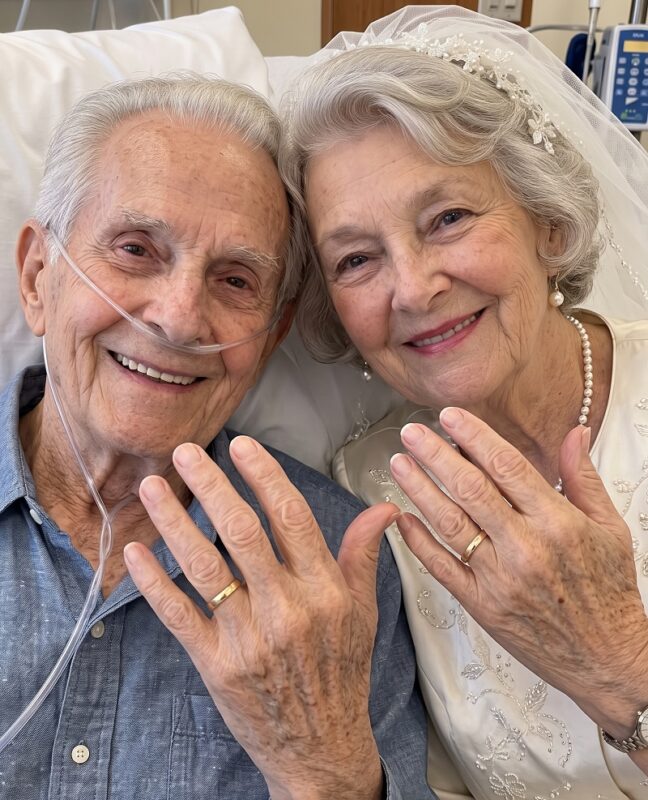
The doctors confirmed that Thomas was mentally capable of making his own decisions. His lawyer prepared the necessary paperwork, and the hospital administrator gave us permission to hold the ceremony in a small family lounge.
The nurses decorated the room with white paper flowers. One of the doctors brought a cake. My former charge nurse helped me find a pale blue dress.
Thomas wore a dark suit that hung loosely on his weakened frame.
When I entered the room, his eyes filled with tears.
“You are beautiful,” he said.
“So are you.”
“That illness has clearly affected your eyesight.”
Everyone laughed.
Our ceremony was small, but it was perfect.
Thomas held my hands as we exchanged vows. His voice shook, yet every word was clear.
“I loved you when we were seventeen,” he said. “I loved you through every year we were apart. And I will love you through whatever comes next.”
When it was my turn, I struggled to speak.
“I once believed leaving you was the price I had to pay to follow my calling,” I said. “Now I understand that love should never have been treated as an obstacle. I cannot return the years we lost, but I promise to fill every day we have left with the truth I should have spoken long ago.”
I leaned closer.
“I love you, Thomas.”
His eyes closed briefly.
“I have waited fifty-six years to hear that.”

Thirty Days as His Wife
Thomas lived for one month after our wedding.
Those thirty days became some of the most precious days of my life.
When he was strong enough, we sat in the hospital garden. He would point to passing couples and invent stories about them.
“That man forgot their anniversary,” he whispered once.
“How could you possibly know that?”
“Look at the size of the flowers. Those are apology flowers.”
On difficult days, I sat beside him and read aloud. Sometimes he fell asleep while holding my hand.
We spoke about the life we might have had.
Strangely, those conversations were not bitter.
We imagined the house we would have shared. Thomas insisted we would have argued about the color of the kitchen walls. I told him he would have spoiled our imaginary children.
“Absolutely,” he said. “And the grandchildren would have been even worse.”
One evening, he became unusually serious.
“Promise me you won’t stop living when I’m gone.”
“I don’t know how to say goodbye to you again.”
“This time is different,” he said. “The first time, you walked away thinking love had ended. This time, you’ll know it didn’t.”
He asked me to promise.
Eventually, I did.
The Final Morning
Thomas passed away early on a Sunday morning.
There was no dramatic speech. No final declaration.
I sat beside him with my head resting near his shoulder, our hands joined beneath the blanket.
Just before sunrise, he opened his eyes.
“Margaret?”
“I’m here.”
His gaze settled on my face.
“My wife,” he whispered.
Then he smiled.
A few minutes later, he was gone.
I had spent decades helping families through loss, but professional experience did not protect me from grief.
At the funeral, the church was filled with people Thomas had helped.
Former employees spoke about how he had paid medical bills without taking credit. Scholarship recipients described handwritten notes encouraging them to continue their education. Local business owners remembered how he had saved jobs during difficult years.
I realized Thomas had lived a much larger life than I had known.
Yet when I returned to my small cottage after the service, I felt completely alone.
I removed my wedding ring and placed it on the kitchen table.
Then I picked it up again.
I could not bear to take it off.
The Knock at My Door
The following afternoon, someone knocked.
A tall man in a gray suit stood outside holding a wooden box.
I recognized him as Thomas’s attorney, Henry Cole. He had attended our wedding and the funeral.
“Mrs. Bennett,” he said.
The name still startled me.
“Please come in.”
Henry entered and placed the box on my table.
For a moment, he simply looked at me.
Then he smiled.
“Thomas was right,” he said. “You finally walked straight into his trap.”
My entire body went cold.
“His what?”
“His trap.”
I stared at him.
Suddenly, doubts rushed into my mind.
Had Thomas hidden something from me? Had the marriage been connected to a debt? Had I signed something without understanding it?
“I don’t know what you’re talking about.”
Henry’s expression softened.
“It was not a cruel trap, Margaret.”
He pushed the box toward me.
“Thomas said those exact words when he gave me this. He told me you were stubborn, independent, and incapable of accepting help unless someone gave you no opportunity to refuse.”
My hands began to shake.
“What did he do?”
“Open the box.”
What Thomas Had Hidden
The wooden lid creaked softly.
At the top lay a bundle of envelopes tied with a faded blue ribbon.
Every envelope had my name on it.
Some were yellow with age. Others looked almost new.
I lifted the first one.
The date was from fifty-six years earlier, only two weeks after I had left Willowbrook.
I opened it.
“Dear Margaret,
I promised myself I would not write, but I have already broken that promise. The town feels empty without you. I am still angry, but anger has not made me love you less.”
There were dozens of letters.
One for every year we had been apart.
Thomas had written about his life, his business, his parents, and the places he visited. He had written on my birthday every year, though he never knew where to send the letters.
I pressed them to my chest.
Beneath the letters was a small black box.
When I opened it, I screamed.
Inside was a diamond ring.
Not the simple wedding band Thomas had given me at the hospital.
This ring was older. The design was delicate, and the metal had softened with time.
A small note rested beneath it.
“I bought this when we were seventeen. I planned to ask you to marry me after graduation. I kept it because some dreams refuse to die.”
I began sobbing.
But Henry gently touched the wooden box.
“There is more.”
Beneath the ring was a brass key, a photograph of Thomas’s childhood home, and a thick folder of legal documents.
I unfolded the first page.
My eyes moved across the words, but my mind refused to understand them.
Thomas had left me his house on Willow Street.
He had also left me a personal trust worth two million dollars.
I dropped the papers.
“This cannot be right.”
“It is.”
“I didn’t marry him for money.”
“He knew that.”
“I never even knew he had this kind of money.”
“That was precisely why he waited until now to tell you.”
I looked deeper into the box and found another folder.
This one contained architectural drawings for a large care facility.
Across the top were the words:
THE MARGARET BENNETT HOUSE FOR COMPASSIONATE CARE
My breath caught.
“What is this?”
Henry sat across from me.
“Thomas sold his company for far more than most people knew. He placed the majority of the proceeds into a charitable trust. The trust is worth approximately eight million dollars.”
I stared at him.
“He wanted to build a residential care center for elderly and terminally ill patients who could not afford private care,” Henry continued. “A place where no one would have to face illness alone.”
“Why is my name on it?”
“Because he wanted you to lead it.”

Thomas’s Real Trap
I shook my head.
“I’m seventy-three.”
“You are also one of the most experienced nurses in this county.”
“I’m grieving.”
“Thomas knew you would be.”
“I cannot manage an eight-million-dollar project.”
“You will have an experienced board, an administrator, and financial advisers. Thomas did not expect you to build it alone.”
Henry handed me a sealed letter.
“He expected you to argue. This explains everything.”
I opened it.
“My dearest Margaret,
By now, Henry has told you that you walked into my trap. Please do not be angry with him. Those were my words.
You spent your life caring for people who had no one else. You gave your strength to strangers, your sleep to frightened families, and your kindness to patients who may never have remembered your name.
But you never learned how to let anyone care for you.
Had I offered you money, you would have refused. Had I offered you a house, you would have called it charity. Had I told you about the care center, you would have insisted someone younger and more important should lead it.
So I trapped you.
I married the woman I loved, gave her the security she deserved, and left her a reason to wake up in the morning after I was gone.”
I covered my mouth as tears ran down my face.
The letter continued.
“The marriage was never a trick. It was the truest wish of my life. But it was not my only wish.
My final wish is that you stop believing your life is almost over.
We lost fifty-six years. Do not lose the years you still have.
Open the house. Build the center. Fill it with warmth. Sit on the porch when the work becomes too much. And whenever you think you are alone, remember that somewhere beyond your sight, a stubborn seventeen-year-old boy is still waiting for you.
Forever yours,
Thomas”
The House on Willow Street
Two days later, Henry drove me to Thomas’s house.
It stood at the end of Willow Street, surrounded by enormous trees. I remembered seeing it when we were teenagers, though I had never gone inside.
The brass key from the box opened the front door.
The house was quiet but beautifully maintained.
In the living room, a framed photograph rested above the fireplace.
It showed Thomas and me at seventeen, sitting beneath the oak tree outside our high school.
I had forgotten the photograph existed.
Beside it was a more recent picture from our hospital wedding.
The two images sat together—our beginning and our ending.
Or perhaps our second beginning.
Upstairs, I found a room filled with files, plans, and medical-care research. Thomas had been planning the center for almost ten years.
He had studied staffing needs, patient costs, government requirements, and possible partnerships with the hospital.
This was not a dying man’s impulsive idea.
It was a carefully designed legacy.
On his desk stood another note.
I knew you would come here. The porch still needs someone to argue about the flowerpots.
For the first time since his death, I laughed.
A Reason to Keep Living
At first, I wanted to refuse everything.
The responsibility frightened me. The money felt overwhelming. I worried that people would think I had married Thomas to inherit his fortune.
Some people did whisper.
Small towns always produce whispers.
But the people who had known Thomas defended me.
“He trusted her,” one former employee said at a town meeting. “That is enough for me.”
The hospital offered to partner with the foundation. Several retired nurses volunteered. A local contractor agreed to renovate an abandoned building at reduced cost.
Gradually, Thomas’s dream became ours.
Construction took eighteen months.
I attended every planning meeting. I chose warm lighting instead of harsh hospital fixtures. I insisted each room have a window. We created gardens, family kitchens, and comfortable spaces where relatives could stay overnight.
No one would feel like a forgotten patient.
They would feel like a person whose life still mattered.
On opening day, more than three hundred people gathered outside.
A blue ribbon stretched across the entrance.
Above it, the sign read:
THE BENNETT HOUSE FOR COMPASSIONATE CARE
I had asked the board to remove my first name.
Thomas’s gift was not supposed to be a monument to me.
It was supposed to be a home for everyone.
Before cutting the ribbon, I told the crowd about the boy I had loved at seventeen and the man I married at seventy-three.
“I believed Thomas’s last wish was to make me his wife,” I said. “But I was wrong. His last wish was to remind me—and all of us—that it is never too late to love, to forgive, or to begin again.”
The Life He Left Me
Today, I am seventy-six.
Bennett House has cared for more than two hundred patients and their families.
I still live in Thomas’s home on Willow Street. Every spring, I plant wildflowers because they remind me of the bouquets he brought when he was late for our dates.
His letters are kept in the wooden box beside my bed.
I read one every Sunday.
Sometimes they make me cry. Sometimes they make me laugh. Mostly, they remind me that love can survive silence, distance, pride, and even death.
I wear the diamond ring Thomas bought when we were seventeen on my right hand.
My wedding band remains on my left.
People occasionally ask whether I regret the years we lost.
Of course I do.
But regret is a room without windows. Thomas did not leave me a house, a fortune, and a mission so I could spend the rest of my life trapped inside it.
He gave me a door.
He gave me a key.
And yes, his lawyer was right.
I walked straight into Thomas’s trap.
It was a trap built from fifty-six years of love, a box full of unsent letters, and one final plan to make sure I would never again choose fear over life.
I thought I was granting a dying man his last wish.
In truth, Thomas was granting mine.
He gave me the chance to be loved completely—even if only for thirty days.
Then he gave me a reason to keep that love alive for many years to come.
Note: This story is a work of fiction inspired by real events. Names, characters, and details have been altered. Any resemblance is coincidental. The author and publisher disclaim accuracy, liability, and responsibility for interpretations or reliance. All images are for illustration purposes only.