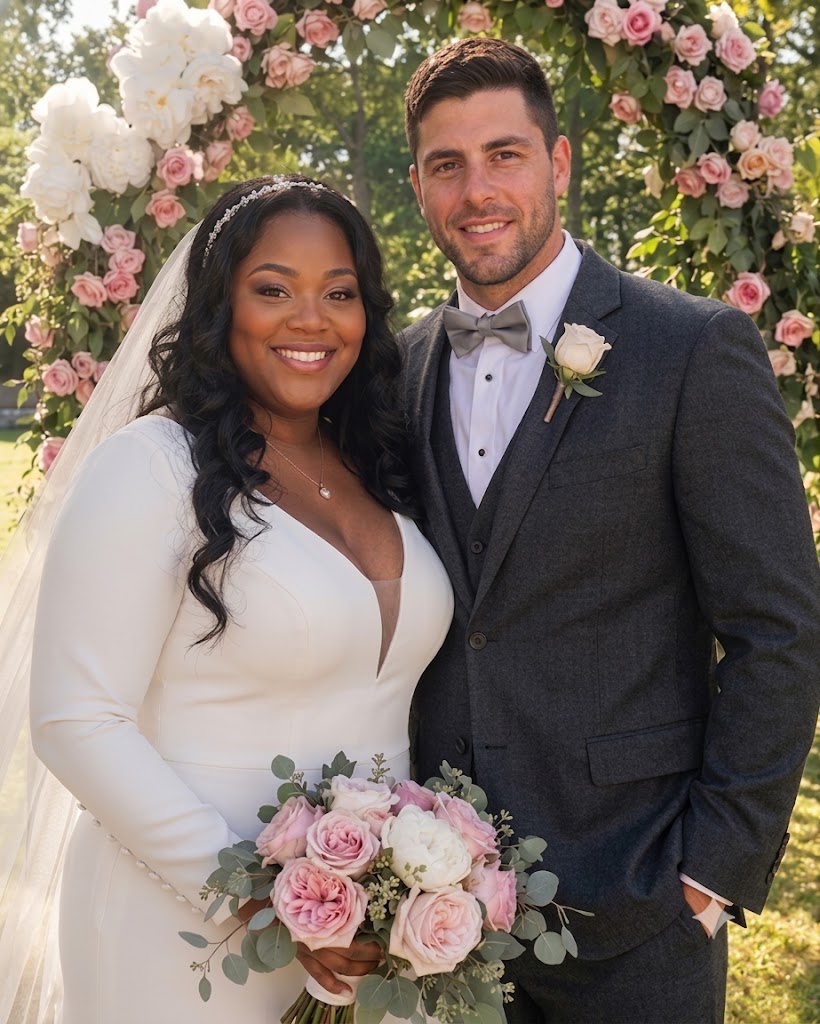
On the night I finally became the wife of the man who had spent years hurting me, I turned around expecting a kiss—and found him holding an envelope that changed everything.
The Maldivian dusk turned the ocean into hammered gold, and the balcony rail was still warm under my palms. I stood there in the soft white dress from the reception, salt in my hair, listening to the waves fold over themselves as if they had all the time in the world.
Two years ago, I would have laughed at anyone who told me I’d be here as Carter’s wife. Carter, who had torn my sketchbook in half in the fifth grade and thrown the pieces into a puddle while I cried. Carter, whose mother, Vivienne, once stood on her manicured lawn and told my father, “Please keep your daughter off the grass. It stains.”
“You’re smiling like an idiot,” Danielle had teased me that morning, straightening my veil.
“I’m allowed.”
“You are. Just don’t forget who you were before all this.”
I hadn’t forgotten. That was the strange part. I remembered every hand-me-down sweater Carter mocked, every rumor that emptied a lunch table around me. And then I remembered the night, two years ago, at a mutual friend’s birthday, when he came back to town thinner, quieter, with a gravity about him I couldn’t place. He cornered me gently by the drinks table, eyes wet.
“I know I have no right to speak to you,” he said. “But I couldn’t let another year go by without telling you I was a monster, and I’m sorry.”
“You think an apology fixes ten years?”
“No,” he said. “I don’t. I just needed you to hear it once from someone who meant it.”
He had meant it. Or I believed he did. He remembered how I took my coffee, two sugars, a splash of oat milk. At our engagement dinner, a single white peony sat beside my plate, my late grandmother’s favorite — a flower I had mentioned exactly once, in passing. Everything he did carried a strange urgency, as though a clock only he could hear was ticking somewhere behind his ribs.
“Why the rush, sweetheart?” my mother had asked, cautious, when we announced the date.
“He just knows what he wants, Mom.”
“People who know what they want don’t usually run this fast.”
I let her calls go to voicemail for a week after that, and by the time I picked up again, we both knew better than to circle back to it.
Vivienne ran faster. The woman who had once treated me like a stain on her lawn suddenly embraced me at brunches, and paid for the entire wedding. Even Carter’s cousins had raised eyebrows.
I hadn’t. I had wanted, so badly, to be chosen by the house next door that I stopped asking questions.
I turned from the balcony now, ready for his arms. Carter stood rigidly by the bed instead. The warm smile he had worn for two years was gone, his face pale as the linen behind him. In his hand was an envelope, and the way he looked at me made the ocean behind me go silent.
“Sit down. Please.”
I lowered myself to the edge of the bed. The white silk of my dress pooled around me, still smelling faintly of the ocean and champagne.
“Two years ago,” he began, “I was told I was dying. A neurological disease. The same one that took my father before forty. They gave me a handful of good years, maybe fewer.”
His hand shook as he opened the envelope and laid the pages on the bedspread. A clinic letterhead. A genetic report. Appointment cards fanned out like the world’s worst hand.
“That’s why I came home,” Carter said. “That’s why I found you at the party. I thought I had a debt to close before I ran out of time. Apologizing to you was supposed to be one item on a list.”
I stared at him. “One item,” I repeated.
“You were never supposed to be the whole list.” He met my eyes and looked away. “But you were. Within a month, you were.”
“Six weeks ago,” he said quietly, “I learned something that changed everything I believed about the last two years.”
“What?”
He pushed the second folder across the bed. “I need you to read this first.”
“What is it?”
“The reason I’m standing here.”
“Then explain it.”
“I can’t. If I start talking now, you’ll think every word is another lie.”
“Then why didn’t you tell me six weeks ago?”
He closed his eyes. “Because if I’d told you then, your parents would’ve paid for it.”
“What does that mean?”
“You’ll understand after you read the folder.”
Silence stretched between us.
“I don’t expect you to believe me,” he said. “I only ask you to read everything before you decide who I really am.”
If I opened that folder while he stood in front of me, he’d explain every page before I had the chance to decide what I believed. I needed to read it somewhere his voice couldn’t reach me. I stood up, gathered the papers, and walked toward the door.
“Where are you going?” Carter asked.
I did not answer, because I did not know whether I was running from him or toward the rest of the truth.
I did not fly home. I checked into a small room on the far side of the resort, closed the curtains, and spread every page from the envelope across the bedspread. For two days I read. Dates. Signatures. The letterhead of a clinic I had never heard of.
I called Danielle on the second morning. “I need you here,” I said.
“I’m already at the airport,” she answered. “Don’t say another word until I’m holding your hand.”
Before we hung up, I told her the doctor’s name. Months earlier, I’d photographed Vivienne’s gala program — the one she’d proudly mailed me at Christmas — and saved it with everything else she’d ever sent me.
Danielle pulled the corporate filings during her layover. By that night, she was sitting cross-legged on my bed, reading through the documents.
“Look at this doctor. Now look at the charity board from Vivienne’s gala.”
Same name.
Danielle read every page twice. Finally she looked up. “Sofi… I don’t think these papers prove Carter lied.”
“They prove someone did.”
“Why?”
“Because none of this proves the diagnosis was real. And none of it proves Carter knew it wasn’t.”
“Who?”
“That’s what we still don’t know.” She closed the folder.
I looked down at the stack of documents. For the first time, I couldn’t think of a single excuse to hand him.
I met Carter on the beach at sunrise, barefoot, in a dress that was not mine anymore. I handed him the printouts without a word.
“There was no disease,” I said. “Was there.”
“I didn’t know.”
“Know what?”
“That the diagnosis wasn’t real.”
“Then why didn’t you tell me six weeks ago?”
“Because by then my mother owned your parents’ mortgage.”
“What?”
“She threatened to ruin them if I walked away.”
“How do you know all this now?”
“Because after you left, I confronted her.”
“And?”
“She finally stopped pretending.”
“Tell me the rest.”
He stared at the sand for a long time. “My mother paid that doctor two years ago,” he said. “Not to invent a disease. To make sure I never saw the real report. A dying son doesn’t argue. He agrees to the wedding she picks. He told me I carried the same mutation that killed my father. I never questioned it. Why would I? I believed every word.”
“Why a wedding at all?”
“The trust,” he said. “It only passes to me if I’m legally married before I turn twenty-seven. So she stopped caring who the bride was. She just needed the ceremony on the record.”
The tide pushed cold water over my feet, and I could not feel it.
“You believed you were dying for two years,” I said.
“Yes.”
“And the second specialist?”
“He asked to see the original laboratory data. The clinic couldn’t produce it.”
For a heartbeat, I wasn’t standing on the beach anymore. I was back in my mother’s kitchen, hearing her quiet warning: People who know what they want don’t usually run this fast.
I’d buried those words because I wanted this family to choose me. I had mistaken every grand gesture for love and every apology for proof people could change. I hadn’t ignored the warning signs. I’d chosen not to believe them.
“So you walked me down the aisle instead.”
“I thought I was buying time,” he said, his voice breaking. “If I could get your parents out from under her first, then I could tell you everything. I kept telling myself six more days, three more days, one more day. I convinced myself that saving them first was the least unforgivable choice.”
I stared at him. “Do you hear yourself?”
He closed his eyes. “I was a coward.”
“You were worse than that.”
He did not argue.
“You know what a man who loved me would have done, Carter?” I asked. “The day that second report came in. Not after the vows. Not after your mother wrote the check.”
“I know.”
“He would’ve burned it all down instead of handing me an envelope on a balcony and calling it honesty.”
Carter’s eyes filled. I did not soften.
“I’m filing for an annulment tomorrow. Fraud voids the marriage as if it never happened. Your birthday is in 18 days. No valid marriage, no trust. Your mother’s check bought her nothing.”
He nodded, as though he’d already accepted the verdict. “What will you do about my mother?” he asked.
I looked past him at the impossible blue ocean. “She paid for a show,” I said. “I’m going to give her one.”
I turned and walked up the beach, leaving him alone with the tide and the pages.
I did not sleep much that night.
Danielle spread the documents across the table one last time before we flew home.
“There’s enough here to ask questions,” she said. “I’m just not sure there’s enough to make people believe the answers.”
“It’s the truth.”
“I know.” She closed the folder. “But Vivienne has spent a lifetime making people believe her version of it. Don’t make this about accusations. Make it about facts. Let the dates speak.”
Back in my room, I slipped off my wedding ring. For a moment, I remembered the man who brought me coffee exactly the way I liked it, who remembered my grandmother’s favorite flower. What if that part had been real?
The thought lasted only a second. Love wasn’t measured by what he felt. It was measured by what he chose. I left the ring on the nightstand.
I didn’t file for an annulment the next morning. I waited two weeks. I accepted Vivienne’s brunch invitation and sent Carter one text: Be there. Say nothing.
Okay, he replied.
Vivienne had gathered her social circle to parade her newlyweds. I wore the same wedding dress. Carter stood beside his mother, exactly where she’d placed him.
In my clutch was a note from Carter’s estranged Aunt Marlene that had reached me at the resort after his confession: Call me if you ever need to. I had.
When Vivienne raised her glass for the welcome toast, I stepped to the microphone.
“Thank you all for coming,” I said. “I’d like to read a few dates.”
I read the date of Carter’s diagnosis. The clinic renovation funded by Vivienne’s shell company. The trust deadline. The second specialist’s report six weeks before the wedding.
I didn’t accuse. I let the dates speak.
“Vivienne,” I said, turning to her, “thank you for paying for the most educational year of my life. There will be an annulment.”
I handed the folder to Marlene, who had waited decades for someone brave enough. She opened it without flinching.
“Darling, this is hardly the place,” Vivienne began.
The room had already turned. Guests gathered coats. Small, mortified clusters drifted toward the doors.
Carter did not defend her. He did not defend himself.
“I’m sorry,” he said quietly. “For all of it. From the sketchbook forward.”
I nodded once. That apology, unlike the first one, had cost him something.
Then I walked out.
Months later, I sat in my parents’ kitchen over Sunday coffee. My old sketchbook rested on the table, its cover softened with age. My mother poured a second cup and quietly left the room, just as she had when I was little and needed space.
I opened to the first blank page and picked up my pencil. After a long moment, I drew a single line.
One line. Mine.
For the first time since fifth grade, the page no longer felt like something someone else could ruin. I added another line, then a window opening onto a horizon that didn’t belong to the house next door.
Outside, life moved on. Vivienne’s social standing had quietly collapsed. The trust deadline had passed. I heard Carter had cut ties with his mother. His one letter remained unopened on the counter.
I hadn’t needed a Prince Charming. I had needed to stop mistaking apologies for love, urgency for devotion, and performances for safety.
I turned the page and started again.