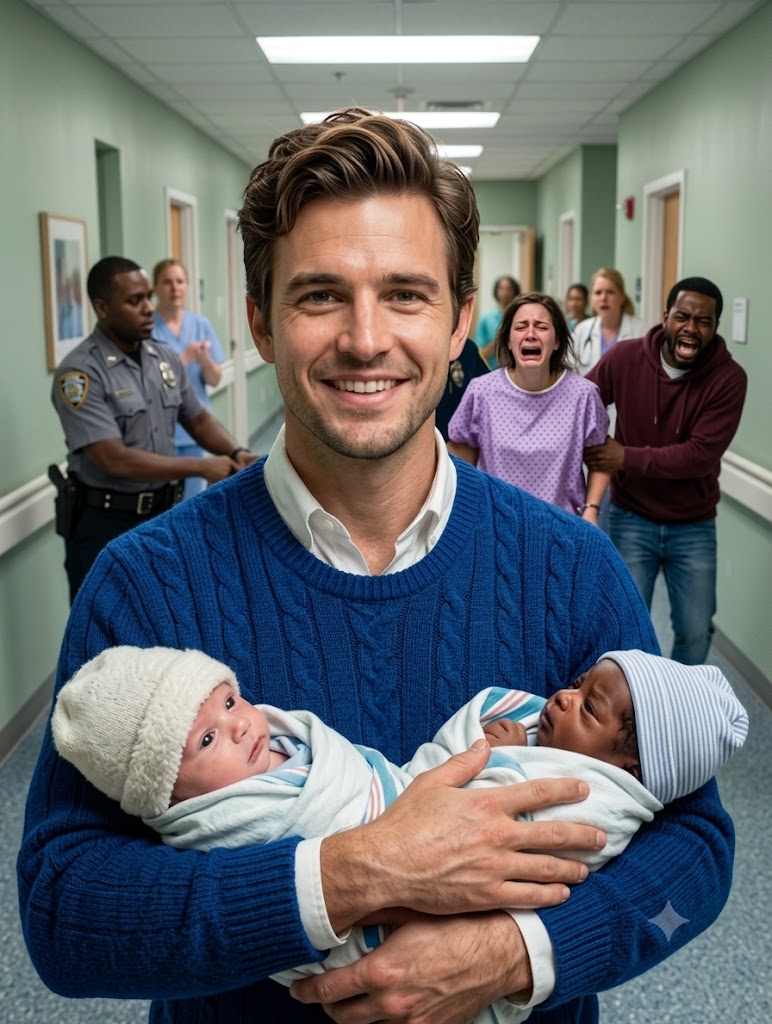
Part 1: The Family We Almost Gave Up On
After three lost pregnancies, my wife finally gave birth to twin boys.
One was pale, with soft blond hair like mine.
The other had warm brown skin, dark curls, and deep brown eyes.
My mother-in-law took one look at them and screamed that my wife had cheated.
Six months later, a DNA test proved something even more impossible: I was the biological father of both babies, but according to the laboratory, my wife wasn’t the mother of one of them.
My name is Michael Turner, and before all of this happened, I thought I understood what made someone family. I was wrong.
Anna and I had dreamed about becoming parents almost from the moment we got married. We talked about baby names during long car rides, saved listings for houses with backyards, and Anna bought a tiny pair of yellow socks before we had even started trying. She kept them in the top drawer of our dresser.
“For luck,” she always said.
But luck seemed determined to avoid us. The first pregnancy ended before we had even told our families. The second lasted long enough for us to hear a heartbeat. The third nearly destroyed us.
Afterward, Anna stopped opening the nursery door. I stopped knowing what to say when I found her crying in the shower. We went to specialists, endured endless appointments, and listened to doctors explain percentages until our future sounded more like a math problem than a life.
At night, Anna would lie beside me and whisper, “Maybe I’m not supposed to be a mother.”
I always took her hand. “You already have the heart of one. We’ll find our way.”
Still, there were days when grief made us strangers.
Then, almost two years after our third loss, Anna became pregnant again. We were afraid to celebrate. We didn’t buy clothes or choose names. At the eight-week appointment, the doctor smiled and turned the monitor toward us.
“There are two heartbeats.”
Anna covered her mouth. I stared at the screen until everything blurred. For the first time in years, our tears were joyful.
When she made it through the first trimester, we finally let ourselves believe. We painted the nursery a soft shade of green, assembled two cribs, and Anna placed the yellow socks in a small frame between them. Our boys were coming home.
We had no idea that the delivery room would become the beginning of a nightmare.
Part 2: The Moment the Room Turned Cold
Anna went into labor three weeks early. The delivery was difficult, and the doctors decided to perform an emergency C-section when one of the babies showed signs of distress.
Anna’s mother, Eleanor, had insisted on being at the hospital. Eleanor came from an old, wealthy family and carried herself as though every room belonged to her. She cared deeply about appearances—family names, private schools, country clubs, and what other people might whisper behind closed doors. She had never thought I was good enough for Anna. I was a public-school science teacher, and Eleanor once introduced me at a charity dinner as “Anna’s little husband,” as if I were a temporary accessory.
But that day, I only cared about Anna and our sons.
Our first baby arrived crying. The nurse held him up, and I saw pale skin, a tiny red face, and wisps of light hair.
“Owen,” I whispered. It was the name Anna and I had chosen only days earlier.
Then the second baby was delivered. For a few seconds, no one said anything. The silence was so sudden that it frightened me more than a scream would have.
Then Eleanor gasped. “That isn’t her baby.”
The nurse looked at her in confusion. “Ma’am, please step back.”
“There’s been a mistake!” Eleanor shouted. “You switched them!”
Anna was exhausted, shaking under the hospital lights as the nurses placed both babies near her. “What is she talking about?” I asked.
Eleanor pointed at our second son. His skin was several shades darker than Owen’s, and his hair was black and tightly curled. He was beautiful, but in that first shocked moment, I froze.
Eleanor saw my expression and attacked. “Look at him, Michael! Open your eyes! That child cannot possibly be yours.”
“Mom, stop,” Anna begged.
“I will not stop! You have humiliated this family!”
Anna began to sob. “Don’t listen to her. Please, Michael. Don’t look at me like that. I’ve only ever loved you. I never betrayed you. They’re both yours. I swear they are.”
Eleanor leaned closer to me. “Demand a paternity test before you sign anything.”
“Get out,” I said.
She blinked. “What?”
“I said get out of this room.”
Hospital security escorted her into the hallway while nurses tried to calm Anna.
I held both boys that night. Owen slept against my left arm, while his brother rested against my right. We named him Caleb. I studied their tiny faces until sunrise. They had the same nose, the same chin, and the same little crease above the left eyebrow. Yet Eleanor’s accusation echoed in my head.
I hated myself for wondering. I hated myself even more for agreeing to the test.
Part 3: The First DNA Test
Anna didn’t try to stop me. That somehow made it worse.
“If you need the test, do it,” she said quietly. “I know what it will say.”
The hospital took samples from me and both boys, and the staff investigated the possibility of an accidental switch. The identification bands matched, the footprints matched, and the delivery-room records were clear. Both babies had come from Anna.
Several days later, the paternity results arrived. The probability that I was Owen’s biological father was greater than 99.9 percent. The probability that I was Caleb’s biological father was also greater than 99.9 percent.
I read the report three times, then sat beside Anna on the hospital bed and cried. “I’m sorry,” I said.
She looked at me for a long moment, then touched my face. “You stayed. That matters.”
A genetic counselor explained that siblings could inherit very different combinations of genes and that distant ancestry could sometimes appear unexpectedly. It was unusual, especially in twins, but not impossible. We accepted that explanation because we needed to. More importantly, both boys were ours.
Eleanor never apologized. Instead, she claimed the laboratory had probably made a mistake. Anna stopped speaking to her for several weeks, but Eleanor gradually returned with gifts, expensive blankets, and carefully controlled smiles. She treated Owen like a prince, but with Caleb, she was distant. She never held him unless someone was watching. I noticed, and so did Anna, but we were too exhausted and happy to begin another battle.
For six months, our home became the loud, sleepless, wonderful place we had once feared we would never have. Owen was serious and observant, while Caleb smiled at everyone. If Owen cried, Caleb cried too. If Caleb laughed, Owen kicked his feet as though he understood the joke. They slept facing each other in their cribs and reached for each other during feedings. Whatever anyone else saw when they looked at them, I saw brothers—my sons.
Then Caleb stopped eating. At first, we thought it was a stomach bug, but he became pale beneath his brown skin, and small bruises appeared on his legs. The pediatrician ordered blood tests, and that evening we received the call every parent fears: “Take him to the hospital immediately.”
Part 4: The Second Test
Caleb’s bone marrow was failing. The doctors explained that his body wasn’t producing enough healthy blood cells. Medication might slow the illness, but his best chance was a bone marrow transplant.
Testing began immediately. Owen wasn’t a suitable match, but I was—not a perfect match, but close enough that the transplant team believed I could be his donor.
Anna squeezed my hand when the doctor told us. “Then we do it,” I said. “Whatever he needs.”
Because Caleb’s condition might have a genetic cause, the medical team ordered broader testing on all four of us. Two days later, we were asked to meet with a geneticist named Dr. Patel. She closed the door before sitting down. That detail frightened me; doctors only close doors when the truth is too heavy for a hallway.
“Mr. and Mrs. Turner,” she began, “we received an unexpected result.”
“Is it the transplant?” Anna asked. “Can Michael still donate?”
“Yes. His compatibility result remains unchanged.”
I exhaled. “Then what’s wrong?”
Dr. Patel placed a report on the desk. “Michael is Caleb’s biological father. We confirmed that finding through two independent laboratories.”
Anna nodded quickly. “We already knew that.”
Dr. Patel looked at her. “The problem concerns your sample. The markers in your blood and cheek swab do not establish a maternal relationship with Caleb.”
I stared at the doctor. “What does that mean?”
“It means that based on the samples tested, Anna is not Caleb’s genetic mother.”
For several seconds, the words meant nothing. “That’s impossible,” I said. “I watched her give birth to him. He was never out of our sight.”
“We reviewed the hospital records.”
Anna’s face had lost all color. “What about Owen?” she whispered.
“Owen’s results confirm that you are his biological mother.”
Anna stood so abruptly that her chair fell backward. “No!”
“Anna—”
“No! They grew inside me together. I felt both of them. I saw them on every ultrasound.”
Dr. Patel spoke gently. “We have repeated the tests. Before we draw conclusions, we need samples from other tissues. Blood and cheek cells do not always tell the entire genetic story.”
“What are you saying?” I demanded.
“I’m saying there may be a rare medical explanation. But we need more information.”
That afternoon, I found Anna in Caleb’s hospital room, holding him against her chest. “He knows me,” she said. “Look at him. He knows I’m his mother.”
“Of course he does.”
“But the paper says—”
“I don’t care what the paper says.” I knelt beside her. “You carried him. You loved him before he had a name. You stayed awake when he couldn’t sleep. You know which cry means he’s hungry and which one means he wants to be held. No test can erase that.”
She pressed her lips to Caleb’s head. But behind her tears, I saw something else: fear, recognition. Anna knew more than she was telling me.
Part 5: Eleanor’s Offer
Eleanor arrived at our house the next morning carrying a leather folder and a cashier’s check. Anna was still at the hospital with Caleb, while I had come home to shower and collect clothes. Eleanor walked into the kitchen without being invited.
“I heard about the test,” she said.
“How?”
“I have friends on the hospital board.”
I felt my anger rise. “You had no right to access our private information.”
“This is no longer private. It is a disaster.”
“My son is sick.”
“That is unfortunate.” She said it as if Caleb were a damaged piece of furniture.
She placed the leather folder on the table. Inside were divorce papers and a cashier’s check for two million dollars.
I stared at her. “What is this?”
“A solution.”
“To what?”
“Take Owen and leave quietly. The money will give you both a comfortable life.”
I couldn’t believe what I was hearing. “And Anna?”
“She’ll recover eventually.”
“What about Caleb?”
Her mouth tightened. “That child is not Anna’s. Whatever mistake produced him is not our responsibility.”
I stepped toward her. “He is six months old.”
“He is evidence of a scandal.”
“He is your grandson.”
“No,” she said coldly. “Owen is my grandson.”
I tore the check in half. Eleanor’s eyes widened. Then I tore the divorce papers. “You need to leave.”
“You’re making an emotional decision.”
“I am making a decision as a father.”
She leaned closer. “You don’t understand the damage this could do to Anna’s name.”
“I don’t care about her name. I care about her life.”
For the first time, Eleanor lost control. “You have no idea what that child represents!”
The room went silent. I studied her face. “You know.”
Her expression changed. It was only for a second, but I saw it. She knew exactly how Caleb could be my son without appearing genetically related to Anna.
Before I could question her, the front door opened. Anna stood there, holding an overnight bag. She had heard enough.
Her mother turned toward her. “Tell him to accept the offer.”
Anna looked at the torn check, then at Eleanor. “Get out of my house.”
“You will regret this.”
“I regret every year I spent being afraid of you.”
Eleanor stepped closer. “I warned you what would happen if you told anyone.”
I looked between them. “What is she talking about?”
Anna closed her eyes, and Eleanor walked out without answering.
That evening, after we returned from the hospital, Anna disappeared into our bedroom. I found her sitting on the cold floor of our closet, surrounded by old shoeboxes. In her hands was a crumbling leather-bound diary and a small digital audio recorder.
“I can’t keep this from you anymore,” she whispered. “My mother promised she would destroy us if I ever breathed a word of it. She told me it was better to let people think I was unfaithful than to let them know the truth.”
“The truth about what?”
She handed me the diary. “About who I am.”
Part 6: The Secret Inside Anna’s Body
The diary had belonged to Anna’s grandmother, Margaret. A ribbon marked a page dated thirty-four years earlier. I began to read:
Eleanor called tonight. She is terrified someone will learn what Dr. Vale did. She paid him to ensure that her final fertility treatment succeeded. He transferred her embryo along with another couple’s embryo, without their permission. One embryo belonged to Eleanor and Richard. The other belonged to a young Black couple named Denise and Malcolm Carter.
I stopped breathing. The next sentence made the room spin:
The doctors now believe the two embryos did not develop into twins. They fused, becoming one child: Anna.
My legs gave out, and I dropped to my knees. “How is this possible?”
Anna hugged her arms around herself. “When I was sixteen, I had surgery to remove an ovarian cyst. The hospital found two different blood-cell patterns in my tissue. Mom pulled me out of school for a month and took me to specialists in another state. They said I was a chimera.”
I had heard the word in mythology—a creature made from different beings. But this was real.
Anna continued. “The specialist explained that two early embryos had fused in my mother’s womb. Instead of becoming twins, they became one baby—me. Different parts of my body carried different DNA.”
“Why didn’t you tell me?”
“I was sixteen. I barely understood it. Mom said the other embryo had been donated legally. She made it sound like an embarrassing medical accident.” Anna picked up the audio recorder. “Grandma Margaret later told me that wasn’t true. She had recorded Mom confessing during an argument.”
Anna pressed a button. Static filled the room, and then Eleanor’s younger voice emerged from the speaker: “I paid Vale to do whatever was necessary. He said the second embryo would increase my chances. I didn’t ask where it came from.”
Margaret’s voice answered: “You knew another family lost that embryo.”
“They were told the transfer failed.”
“And when Anna’s tests revealed the truth?”
“I protected her.”
“You protected your reputation.”
Then Eleanor said the words that chilled me: “If Anna ever tells anyone, people will question everything—her inheritance, her identity, the family foundation. I will not allow that.”
The recording ended. I looked at my wife.
“So part of your body carries DNA from Eleanor and Richard.”
“Yes.”
“And another part carries DNA from Denise and Malcolm Carter.”
“That’s what the doctors believed.”
“Your ovaries…”
Anna nodded slowly. “They said my reproductive cells could come from either genetic line.”
The explanation was extraordinary. When Anna released two eggs, one had come from each genetic cell line, and both had been fertilized by me. Owen’s maternal DNA came from the part of Anna descended from Eleanor and Richard. Caleb’s maternal DNA came from the part descended from Denise and Malcolm Carter.
That was why I was the biological father of both boys, why Anna’s blood and cheek cells matched Owen but not Caleb, and why the twins had such different appearances. Caleb had not been switched, and Anna had not cheated. She had carried two genetic histories inside her body her entire life.
Decades earlier, a fertility doctor had taken an embryo from another family without consent and used it in Eleanor’s treatment. Caleb was not a mistake; he was living evidence of what they had done.
Part 7: The Fight for Caleb
The next morning, we gave the diary and recording to Dr. Patel. She listened without interrupting, then ordered specialized testing using archived tissue from Anna’s past surgery, along with samples from her hair follicles and skin.
The results took several days. During that time, Caleb grew weaker. I began the preparation required to donate marrow, while Anna rarely left his room.
One night, I found her singing softly beside his crib. “I should have told you before we got married,” she said.
“You were threatened by your own mother.”
“I still hid it.”
“You hid a medical secret you had been taught to fear. You didn’t hide another man or another family.” I placed my hand over hers.
“What if he grows up and thinks I’m not really his mother?”
“Then we’ll tell him the truth.”
“What truth?”
“That families can be made in ways nobody expects. That you carried him. That I donated marrow to him. That his brother slept beside him every night he was in the hospital. And that when someone tried to call him a mistake, we chose him without hesitation.”
The specialized results arrived two days later. Dr. Patel showed us a chart containing two distinct genetic profiles: one matched Owen, and the other matched Caleb.
“You are what medicine calls a tetragametic chimera,” she told Anna. “This happens when two early embryos combine and develop as one person.”
“So Caleb is mine?” Anna asked.
Dr. Patel smiled. “He came from one of your eggs. You carried him and gave birth to him. Genetically, the egg originated from the second cell line in your body. The cheek sample simply came from the first.”
Anna began to cry. Dr. Patel reached across the desk. “There is no question that you are his mother.”
The transplant took place the following week. I remember the hospital gown, the bright lights, and the nurse asking me one last time whether I understood the procedure.
“I understand,” I said. “Help my son.”
Recovery wasn’t immediate, but slowly, Caleb’s blood counts began to rise. The first morning he smiled again, Anna laughed so loudly that a nurse came running into the room.
Owen visited whenever the doctors allowed it. The moment we placed him near Caleb, he reached through the crib bars and grabbed his brother’s hand. Even the nurses cried.
Part 8: The Other Family
With the help of an attorney and the old clinic’s archived records, investigators located Denise Carter. Malcolm had passed away several years earlier, but Denise was living in Maryland with her adult daughter, Simone.
Anna and I debated whether contacting them would cause more pain, but Denise deserved to know. We met in a quiet conference room at the hospital. Denise was in her late sixties, with silver threaded through her dark curls. Simone sat beside her.
Anna’s hands shook as she explained everything. When she finished, Denise remained silent, then took an old photograph from her purse showing a young couple standing outside a fertility clinic.
“We were told our final embryo stopped developing,” she said. “I blamed myself for years.”
Anna covered her mouth. “I’m so sorry.”
Denise looked at her. “You didn’t do this.” Then she asked to see Caleb.
We brought him into the room wearing a blue sweater and a tiny knit cap. Denise began to cry. She didn’t try to claim him or demand anything; she simply touched his hand.
“He has Malcolm’s eyes,” she whispered.
Anna broke down, and Denise pulled her into an embrace.
That moment changed all of us. The Carters didn’t replace our family; they became part of it. Simone joked that she might be the only woman in America who could truthfully call herself both Caleb’s biological aunt and his mother’s genetic sister. The science was complicated, but the love wasn’t.
Part 9: What Makes a Family
Eleanor denied everything until her own recorded voice was played during the legal investigation. The clinic had closed years earlier, and Dr. Vale was no longer alive, but surviving records showed that multiple patients had reported suspicious losses during the same period. Our case helped several families reopen questions they had been forced to bury.
Eleanor resigned from the family foundation and sent Anna letters asking for forgiveness. Anna returned every one unopened. Maybe one day that will change; maybe it won’t. Forgiveness cannot be demanded simply because the truth becomes inconvenient.
Today, Owen and Caleb are healthy, loud, curious little boys. Owen loves building towers and becomes furious when Caleb knocks them down. Caleb knocks them down anyway. They still sleep facing each other.
Sometimes strangers stare when they realize they’re twins, and a few people ask questions they have no right to ask. I no longer feel embarrassed; I simply say, “Yes, they’re brothers. Yes, they’re both ours.”
Because that is the truth. Caleb carries my DNA and a genetic history stolen from the Carter family. Owen carries my DNA and the genetic line most people expected to see. Anna carries both histories inside her.
But DNA is only one chapter. It doesn’t show the nights Anna slept in a hospital chair with Caleb against her chest, Owen reaching for his brother through the rails of a crib, Denise smiling at the little boy connected to the child she once believed she had lost forever, or the moment I tore up two million dollars because no amount of money could persuade me to abandon my son.
For years, Eleanor believed Caleb’s existence would destroy her family’s reputation. Instead, the truth destroyed only the lies. Our family survived—not because we shared the same skin color or because every laboratory result fit neatly onto a page, but because when fear told us to divide, we chose to stay together.
Three lost pregnancies had once made Anna believe she would never become a mother. Now, every night, two little voices call for her from the room across the hall, and every night, she goes to them.
Whatever the DNA once appeared to say, Anna was never a stranger to Caleb. She was his first home.