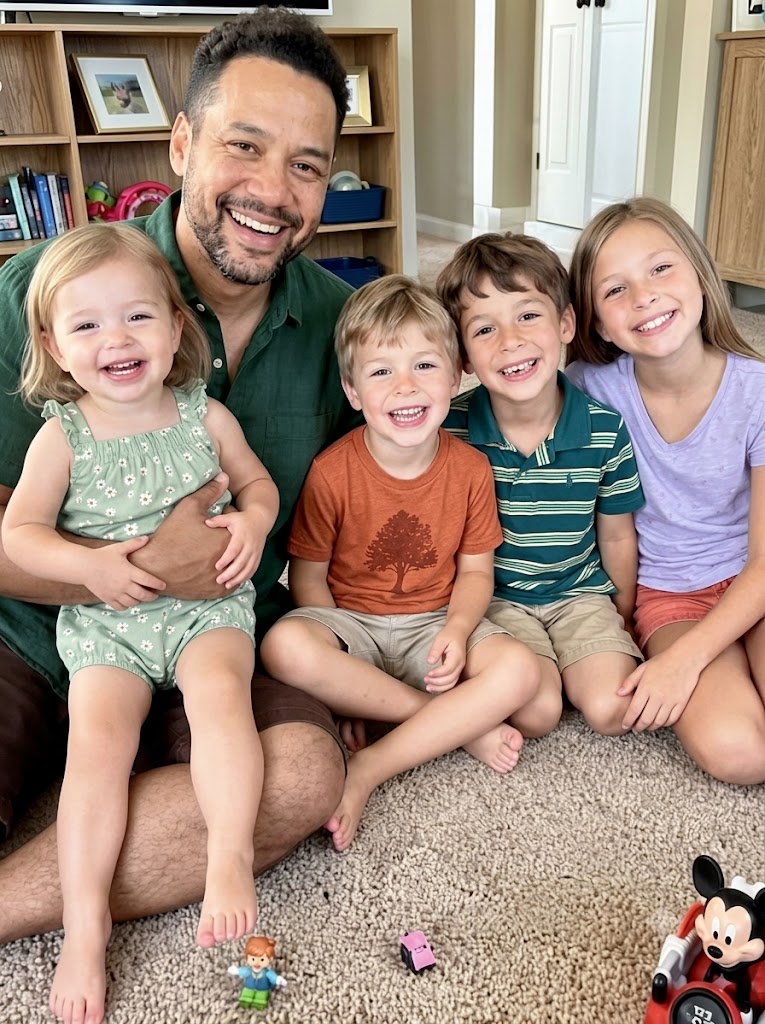
Part 1: The Woman on My Porch
A year after I adopted four children no one else was willing to keep together, a stranger appeared on my porch carrying a black leather briefcase.
She looked to be in her late fifties, dressed in a gray suit despite the summer heat. Her expression was calm, but there was something serious in her eyes.
“Good morning,” she said. “Are you Michael Turner?”
I kept one hand on the door.
“Yes.”
“And you adopted the four Harrison children?”
Before I could answer, a crash came from the kitchen, followed by three children shouting at once.
“Ben knocked it over!”
“I did not!”
“Sophie pushed me!”
The woman glanced past me, and for the first time, her expression softened.
“I suppose that answers my question,” she said.
I stepped onto the porch and pulled the door nearly closed behind me.
“Who are you?”
She opened the briefcase and removed a thick envelope.
“My name is Evelyn Brooks. I was the attorney for Daniel and Claire Harrison—the children’s biological parents.”
My chest tightened.
The children rarely spoke about the months surrounding their parents’ deaths. I knew only what the caseworker had been allowed to tell me: their mother had died after a serious illness, and their father had passed away unexpectedly several months later.
Evelyn held the envelope out to me.
“Before they died, Daniel and Claire left a final request. They instructed me to wait until their children had been living safely with one permanent family for a full year.”
I stared at the envelope but didn’t take it.
“Why?”
“Because they needed to know the person raising their children had chosen them for the right reason.”
That sentence made no sense to me.
“What other reason could there be?”
Evelyn looked directly into my eyes.
“Mr. Turner, the children’s parents were not who everyone believed they were.”
She placed the envelope in my hands.
When I opened it and saw the documents inside, my knees nearly gave out.
But to understand why, you need to know who I had been before those four children entered my life.
Or more accurately, who I had stopped being.
Part 2: The House That Went Silent
Two years before Evelyn arrived on my porch, my wife, Rachel, and our six-year-old son, Noah, died in a car accident.
One ordinary Saturday morning, they left the house to buy supplies for Noah’s school project.
They never came home.
There are moments when life divides into two separate worlds: before and after.
Before that day, our house had been noisy.
Noah built blanket forts in the living room. Rachel played music while she cooked. Shoes were always left in the hallway, cabinet doors were rarely closed, and someone was constantly calling my name from another room.
Afterward, the house became so quiet that I could hear the refrigerator humming from the couch.
I stopped sleeping in our bedroom because Rachel’s robe still hung behind the door. Her book remained facedown on the nightstand, exactly where she had left it.
Noah’s room was even harder.
His plastic dinosaurs stood along the windowsill. A half-finished solar system hung from the ceiling. On his desk sat the cardboard volcano he had planned to paint that afternoon.
I closed the door and didn’t open it again for almost a year.
People tried to help.
My sister brought food. My coworkers invited me to dinner. A grief counselor called several times.
I told everyone I was fine.
I wasn’t.
I woke up, went to work at the city planning office, returned home, heated something from a box, and fell asleep on the couch with the television playing.
I wasn’t trying to die.
But I had forgotten how to live.
Then, one rainy evening, I saw a Facebook post from a local child welfare organization.
URGENT: PERMANENT FAMILY NEEDED FOR FOUR SIBLINGS
The photograph showed four children sitting together on a bench.
Emma was nine. She had one arm wrapped protectively around three-year-old Sophie.
Liam, seven, sat on Emma’s other side, his shoulders stiff and his expression far too serious for a child.
Five-year-old Ben held a small red truck against his chest.
The post explained that their parents had passed away. No approved relatives were able to care for all four children, and no foster-to-adopt family had agreed to accept them together.
Unless something changed soon, they would be placed in separate homes.
I closed the post.
Ten minutes later, I opened it again.
They had already lost their mother and father.
Now they were about to lose one another.
I kept thinking about Noah and how frightened he used to become during thunderstorms. He would crawl between Rachel and me and hold both our hands until he fell asleep.
What would he have done if he’d lost us?
What would these children do if the only people who shared their memories were taken away too?
I barely slept that night.
The next morning, I called the number on the post.
Part 3: “I’ll Take All Four”
The woman who answered was named Denise Carter.
She listened quietly as I explained who I was, but when I said I wanted to adopt all four children, there was a long pause.
“Mr. Turner,” she said gently, “have you ever been a foster parent?”
“No.”
“Do you have experience caring for multiple children?”
“I was a father.”
Another pause.
Denise had read enough of my application to know about Rachel and Noah.
“I’m sorry for your loss,” she said. “But four children with recent trauma will require more than love. They need stability, patience, training, counseling and a great deal of support.”
“I understand.”
“With respect, I don’t think anyone understands until they’re living it.”
She wasn’t trying to discourage me. She was protecting them.
So I attended orientation. I completed background checks, interviews and home inspections. I took parenting classes and trauma-informed care training.
I met with a therapist to make sure I wasn’t trying to replace my wife and son.
That question hurt, but it was fair.
“No one could replace them,” I told the therapist. “And I wouldn’t ask four grieving children to try.”
Three weeks later, Denise arranged my first meeting with the siblings.
They were staying in a temporary group home because no foster family nearby had space for all four.
When I entered the playroom, Emma immediately moved in front of the younger children.
“Who are you?” she asked.
“My name is Michael.”
“Are you taking one of us?”
The directness of her question stopped me.
“No.”
She narrowed her eyes.
“Then why are you here?”
“I’m hoping to get to know all of you.”
Liam stared at the floor. Ben rolled his truck back and forth. Sophie hid behind Emma’s leg.
I sat on the carpet several feet away.
I didn’t tell them everything would be okay. Adults had probably said that before their entire world fell apart.
Instead, I asked Ben about his truck.
He didn’t answer.
I asked Liam if he liked the superhero shirt he was wearing.
He shrugged.
I asked Emma what kind of books she read.
“I don’t read much.”
A book was open beside her.
I smiled slightly but didn’t point that out.
Then Sophie began crying.
“I want Mommy.”
Emma picked her up, though Sophie was almost too heavy for her.
I watched a nine-year-old child trying to become a mother because she believed no adult would stay long enough to do it.
Something inside me broke open.
I didn’t reach for Sophie. I didn’t tell Emma to put her down.
I simply said, “You’ve been taking care of everyone for a long time, haven’t you?”
Emma’s face changed.
For one brief second, she looked like a little girl instead of a guard standing at a gate.
The next day, I called Denise.
“I know the process takes time,” I said. “I know this will be difficult. But I want to move forward.”
“With which child?”
“All four.”
“Michael—”
“I’m not separating them. Please start the paperwork.”
Part 4: Becoming a Family
Love did not magically solve everything.
The first few months were exhausting.
Before the adoption could be finalized, the children were placed with me under a supervised foster arrangement.
On their first night in my house, Sophie cried until nearly two in the morning. Every time I thought she had fallen asleep, she woke up calling for her mother.
Ben refused to unpack his backpack.
Liam checked the front door lock six times before going to bed.
Emma wanted to know where I kept the important papers, what time I left for work and who would take care of them if I died.
That last question stayed with me.
“I have plans in place,” I told her. “You won’t be left alone.”
She didn’t look convinced.
For weeks, she hid granola bars in her pillowcase. Liam pushed food around his plate and watched to see whether I became angry. Ben broke a lamp and immediately packed his backpack because he assumed I would send him away.
I found him sitting on the stairs with tears running down his face.
“I’m ready,” he whispered.
“For what?”
“To go back.”
I sat beside him.
“Ben, you broke a lamp.”
He nodded miserably.
“Lamps can be replaced.”
He looked at me.
“Kids can’t.”
His chin trembled.
“You’re not sending me away?”
“No.”
“Even if I break another one?”
“Let’s try not to test the theory.”
That earned the smallest smile.
There were good moments too.
Liam discovered that I made terrible pancakes, so he appointed himself breakfast supervisor.
Sophie began following me everywhere, carrying a toy purse filled with plastic animals.
Ben loved helping me repair things, though his version of helping usually involved handing me the wrong tool.
Emma remained cautious the longest.
She was polite. Responsible. Careful.
But she never asked me for anything.
Then one evening, I found her standing outside Noah’s room.
I had finally opened the door a few weeks earlier, but I hadn’t changed anything.
“Was this your son’s room?” she asked.
“Yes.”
“Do you miss him?”
“Every day.”
She stared at the cardboard planets hanging from the ceiling.
“Do you think he’d be mad that we’re here?”
The question nearly brought me to my knees.
“No,” I said. “Noah loved having people around. He would probably be annoyed that Ben touched all his dinosaurs, but he wouldn’t be mad.”
Emma smiled.
Then she looked at me seriously.
“Are we taking his place?”
I shook my head.
“No one takes another person’s place. Families don’t work like chairs around a table. Loving someone new doesn’t mean you have to stop loving someone who’s gone.”
Her eyes filled with tears.
“Then I can still love my mom and dad?”
“Always.”
That night, Emma hugged me for the first time.
A few months later, the adoption became official.
When the judge asked if I understood the responsibility I was accepting, I looked at the four children sitting beside me.
“I do.”
When she asked the children whether they wanted me to become their legal father, Sophie shouted, “Yes!” before the judge finished the question.
Everyone laughed.
Even Emma.
Part 5: The Secret in the Envelope
One year after the adoption, Evelyn Brooks stood on my porch and handed me the documents that changed everything again.
The first page contained the names Daniel and Claire Harrison.
Below them was the name of a company I recognized immediately: BrightPath Learning Systems.
BrightPath produced educational software used in thousands of schools across the country. Noah’s elementary school had used one of its reading programs.
I looked up at Evelyn.
“What does this have to do with the children’s parents?”
“Daniel and Claire founded the company.”
I stared at her.
“No. The founders were listed as D.C. Harrison and a group of private investors.”
“D.C. stood for Daniel and Claire. They valued their privacy and rarely appeared publicly. When BrightPath was sold, their share was worth more than thirty million dollars.”
I nearly dropped the papers.
The children’s parents had lived in a modest house. The case reports described Daniel as a software consultant and Claire as a former teacher.
“They were wealthy?”
“Very.”
“Then why were their children in foster care?”
Evelyn took a breath.
“Money can pay for a house, Mr. Turner. It cannot automatically create a safe family.”
She explained that Claire had become seriously ill several years earlier. Knowing her condition might worsen, she and Daniel created a trust for the children.
Then Claire died.
Seven months later, Daniel suffered a sudden medical emergency and passed away.
Several distant relatives came forward after his death, but none were willing to take all four children without receiving immediate control of the estate.
One couple wanted Emma and Sophie.
Another relative offered to take Liam but not Ben.
Some asked detailed questions about the money before asking anything about the children.
Daniel and Claire had anticipated that possibility.
Their trust was sealed, and control of it could not be transferred to any guardian who separated the siblings. Evelyn could cover emergency expenses, but she could not choose their legal parent or bypass the state’s placement process.
“Their instructions were unusually specific,” she said. “They wanted the children placed together with someone who knew nothing about the inheritance.”
“So this was a test?”
My voice came out sharper than I intended.
“No. It was protection. They had seen what money did to people around them. They wanted their children chosen before their wealth was revealed.”
I looked through the papers again.
There were four education accounts, medical funds and a family trust worth more than eleven million dollars.
There was also a deed to a large property outside town, held in trust for the children.
Then I found a handwritten letter.
On the front, it said: To the person who kept our children together.
My hands began to shake.
Part 6: Their Parents’ Final Wish
I sat on the porch steps and opened the letter.
Evelyn remained a respectful distance away.
The letter began with Claire’s handwriting.
Dear friend,
We do not know your name, and we may never have the chance to meet you. But if you are reading this, you did something we feared no one would be willing to do.
You chose all four of our children.
The next paragraph had been written by Daniel.
Emma will try to become the adult. Please remind her that she is allowed to be a child.
Liam may grow quiet when he is afraid. Sit nearby. He speaks when he feels safe.
Ben will believe every mistake is the end of the world. Teach him that love survives broken things.
Sophie may remember us only in pieces. Please tell her that her mother sang badly but loudly, and that her father always let her steal food from his plate.
I covered my mouth with one hand.
They knew their children so well.
The letter continued.
We built a successful company, but our greatest fear is that our money will become more important than our children.
That is why we asked Evelyn not to reveal the trust immediately.
Whoever accepted our children without knowing what they would inherit would be someone who saw four human beings—not four bank accounts.
Please do not think we expected perfection from you. We were not perfect parents either. We ask only that you keep them together, tell them the truth about us, and allow them to love you without feeling they have betrayed us.
If you have your own grief, we hope our children do not erase it. We hope they help you carry it, just as you help them carry theirs.
Our final wish is not for them to grow up rich.
It is for them to grow up together.
At the bottom were both signatures.
I read the letter twice.
Then a third time.
Evelyn sat beside me.
“There is one more provision,” she said.
I almost laughed from disbelief.
“What could possibly be left?”
“Daniel and Claire established a separate guardian fund. It contains one million dollars. It is legally yours, not the children’s. They wanted the person raising four children to have enough support to reduce work hours, purchase a suitable home or handle any unexpected needs.”
“I don’t want to be paid for loving them.”
“It isn’t payment.”
“It feels like it.”
“Then don’t decide today.”
I stared through the open doorway.
Inside, Liam and Ben were arguing over a game. Sophie was singing to herself. Emma was trying to clean the mess from the kitchen before I saw it.
A year earlier, the house had been silent.
Now I couldn’t hear myself think.
And I had never been more grateful.
“I would have adopted them if they had nothing,” I said.
Evelyn smiled.
“That is exactly why Daniel and Claire wanted you to have everything you needed.”
Part 7: What I Told the Children
I didn’t tell the children about the money immediately.
That evening, I made spaghetti and gathered everyone around the table.
“I met someone today who knew your mom and dad,” I said.
Emma froze.
“Who?”
“Her name is Evelyn. She was their attorney.”
“What did she want?”
“She brought letters and some information your parents saved for you.”
Liam looked worried.
“Are we moving?”
“No.”
“Is someone taking us?”
“No one is taking anyone.”
Emma watched my face carefully.
“Did our parents do something bad?”
I reached across the table and took her hand.
“No. They did something remarkable.”
Over the next few days, I explained everything in ways each child could understand.
Their parents had created a company that helped children learn. They had saved money for their future. They had also left letters, photographs and videos.
The money meant little to Sophie. She cared more about a recording of her mother singing “You Are My Sunshine” off-key while Daniel laughed behind the camera.
Ben wanted to know whether his father had really let him paint the dog blue.
“It was washable paint,” Emma said, rolling her eyes. “And Dad didn’t let him. Ben did it when no one was looking.”
Liam found a video of himself learning to ride a bicycle. He watched it six times without speaking.
Emma cried when she opened a letter her mother had written for her tenth birthday.
“I thought I was forgetting her voice,” she whispered.
I pulled her close.
“Then we’ll keep finding ways to remember.”
We visited the house their parents had left in trust.
It was larger than I expected but not a mansion. It stood near a lake with a wide porch, five bedrooms and a maple tree with an old wooden swing.
Inside one closet, we found height marks written in pencil.
Emma pressed her fingers against the line beside her name.
Ben ran straight to his old bedroom.
Sophie seemed confused at first. Then she found a faded stuffed rabbit beneath a dresser and held it to her chest.
“Bunny,” she whispered.
It was the first clear memory she had expressed from her life before foster care.
We decided to move there, but only after everyone agreed.
I brought Rachel and Noah’s photographs with us.
In the new living room, we created one long shelf.
Daniel and Claire’s pictures stood on one side.
Rachel and Noah’s stood on the other.
In the middle, we placed our adoption-day photograph.
It wasn’t a replacement family.
It was our whole family—every person who had loved us, including those who could no longer sit at the dinner table.
Part 8: What We Did With the Final Gift
For months, I didn’t touch the guardian fund.
Then Emma brought home a school assignment about changing something unfair in the world.
She wrote about siblings in foster care.
At the bottom of the page, she had written:
Children should not lose their brothers and sisters just because adults cannot find enough beds.
That sentence gave me an idea.
I met with Evelyn, Denise and several local child welfare advocates.
With part of the guardian fund, and additional support from the Harrison family foundation, we started the Together Home Project.
The program helped foster and adoptive parents prepare their homes for sibling groups. It paid for extra beds, larger vehicles, childcare, counseling and emergency repairs.
It also provided temporary assistance to relatives who wanted to keep children together but lacked the financial resources.
The first family we helped was a couple willing to foster three brothers. They had enough love and experience but needed to convert their basement into two safe bedrooms.
The project covered the renovation.
The day those boys arrived together, I stood outside their new home and watched them run through the front door.
Emma stood beside me.
“Do you think Mom and Dad would like this?” she asked.
“I think this is exactly what they hoped for.”
She slipped her hand into mine.
A year later, the Together Home Project had helped keep twenty-two siblings from being separated.
I continued working, though I reduced my hours. I still made terrible pancakes. Liam still supervised breakfast. Ben still broke things occasionally. Sophie eventually stopped calling every woman with brown hair “Mommy.”
And Emma slowly learned that she didn’t have to carry the whole family on her shoulders.
One night, during a storm, I heard footsteps in the hallway.
Sophie entered my room first, dragging her blanket. Ben followed. Then Liam.
Emma stood in the doorway pretending she was only checking on everyone.
“Get in,” I told her.
“There’s no room.”
“We’ll make room.”
We always did.
The five of us lay there listening to the rain against the windows.
For a moment, I thought about the years before them—about the couch, the silent rooms and the man who had forgotten how to live.
I had believed I went to the family services center to rescue four children.
The truth was, they rescued me too.
Their parents’ greatest gift wasn’t the company, the house or the millions of dollars protected in a trust.
It was the letter that reminded me what family really meant.
Family isn’t created by sharing a last name.
It isn’t measured by blood, money or perfect circumstances.
It is built in ordinary moments—burned pancakes, bedtime stories, school pickups, broken lamps and promises kept when children are terrified everyone will leave.
Daniel and Claire’s final wish was that their children grow up together.
I made them a promise I intend to keep for the rest of my life.
Those four children had already lost their parents.
They were not going to lose one another.
And as long as I was breathing, they would never again have to wonder whether they had a home.